
01
Does stem cell therapy work for type 1 and type 2 diabetes?
The honest answer depends on the type of diabetes, how long you have had it, and what you mean by “work”. Researchers judge results with three numbers:
- HbA1c average blood sugar over about three months
- C-peptide how much insulin your pancreas still makes
- Insulin dose units needed per day
Stem cell therapy for type 2 diabetes: does it work?
In type 2 diabetes the pancreas usually still makes insulin, but the body responds to it poorly, and long-term inflammation slowly exhausts the insulin-producing beta cells. MSCs are studied here mainly for their effect on that inflammation and on insulin sensitivity.
The strongest umbilical-cord trial so far was double-blind and placebo-controlled, with 91 adults who received three infusions four weeks apart. After 48 weeks, HbA1c fell by 1.31 percentage points with cord MSCs against 0.63 with placebo, and daily insulin fell by about 28% against about 16%. Tests showed the body responded better to insulin; beta-cell function itself did not measurably improve. A small group (13.5%) could stop insulin for several months, but still needed tablets.1
What this means for you: for type 2, the realistic goal is better control on less insulin, not coming off treatment.
Stem cell therapy for type 1 diabetes: does it work?
Type 1 diabetes is autoimmune: the immune system destroys the beta cells. MSCs calm and re-educate immune responses, so the question in type 1 is whether they can slow that destruction and protect the insulin production that is left.
The clearest Wharton’s jelly study (ProTrans) treated adults diagnosed within the previous two years with a single infusion of 200 million cells, double-blind against placebo. After one year, their own insulin production (C-peptide) had fallen by about 10% with the cells and by about 47% with placebo, and their insulin need stayed stable while it rose with placebo.5 An earlier randomised Wharton’s jelly study in young people with new-onset type 1 found better HbA1c and C-peptide than controls for up to two years.14
What this means for you: in type 1, timing matters most. The evidence is for people treated early, while beta cells remain. For long-standing type 1 with no remaining C-peptide, MSCs are not expected to restore insulin production, and we will tell you so.
02
How do stem cells work in diabetes?
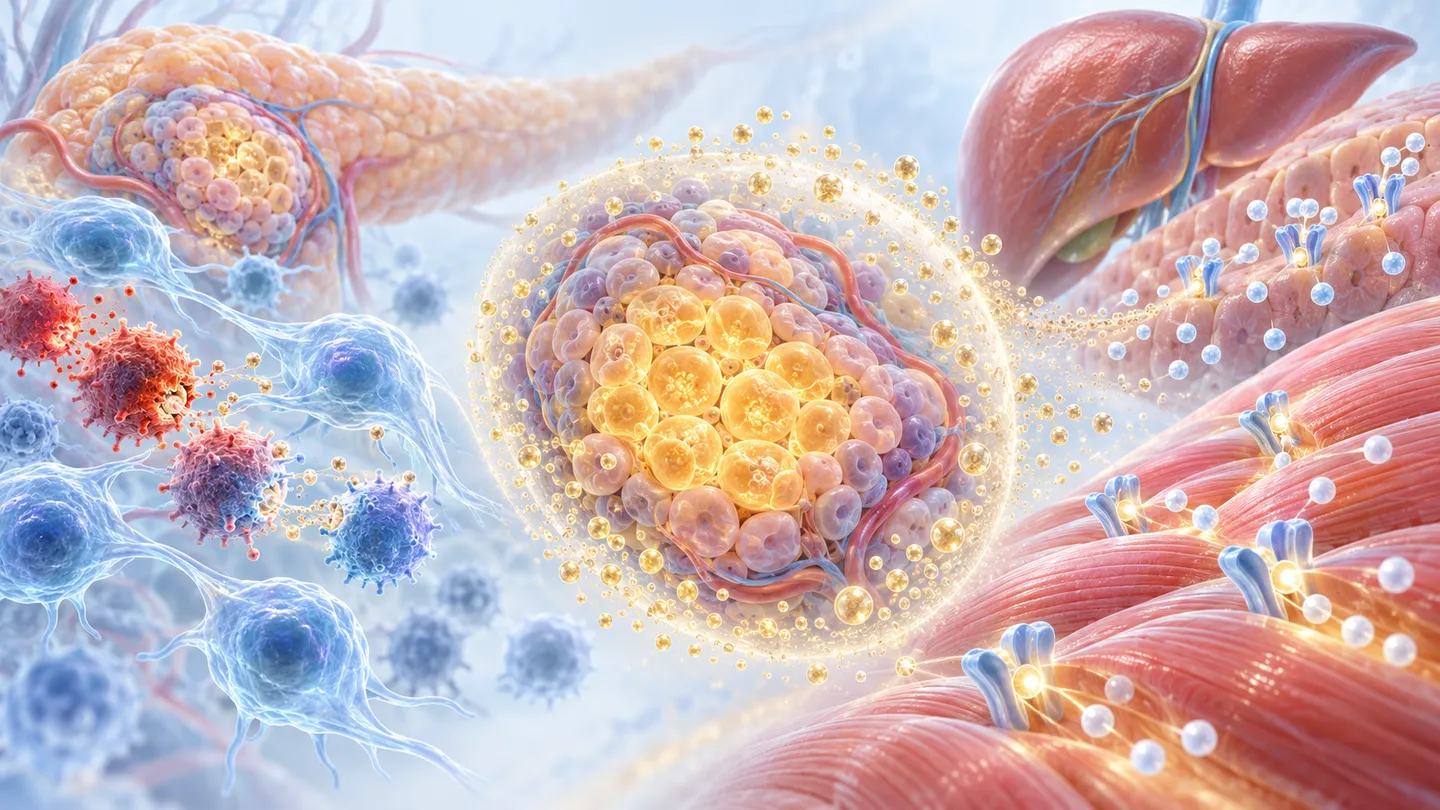
Mesenchymal stem cells rarely turn into new insulin-producing cells. Most of what they do comes from the signals they release, including exosomes, which act on the immune system, the pancreas and the tissues that use insulin. Three effects are studied most.
Calming the immune attack
In type 1 diabetes the immune system targets the beta cells. Wharton’s jelly cells suppress activated immune cells in the laboratory,23 and in people treated soon after diagnosis they slowed the loss of insulin production.514
Protecting the remaining beta cells
Signals from MSCs, carried partly by exosomes, reduce inflammation and stress around the islets. In animal studies this protected beta cells from dying;25 in people, the measurable sign is better-preserved C-peptide.5
Better insulin sensitivity
In type 2 diabetes the body responds poorly to insulin. In the 91-patient trial, clamp tests showed the body used insulin better after cord MSCs, which is why insulin doses could come down.1
03
Stem cell therapy for diabetes: success rates and clinical evidence
“Success rate” is not a single number in this field. Trials measure how much HbA1c falls, how much insulin is saved and how well your own insulin production is preserved. The chart shows the two strongest controlled results; the table lists the main studies.
Results from the two strongest umbilical-cord MSC trials
Type 2: fall in HbA1c over 48 weeks (percentage points)1
Type 2: fall in daily insulin over 48 weeks1
New type 1: loss of own insulin production (C-peptide) in one year, lower is better5
Type 2 diabetes stem cell therapy success rate
In the 91-patient double-blind trial, 20% of people on cord MSCs reached the combined goal of an HbA1c under 7% with insulin cut by at least half, against 4.5% on placebo.1 Reviews of all randomised MSC trials report an average HbA1c fall of about 0.7–1 percentage point.217
Type 1 diabetes stem cell therapy success rate
In type 1, success means keeping your own insulin production. In a cord-MSC study of recently diagnosed patients, 41% had a meaningful rise in C-peptide, with the benefit seen in adult-onset rather than childhood-onset diabetes.16 No trial has shown lasting insulin independence for the group as a whole.3
| Study | Diabetes | Cells | Patients | What changed |
|---|---|---|---|---|
| Zang 2022 1 | Type 2 | Umbilical cord MSCs, IV ×3 | 91, double-blind RCT | HbA1c −1.31 vs −0.63 points; insulin −28% vs −16% over 48 weeks |
| Carlsson 2023 (ProTrans) 5 | New type 1 | Wharton’s jelly MSCs, single IV | 15 in RCT (+9 dose-finding) | C-peptide −10% vs −47% at 1 year; insulin need stable |
| Hu 2013 14 | New type 1 | Wharton’s jelly MSCs, IV ×2 | 29, randomised | Better HbA1c and C-peptide than controls to 24 months |
| Liu 2014 15 | Type 2 | Wharton’s jelly MSCs | 22, no placebo | HbA1c and glucose fell; C-peptide rose over 12 months |
| Lu 2021 16 | Recent type 1 | Umbilical cord MSCs, IV ×2 | 53, parallel control | 41% had a ≥10% C-peptide rise; benefit in adult-onset, not juvenile |
| Izadi 2022 11 | New type 1 | Bone-marrow MSCs (own) | 21, RCT | Safe; fewer hypos; C-peptide benefit only in the early-treated subgroup |
What the reviews say
- Pooling randomised trials of MSCs from all sources, HbA1c falls on average by about 0.7 percentage points and daily insulin by about 14 units at 12 months, but results vary widely between studies.2
- A review limited to umbilical-cord MSCs (8 trials, 334 patients) found a slightly larger HbA1c drop, about 1 point.17
- The most cautious review, prepared for a national guideline, rated the certainty as low: it found insulin savings in type 2 but no insulin-free state in type 1.3
- A broader review of 34 trials also favoured cell therapy over controls, with inconsistent statistics.4
Our reading: the signal is real but modest, and strongest in early type 1 and in type 2 on high insulin doses. Anyone quoting a percentage “cure rate” for MSCs is not quoting these trials.
04
Wharton’s jelly vs fat-derived (adipose) stem cells for diabetes
Many clinics grow MSCs from the patient’s own fat, harvested by liposuction. We chose fresh Wharton’s jelly MSCs from donated umbilical cords. Here is the reasoning, and its limits.
- Newborn tissuevsCells as old as you are
- Nothing taken from youvsLiposuction first
- Fresh, never frozen, on your datesvsWeeks of culture
- Healthy screened donorvsCells shaped by your own diabetes
| Wharton’s jelly MSCs (our cells) | Your own fat-derived MSCs | |
|---|---|---|
| Collection | From a donated cord after a healthy birth; nothing is taken from you | Liposuction under local anaesthetic |
| Preparation | Prepared fresh for your treatment date and never frozen | Liposuction first, then weeks of culture |
| Cell age | Newborn tissue | Your age; in lab studies, cells from donors over 60 age faster and grow less well 18 |
| Effect of your diabetes | None: the donor is healthy and screened | Lab studies found fat MSCs from people with obesity or type 2 diabetes more inflammatory and less able to calm immune responses 1920 |
| Growth in the lab | Grow faster and show later signs of ageing in side-by-side tests 2122 | Slower, with earlier senescence in long culture 21 |
| Immune profile | Lack the co-stimulatory markers that trigger rejection, so no matching is needed 23 | Your own cells, so no matching is needed |
| Diabetes trials | Studied directly in type 1 and type 2 51415 | Mainly studied in wound healing 7 |
In fairness: fat-derived cells have strengths of their own; in one comparison they were better at stimulating new blood vessels.22 One study found that fat cells from people with diabetic kidney disease kept their immune activity.24 No large trial has compared the two cell types head to head in diabetes.
What tipped our choice is practical and biological: young cells, given fresh and never frozen, no surgery for you, and a product that does not depend on cells already shaped by your diabetes.
05
Exosome therapy for diabetes: what exosomes add
Exosomes are tiny packages that cells release to send signals, carrying proteins and genetic messages to neighbouring cells. Much of the benefit of MSCs seems to come from these signals rather than from the cells settling in the pancreas. Our exosomes are made by Wharton’s jelly MSCs and contain no living cells. Read more on our exosome therapy page.
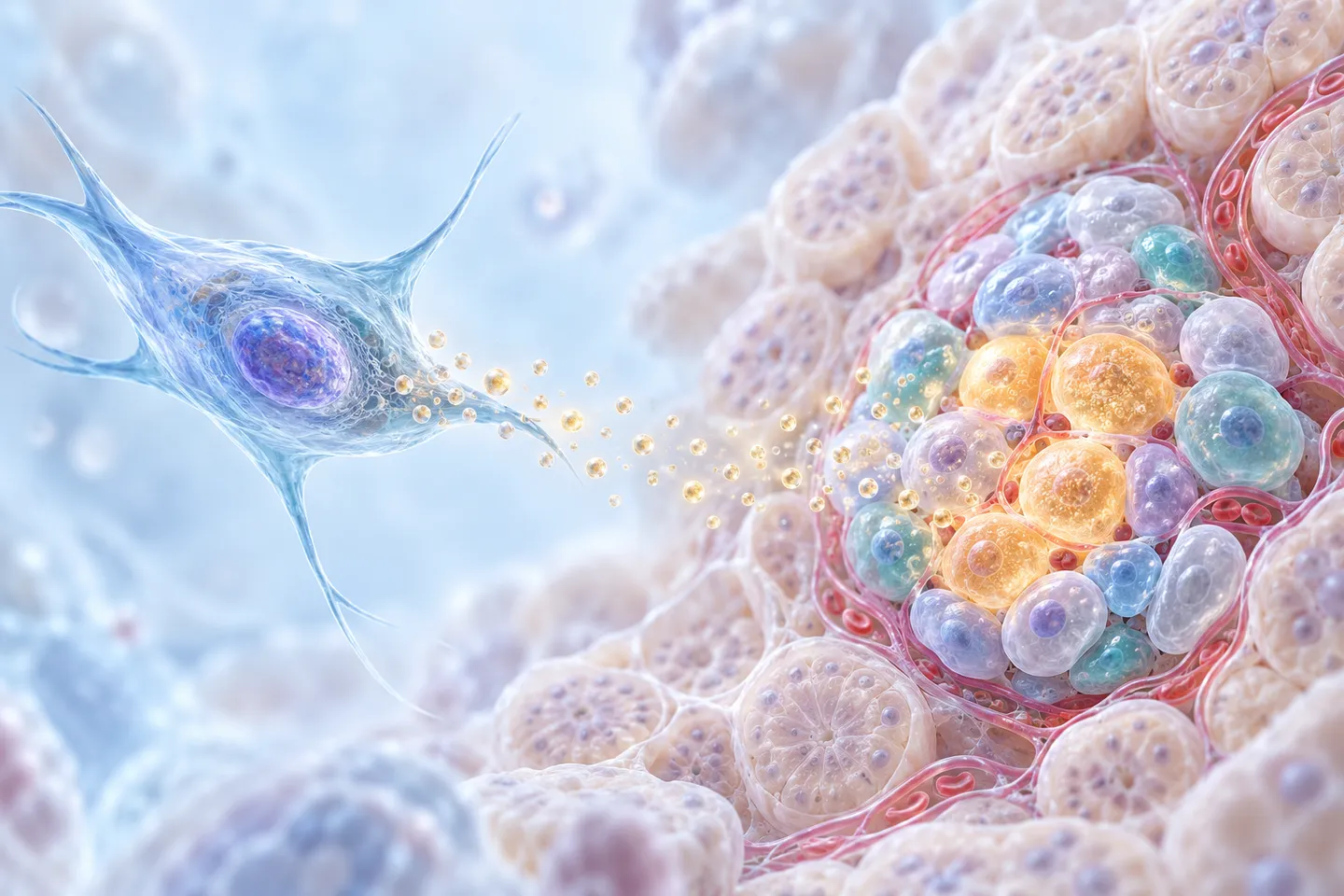
- In the lab, umbilical-cord MSC exosomes lowered blood sugar, improved insulin sensitivity and protected beta cells in rats with type 2 diabetes.25
- In people, the evidence so far concerns complications: kidney disease (a 40-patient placebo-controlled study)26 and diabetic foot ulcers (a randomised study of a Wharton’s jelly exosome gel, and a small open study).2728
- No published human trial has yet tested exosomes for blood-sugar control. We use them as a complement to the cells, for their signalling and repair role, and we describe them that way.
06
Stem cell therapy for diabetic complications
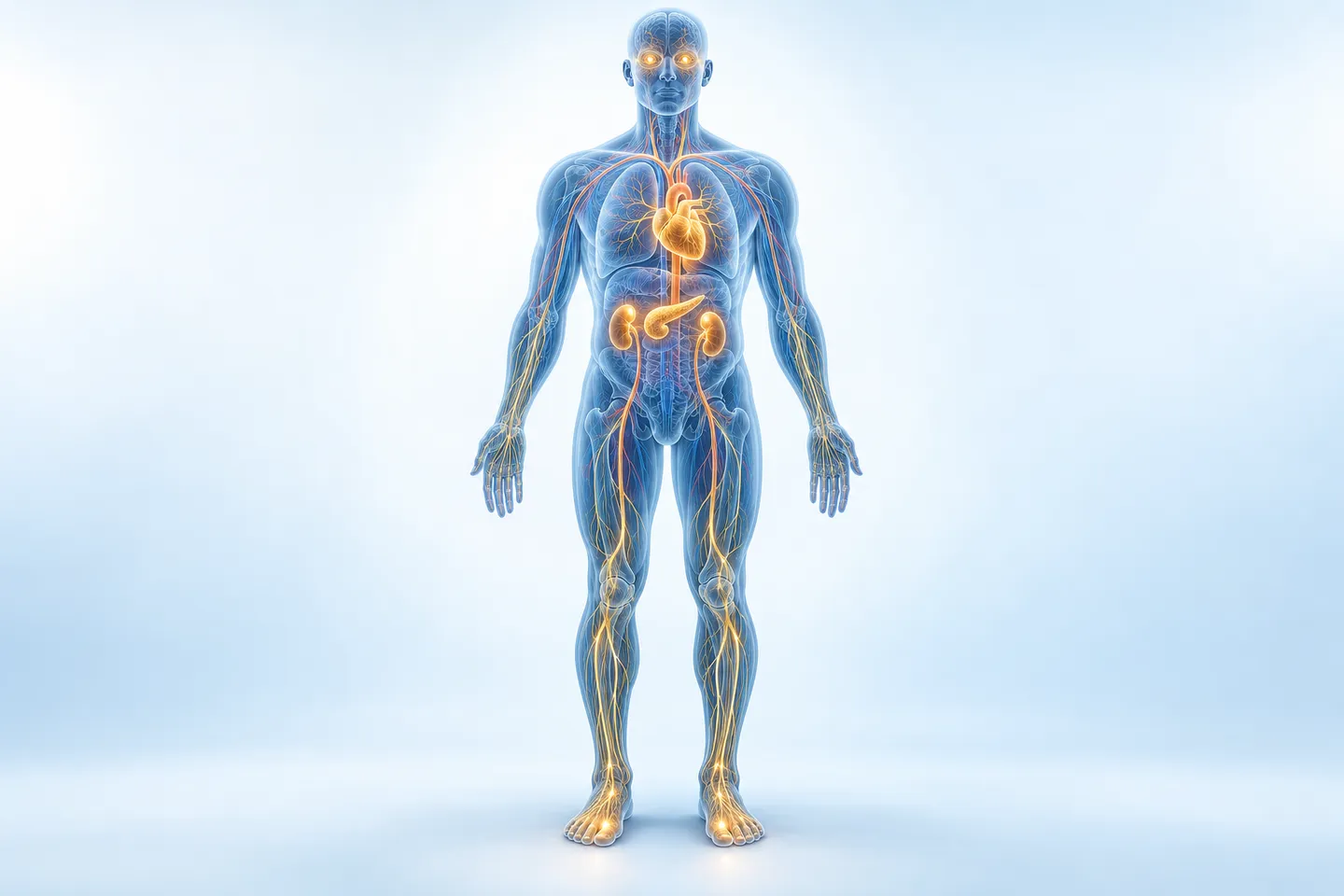
Diabetes harms blood vessels, nerves, kidneys, eyes and skin, and this is where many patients feel it most. Cell therapy is being studied for each.
Foot ulcers and circulation
In a small randomised study of diabetic leg ischaemia (24 patients), no limbs were lost over a year with Wharton’s jelly cells, against amputations in 60% of the placebo group.29 A pooled analysis of umbilical-cord MSC trials found ulcers were almost three times as likely to heal.30
Kidneys
The best-known kidney trials (NEPHSTROM) used bone-marrow cells: safe, but with an uncertain effect on measured kidney function.6 We do not present them as evidence for our cells.
Nerves
An eight-year follow-up of type 1 patients treated with cord MSCs plus bone-marrow cells found far less neuropathy and kidney disease than in controls; eye disease was also less common, though that difference was not statistically certain.31 Other nerve studies used different cells and gave mixed results.13
Eyes
Diabetic eye disease (retinopathy) has not been a main target of MSC trials. In the eight-year follow-up above, it was less common after cell therapy, but the difference was not statistically certain.31 Regular eye checks remain essential.
Erectile dysfunction
In a 22-man study without a control group, two Wharton’s jelly MSC injections improved erection scores and penile blood flow over a year.32 See erectile dysfunction.
07
Is stem cell therapy a cure for diabetes?
No. No MSC trial has produced lasting, medication-free remission in a meaningful share of patients.
Doctors define remission in type 2 diabetes as an HbA1c below 6.5% at least three months after stopping all glucose-lowering medicine.10 In the largest umbilical-cord trial, the patients who stopped insulin still needed tablets, so they were not in remission.1
The headline “type 1 cure” stories are about a different technology: lab-grown islet cells (zimislecel), infused into the liver. In a 2025 study, 10 of 12 patients no longer needed insulin after a year, but every patient also took lifelong immune-suppressing drugs, and two died of unrelated causes during the study.9 Those results belong to islet replacement, not to MSCs.
What MSCs may offer is better control on less insulin, slower loss of insulin production when treated early, and support for damaged tissues. That is worth having for many people, provided it is described honestly.
08
Who is a candidate for stem cell therapy for diabetes?
Often suitable for assessment
- Adults with type 2 diabetes, especially if they need rising insulin doses or have poor control despite treatment
- Adults diagnosed with type 1 recently (ideally within two years) who still make some insulin (measurable C-peptide)
- People with complications such as foot ulcers, poor circulation, neuropathy or erectile dysfunction
Assessed case by case
- Long-standing type 1 diabetes
- Advanced kidney disease
- Recent heart attack or stroke
- Heavily treated autoimmune disease
Not suitable
- Active cancer, or a cancer diagnosis within 5 years
- Active infection
- Pregnancy or breastfeeding
- Uncontrolled ketoacidosis or a hyperosmolar state
We ask for recent HbA1c, C-peptide, kidney and liver tests and your medication list before confirming anything.
09
Stem cell treatment for diabetes in Istanbul, step by step
- Before you travelFree online consultationResults reviewed, written plan and fixed price
- Day 1AssessmentExamination, blood tests, final safety check
- Day 2TreatmentFresh stem cells and exosomes by IV infusion, 60–90 minutes
- Day 3Check and homeReview before you fly; insulin and medicines unchanged
- 1, 3, 6, 12 monthsFollow-upHbA1c, insulin dose and logs reviewed with you
Free consultation (online)
Share your results and history with our medical team. We tell you honestly whether treatment makes sense and which goals are realistic.
Personal plan and travel
A written plan: dose, dates and total price. Your case manager arranges airport transfer and accommodation.
Day 1 in Istanbul: assessment
Examination and blood tests (including HbA1c and C-peptide where needed), and a final check that treatment is safe for you.
Treatment
Fresh Wharton’s jelly MSCs and exosomes are given by IV infusion over about 60–90 minutes, with monitoring of pulse, blood pressure, temperature and blood sugar. Assessment, treatment and the check before you leave all fit within 3 days.
Going home
You continue your insulin and medicines exactly as prescribed. Any change is made only by your own doctor.
Follow-up
We review your HbA1c, insulin dose and blood-sugar logs at about 1, 3, 6 and 12 months, with your home doctor where possible.
| Measure | Why | When |
|---|---|---|
| HbA1c | Overall control | Baseline, 3, 6, 12 months |
| C-peptide | Your own insulin production | Baseline, 6, 12 months |
| Daily insulin dose | Treatment burden | Your log, every review |
| Hypoglycaemia episodes | Safety | Your log |
| Kidney function (eGFR, urine albumin) | Complications | Baseline, 12 months |
10
What happens to my diabetes medication after treatment?
Nothing changes on the day. You keep taking insulin and every other medicine exactly as prescribed. If stem cell therapy helps, the first sign is usually that your blood sugar runs a little lower over the following weeks and months.
- Check more often. Measure blood sugar more often for the first three months, or use a sensor if you have one.
- Watch for lows. If your insulin need falls, the same dose can cause hypoglycaemia. Know the warning signs and keep fast-acting sugar with you.
- Let your own doctor adjust. Any change in insulin or tablets is decided by your doctor at home, based on your readings. We send them a written summary of your treatment.
- Test at three months. An HbA1c at about three months shows whether there is a real change.
11
How much does stem cell therapy for diabetes cost?
USD 4,950–15,000 per treatment
The price depends on how many stem cells and how much exosome product your plan includes, which follows your type of diabetes, your test results and your goals. Your plan states the total in writing before you travel.
Included
- Consultation
- Fresh stem cells and exosomes
- Infusion and monitoring
- Pre-treatment tests
- Your case manager
- Airport transfers
- Follow-up reviews
Not included
- Flights
- Hotel (we can book it for you)
- Any extra tests
Questions to ask any clinic, including us
- Where do the cells come from, and how are donors screened?
- How many viable cells will I receive, and is viability tested before release?
- What exactly will be measured to judge whether it helped?
- Who follows me up afterwards, and how?
- Is the price fixed and in writing?
12
Where can I get stem cell treatment for diabetes?
Where you can be treated, and with which cells, depends on the country. Here is the general picture.
| Country | How it is offered | What to know |
|---|---|---|
| United States | Mainly within clinical trials | No MSC product is FDA-approved for diabetes; the FDA warns against clinics selling unapproved stem cell products.35 Trials are listed on ClinicalTrials.gov. |
| European Union | Mainly within clinical trials | The European Medicines Agency warns patients against unproven cell-based therapies.36 |
| Japan | Private clinics under registered regenerative-medicine plans | Usually the patient’s own fat-derived cells, which means liposuction and weeks of culture before treatment. |
| Mexico, Panama, Colombia and others | Private clinics | Cell types, quality control and follow-up vary widely; ask the five questions in the cost section. |
| Turkey (Istanbul, with us) | Private clinic, treatment in 3 days | Fresh Wharton’s jelly MSCs and exosomes from screened donors, USD 4,950–15,000, follow-up with your home doctor. |
Whichever you choose, treatment should add to your diabetes care, not replace it.
13
Our cells: how each treatment is prepared
- Screened donorsUmbilical cords donated after healthy births, from screened donors
- Fresh, never frozenCells are prepared for your treatment date and never frozen
- Tested before releaseCell count and viability are checked before every treatment, under GMP conditions
Your plan states how many cells you receive and how much exosome product is included, and your price follows from that.
14
Is stem cell therapy for diabetes safe? Risks and regulation
MSC infusions have a reassuring safety record so far. Two large reviews pooled more than 50 randomised trials each (over 3,500 and over 2,600 patients): the most common side effect was a short-lived fever, with no increase in infections, blood clots, cancers or deaths.833 In diabetes trials, side effects were mostly mild, such as fever, headache and discomfort at the infusion site. One trial noted changes in clotting markers, so we check these.34 Long-term data beyond a few years are limited.
MSC therapy is not an approved standard treatment for diabetes. The US FDA has approved one MSC product, for a different condition (childhood graft-versus-host disease), and both the FDA and the European Medicines Agency warn patients about unproven cell therapies.3536 Our cells are prepared fresh under GMP conditions and tested before release.
Our commitments: we give our cells as a complement to your diabetes care, never a replacement, and we never ask you to stop insulin.
15
Stem cell options for diabetes compared
| Wharton’s jelly MSCs + exosomes (us) | Own fat-derived MSCs | Donor islet transplant | Lab-grown islets (zimislecel) | |
|---|---|---|---|---|
| Goal | Calm inflammation and autoimmunity, protect remaining beta cells, support tissues | Same | Replace beta cells | Replace beta cells |
| Procedure | IV infusion; nothing harvested from you | Liposuction, weeks of culture, IV infusion | Islets infused into the liver | Infused into the liver |
| Immune suppression | Not needed | Not needed | Lifelong | Lifelong |
| Evidence | Small RCTs in type 1 and type 2 | Mainly wound healing | Established for selected type 1 | Early trial (2025) |
| Availability | Now, in Istanbul | Selected clinics | Specialist transplant centres | Clinical trials only |
16
Terms explained
- HbA1c
- Your average blood sugar over the last two to three months, as a percentage. Below 7% is a common treatment target.
- C-peptide
- A substance released together with insulin. It shows how much insulin your own pancreas still makes, even if you inject insulin.
- Beta cells
- The insulin-producing cells in the islets of the pancreas. They are destroyed in type 1 and slowly exhausted in type 2.
- Mesenchymal stem cells (MSCs)
- Adult stem cells that mainly work by releasing signals that calm inflammation and support repair.
- Wharton’s jelly
- The soft, gel-like tissue inside the umbilical cord, a rich source of young MSCs.
- Exosomes
- Tiny packages released by cells that carry proteins and genetic messages to other cells.
- Remission
- In type 2 diabetes: an HbA1c below 6.5% at least three months after stopping all glucose-lowering medicine.
17
Frequently asked questions
Can stem cell therapy cure diabetes?
No. Trials show improvements in blood sugar, insulin dose and, in early type 1, preserved insulin production, but not lasting medication-free remission.
Does stem cell therapy work for type 2 diabetes?
In the largest double-blind trial with umbilical-cord MSCs, HbA1c and insulin needs fell more than with placebo over 48 weeks. It is a modest, worthwhile effect for some people, not a cure.
Can stem cells help type 1 diabetes?
Mainly if given soon after diagnosis. In the ProTrans trial, Wharton's jelly MSCs slowed the loss of insulin production over a year. In long-standing type 1, benefits are not expected.
What is the success rate?
There is no single figure. Average HbA1c falls of about 0.7–1 percentage point are reported across trials, with wide variation between people. We define success with you beforehand, in measurable terms.
Will I be able to stop insulin?
Do not plan on it. A minority of trial patients reduced or paused insulin for a time. Never change your insulin without your own doctor.
Why Wharton's jelly instead of fat-derived stem cells?
They come from healthy newborn tissue, are given fresh and never frozen, need no liposuction, and are not affected by your own age or diabetes. No large trial has compared the two head to head.
What are exosomes and do they treat diabetes?
They are signalling packages released by MSCs. Human studies so far concern complications such as foot ulcers and kidney disease, not blood-sugar control. We use them alongside the cells.
Is it safe?
Large safety reviews of MSC infusions found mainly short-lived fever and no rise in serious problems. Long-term data are still limited. We screen you carefully beforehand.
How much does it cost?
USD 4,950–15,000, depending on the number of stem cells and the amount of exosomes in your plan. Your exact price is fixed in writing before you travel.
How long do I need to stay in Istanbul?
No more than 3 days: assessment, treatment and a final check.
When might I notice changes?
Trials measured changes from about three months, with results tracked to 12 months. We review your numbers at 1, 3, 6 and 12 months.
Is it approved by the FDA?
No. No MSC product is FDA-approved for diabetes, and the treatment is investigational. We are open about that.
Can I have it if my doctor at home is sceptical?
Yes. We send your doctor a clear summary and encourage them to keep managing your diabetes. Their involvement makes follow-up better.
Can it help diabetic foot ulcers or neuropathy?
Small studies with umbilical-cord cells are encouraging for foot ulcers and poor circulation. Nerve results are mixed. We assess each case individually.
Where can I get stem cell treatment for type 1 diabetes?
In the United States and Europe mainly within clinical trials; elsewhere at private clinics. We treat adults with recently diagnosed type 1 diabetes in Istanbul with fresh Wharton’s jelly MSCs and exosomes, after reviewing your C-peptide and history.
Is stem cell therapy for diabetes available in the USA?
Only within clinical trials. No MSC product is approved by the FDA for diabetes, which is why many patients look at treatment abroad.
What happens to my diabetes medication after treatment?
You keep taking everything exactly as prescribed. Check your blood sugar more often for three months; if readings fall, your own doctor decides whether to lower insulin or tablets.
How many stem cells are used for diabetes?
Usually 50 to 200 million viable Wharton’s jelly MSCs by IV infusion, with exosomes. The amount in your plan depends on your type of diabetes, your test results and your goals.
Medical review
Uzm. Dr. Cihan Bolat, MD
Specialist in Anaesthesiology & Reanimation and Regenerative Medicine
This page was written from the published studies listed below and reviewed for medical accuracy on . It is for information and does not replace advice from your own doctor.
18
References
- Zang L, et al. Umbilical cord-derived MSCs in adults with type 2 diabetes: a double-blind, randomised, placebo-controlled trial. Stem Cell Res Ther. 2022;13:180. PMID 35505375
- Kashbour M, et al. Mesenchymal stem cell-based therapy for type 1 & 2 diabetes: systematic review and meta-analysis of RCTs. Diabetol Metab Syndr. 2025;17(1):189. PMID 40462158
- Manikandan S, Hariprasad R, Bagepally BS. Efficacy and safety of stem cell therapy in diabetes mellitus: systematic review and meta-analysis. Syst Rev. 2026;15(1):75. PMID 41639868
- Li H, et al. Meta-analysis of cell therapy in diabetes mellitus. Stem Cell Res Ther. 2025;16(1):249. PMID 40390031
- Carlsson PO, et al. Umbilical cord-derived MSCs preserve endogenous insulin production in type 1 diabetes: phase I/II randomised trial (ProTrans). Diabetologia. 2023;66(8):1431-41. PMID 37221247
- Perico N, et al. MSC therapy in diabetic kidney disease (NEPHSTROM), cohort 1. J Am Soc Nephrol. 2023;34(10):1733-51; cohort 2: Kidney Int Rep. 2026;11(8):106628. PMID 37560967 PMID 42433663
- Elainein MAA, et al. Adipose-derived stem cells for diabetic foot ulcers: systematic review and meta-analysis. Diabetol Metab Syndr. 2025;17(1):9. PMID 39773633
- Wang Y, Yi H, Song Y. The safety of MSC therapy over 15 years: meta-analysis. Stem Cell Res Ther. 2021;12:545. PMID 34663461
- Reichman TW, et al. Stem cell-derived, fully differentiated islets for type 1 diabetes. N Engl J Med. 2025;393(9):858-68. PMID 40544428
- Riddle MC, et al. Consensus report: definition and interpretation of remission in type 2 diabetes. Diabetes Care. 2021;44(10):2438-44. PMID 34462270
- Izadi M, et al. MSC transplantation in newly diagnosed type 1 diabetes: phase I/II randomised trial. Stem Cell Res Ther. 2022;13:264. PMID 35725652
- Rigato M, Monami M, Fadini GP. Autologous cell therapy for peripheral arterial disease: systematic review and meta-analysis. Circ Res. 2017;120(8):1326-40. PMID 28096194
- Mao H, et al. Autologous bone marrow mononuclear cells in refractory diabetic peripheral neuropathy. Chin Med J. 2019;132(1):11-16. PMID 30628954
- Hu J, et al. Wharton's jelly MSCs in new-onset type 1 diabetes. Endocr J. 2013;60(3):347-57. PMID 23154532
- Liu X, et al. Wharton's jelly MSCs in type 2 diabetes. Stem Cell Res Ther. 2014;5(2):57. PMID 24759263
- Lu J, et al. Umbilical cord MSCs in recent-onset type 1 diabetes. Stem Cell Res Ther. 2021;12:340. PMID 34112266
- Nada AH, et al. Umbilical cord MSCs in diabetes: meta-analysis. Expert Rev Endocrinol Metab. 2025;20(2):107-17. PMID 39905688
- Choudhery MS, et al. Donor age and adipose MSC function. J Transl Med. 2014. PMID 24397850
- Serena C, et al. Obesity and type 2 diabetes alter adipose MSC properties. Stem Cells. 2016. PMID 27352919
- Oñate B, et al. Adipose stem cells in obesity. FASEB J. 2012. PMID 22772162
- Christodoulou I, et al. Wharton's jelly vs adipose MSCs in long-term culture. Stem Cells Int. 2013. PMID 23533440
- Amable PR, et al. Bone marrow, adipose and Wharton's jelly MSCs compared. Stem Cell Res Ther. 2014;5:53. PMID 24739658
- Weiss ML, et al. Immune properties of human umbilical cord Wharton's jelly cells. Stem Cells. 2008. PMID 18703664
- Hickson LJ, et al. Adipose MSCs in diabetic kidney disease. Diabetes. 2021. PMID 33858824
- Sun Y, et al. Umbilical cord MSC exosomes in type 2 diabetic rats. ACS Nano. 2018. PMID 30052036
- Nassar W, et al. Cord MSC extracellular vesicles in chronic kidney disease. Biomater Res. 2016;20:21. PMID 27499886
- Kishta MS, et al. Wharton's jelly MSC exosome gel for diabetic foot ulcers. Stem Cell Res Ther. 2025;16:559. PMID 41084065
- Jafar H, et al. Umbilical cord MSC products for refractory diabetic foot ulcers. Stem Cell Res Ther. 2025;16:657. PMID 41287013
- Arango-Rodríguez ML, et al. Wharton's jelly MSCs in diabetic chronic limb-threatening ischaemia: pilot RCT. Stem Cell Res Ther. 2023;14:221. PMID 37626416
- Zhang H, et al. Umbilical cord MSCs for diabetic foot: meta-analysis. Int J Low Extrem Wounds. 2026. PMID 41789620
- Wu Z, et al. Eight-year follow-up of cell therapy in type 1 diabetes. Cytotherapy. 2022;24(4):421-7. PMID 35086778
- Al Demour S, et al. Wharton's jelly MSCs for diabetic erectile dysfunction. Urol Int. 2021;105:935-43. PMID 34384079
- Thompson M, et al. Safety of intravascular MSC therapy: meta-analysis. EClinicalMedicine. 2020;19:100249. PMID 31989101
- Lian XF, et al. Safety of umbilical cord MSCs in type 2 diabetes. World J Clin Cases. 2023;11(21):5083-96. PMID 37583846
- US FDA. Important patient and consumer information about regenerative medicine therapies; FDA approves remestemcel-L (2024). Source
- European Medicines Agency. EMA warns against using unproven cell-based therapies (EMA/110734/2020). Source