Stem cell therapy for muscular dystrophy at our Istanbul clinic uses fresh Wharton’s jelly stem cells by IV drip and gentle injections into the muscles, with their exosomes by drip, to ease muscle inflammation and scarring and support strength and everyday life.123 It is planned for children and adults with Duchenne, Becker, limb-girdle and other types, alongside steroids, physiotherapy, genetic treatments and the neuromuscular team. Dr. Cihan Bolat reviews your reports free of charge.
01
Living with muscular dystrophy: we understand
If you are the parent of a child with muscular dystrophy, or you live with it yourself, you know how much thought goes into ordinary days: the stairs at school, the walk from the car, the energy for an evening out. You fit stretches, physiotherapy and clinic visits around homework, work and family life, and you notice every small change.
You are far from alone: about 20 in every 100,000 boys are born with Duchenne muscular dystrophy,7 and other types, such as Becker and limb-girdle, can begin in childhood or adult life. Children often see their lives more brightly than the adults around them: in a study of 117 boys with Duchenne, the older boys rated their emotional and social well-being higher than younger boys did, whatever their need for mobility aids, and more positively than their parents rated it.8 That is what we listen for first: friendships, school and your hopes.

Playtime and keeping up
Running with friends and joining in at school.
Stairs and getting up
Climbing stairs and getting up from the floor with confidence.
Arms and hands
Reaching, writing and gaming without tiring so quickly.
Independence and family time
Days out, holidays and doing more on your own terms.
Here is the hopeful part: care for muscular dystrophy keeps improving. Fresh Wharton’s jelly stem cells and exosomes add a gentle new way to support the muscles, alongside everything your neuromuscular team already does. Here is how, in plain words:
02
How stem cells and exosomes can help muscles in muscular dystrophy, in plain words
Picture each muscle fibre as a rope woven from many threads. In muscular dystrophy, a key muscle protein, such as dystrophin, is missing or weak, so the rope is more delicate. Everyday running, climbing and playing cause tiny tears. Each tear sets off an alarm (inflammation), and over the years the repairs leave stiff scar tissue. Wharton’s jelly stem cells, from healthy donors, act like a calm site manager. They do not change the gene. They work mainly through the signals they send, and their exosomes carry those signals: tiny text messages for the muscle cells.
Calming the alarm
Given by drip, into chosen muscles and, where planned, into the spinal fluid, the stem cells release calming signals. They aim to quiet the inflammation that each tiny tear sets off, so the muscle can settle.
Sending repair messages
Their exosomes carry instructions to the muscle cells and to the muscle’s own repair cells (satellite cells): calm down, protect yourselves and get on with the repairs.
Protecting the muscle you have
The aim is to protect the muscle there is today. In a research model of Duchenne, Wharton’s jelly stem cells reduced scarring and damage.2 In 9 boys with Duchenne given donor cells, more dystrophin was found in the muscle.4
What this could mean for you: every bit of strength matters, and the aim is to support it. That may mean more energy to join in at school and keep up with friends. It may mean climbing stairs or getting up from the floor with more confidence, reaching and writing without tiring so quickly, and more days out and holidays together.
03
Stem cell treatment for Muscular Dystrophy
Stem cell treatment for muscular dystrophy aims to support muscle strength and mobility.
Read the full section
Muscular dystrophy (MD) is a genetic disease with approximately 30 variations (including 9 main types and subtypes), all of which can lead to both muscle weakness and muscle loss due to defects in muscle proteins, resulting in the death of muscle cells and tissues and their replacement by fat tissue. The types of MD can vary in onset (from childhood, adolescence, or as late as mid to late thirties), but they are all genetic diseases with similar symptoms ranging from mild to severe. Most types of MD are multisystem disorders that affect not only the muscles but also the cardiovascular, gastrointestinal, and nervous systems, as well as endocrine glands, eyes, and the brain. Because it is written in a person’s DNA, the gene change itself cannot yet be corrected in every muscle, but care keeps improving: steroids, physiotherapy and, for some types, genetic treatments help protect strength and health.

04
Why acting early can make a difference
Muscular dystrophy usually changes gradually. Without enough of a key muscle protein, such as dystrophin in Duchenne and Becker, muscle fibres are more sensitive to everyday wear, so muscle tissue and strength change over the years.9 Research in Duchenne also shows that inflammation begins in the muscle very early, even before symptoms appear, while the signals that drive scarring become stronger later.10
Today’s care does a great deal. In a 10-year study of 440 boys and young men with Duchenne, a year or more of steroids helped them keep everyday abilities, such as standing up, climbing stairs and using their hands, for longer.11 In a randomised trial, 24 weeks of assisted cycling kept motor function steady,12 and many newer treatments aim to restore dystrophin or ease the damage that follows its absence.9
That is where regenerative research brings real hope: in a research model of Duchenne, mesenchymal stromal cells given early by IV calmed muscle inflammation and improved grip strength, running and heart function over the long term.1 The more healthy muscle there is today, the more any support has to protect.
05
How Wharton’s jelly stem cells and exosomes work in muscular dystrophy
In muscular dystrophy, a missing or weakened muscle protein leaves muscle fibres fragile. Everyday movement causes small injuries, which bring inflammation and, over time, scarring.9 Wharton’s jelly stem cells do not need to replace the missing protein to help. They are a living source of calming, repair signals, and their exosomes carry the same messages through the bloodstream.
How Wharton’s jelly stem cells and exosomes aim to support muscle in muscular dystrophy
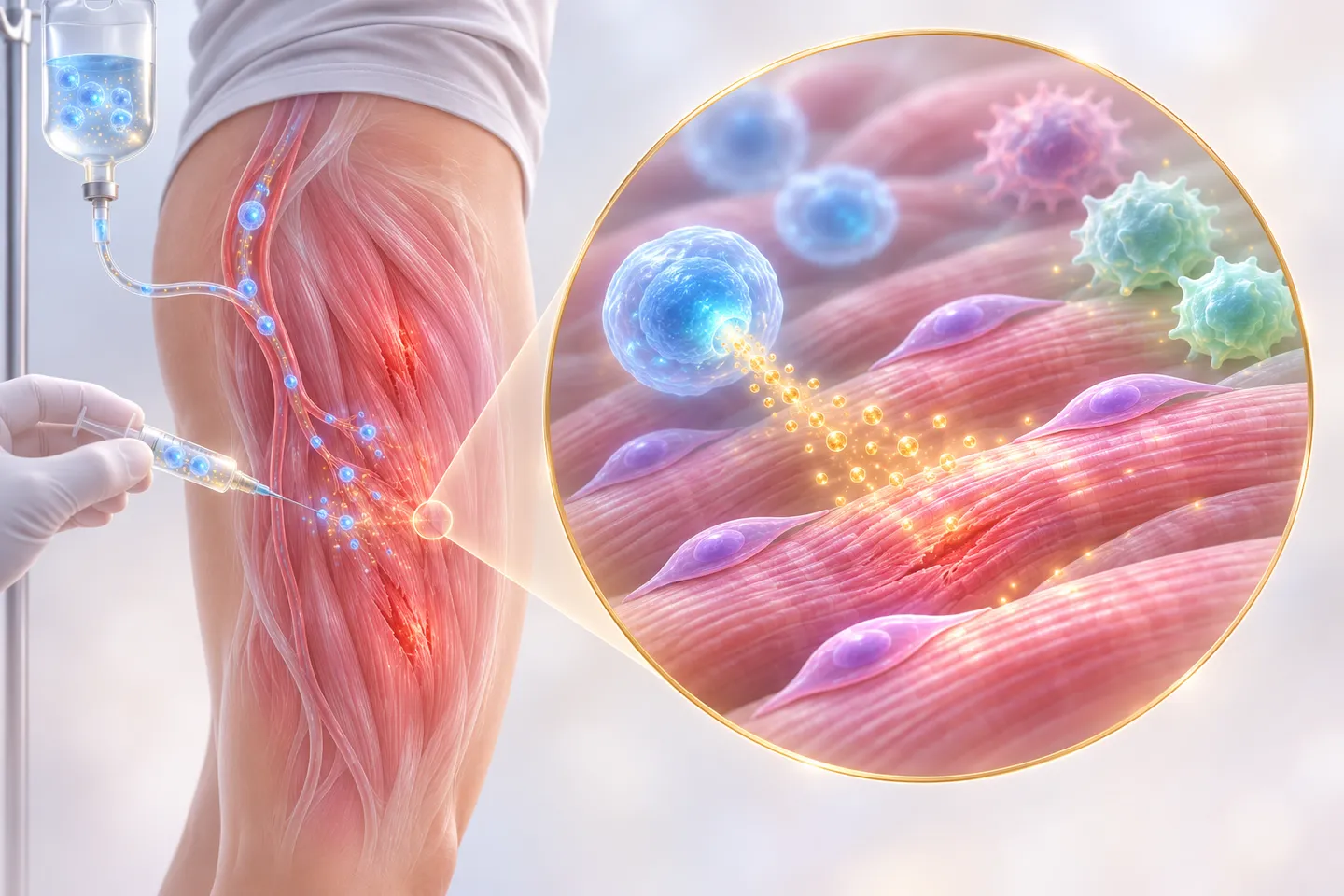
- IV dripFresh Wharton’s jelly stem cells are given by IV infusion.
- Cells in the bloodstreamThe stem cells travel with the blood to the muscles and release calming signals.
- Muscle injectionWhere Dr. Cihan Bolat plans it, cells are also placed directly into chosen muscles with a fine needle.
- Weakened fibresIn muscular dystrophy, muscle fibres are fragile and become inflamed and damaged over time.
- Stem cellA Wharton’s jelly MSC. It works mainly by releasing protective signals.
- ExosomesTiny messages from stem cells that tell muscle cells to calm inflammation and protect themselves.
- Muscle stem cellsSatellite cells, the muscle’s own repair cells. Supporting them is an aim shown mainly in research models.
- Calmer immune cellsLess inflammation in the muscle, one of the main aims of the treatment.
Read the science: how the treatment aims to support muscle
A drip reaches the whole body, and injections place cells into chosen muscles. Each effect below says whether it was seen in people or in research models. Learn more about our stem cell therapy and our exosome therapy.
Calming muscle inflammation
Seen in research models. In a research model of Duchenne, mesenchymal stromal cells given by IV turned immune cells in the muscle towards their calming, repairing (M2) form and reduced the build-up of inflammatory cells.1
Less scarring, less damage
Seen in research models. In a research model of Duchenne, IV Wharton’s jelly stem cells significantly reduced scarring (fibrosis) and damaged fibres, through MMP-1, an enzyme that breaks down excess scar tissue.13 They also lowered CK, a blood marker of muscle damage, with stronger effects at higher doses.2
Exosomes and a back-up protein
Seen in laboratory studies. Exosomes are tiny parcels of proteins and RNA messages. Exosomes from placental mesenchymal stromal cells helped muscle cells from people with Duchenne mature, lowered scarring genes and raised utrophin, a natural back-up for dystrophin.14
Strength and dystrophin in people
Seen in people. After donor Wharton’s jelly stem cells, strength rose significantly in 14 measured movements in 22 people with different muscular dystrophies,3 and in 9 boys with Duchenne, donor cells were found in the muscle and dystrophin expression rose.4
06
How is our stem cell therapy transplantation for Muscular Dystrophy performed in Istanbul?
Our Muscular Dystrophy (MD) treatment harnesses the regenerative power of mesenchymal stem cells (MSCs) to address the progressive muscle weakness and degeneration characteristic of this condition. This advanced therapy aims to enhance muscle repair and function by targeting the affected tissue with high-quality MSCs, which are known for their ability to differentiate into various cell types and release bioactive molecules that aid in tissue regeneration.
Read the full section
How the Treatment Works
MSCs are harvested from allogeneic sources, then prepared fresh under strict laboratory standards, with over 97% cell viability. At the time of transplantation, the MSCs are administered through targeted injections into areas where muscle deterioration is most pronounced, alongside an intravenous component to ensure systemic support. Our procedure may also include Platelet Rich Plasma (PRP) therapy, which provides additional growth factors that support tissue healing, enhance cell survival, and improve MSC functionality within the affected muscle tissues.
Expected Benefits
MSC therapy has shown promise in slowing muscle degeneration and improving strength and mobility in MD patients by:
- Reducing Inflammation: MSCs possess anti-inflammatory properties that help alleviate chronic inflammation in muscle tissues, which is a common issue in MD patients.
- Supporting Muscle Repair: MSCs mainly release growth factors that support the muscle’s own repair cells, and a small number of donor cells can join existing muscle fibres.
- Enhancing Cellular Communication: MSCs release exosomes and cytokines that encourage cellular signaling for regeneration, promoting healthier tissue.
- Supporting Vascularization: New blood vessel formation stimulated by MSCs can improve oxygen and nutrient supply to muscles, crucial for recovery and strength.
Safety and Standards
This treatment meets the highest standards, adhering to Good Manufacturing Practice (GMP) as well as national and international health regulations. Our cells are prepared fresh in a GMP laboratory approved by the Turkish Ministry of Health, and every batch is certified for cell count, viability and sterility.
Candidate Suitability
Not every patient with MD qualifies for MSC therapy. Our medical team thoroughly evaluates each case, reviewing medical history, current health status, and specific MD subtype. This comprehensive evaluation ensures that MSC therapy is a suitable option with the potential for meaningful outcomes in the patient’s quality of life.
This MSC therapy is a non-surgical option, used alongside steroids, physiotherapy and genetic treatments, aimed at providing patients with improved mobility, reduced symptoms, and an enhanced ability to perform daily activities.
07
Why Wharton’s jelly stem cells and exosomes lead our muscular dystrophy treatment
Wharton’s jelly is the soft, protective tissue inside the umbilical cord. Its stem cells come from cords donated after healthy births, so they are among the youngest used in treatment, and no cells are taken from you or your child. That matters in a genetic muscle condition: the cells come from healthy donors, and in boys with Duchenne, donor cells were later found in the muscle.4 Umbilical cord MSCs and CD34+ exosomes can be added; Muse cells and Muse exosomes are optional IV add-ons.
Compare Wharton’s jelly stem cells with your own cells
| Fresh Wharton’s jelly stem cells (our cells) | Stem cells from your own bone marrow or fat | |
|---|---|---|
| Age of the cells | From newborn tissue: umbilical cords donated after healthy births | As old as you are |
| A procedure for you or your child | None: the cells come from a donated umbilical cord | A bone marrow draw or liposuction first |
| Ready for treatment | Prepared fresh for your date, usually within 5 to 10 days | Only after collection and growing in the laboratory |
| The muscle gene | From healthy donors; in boys with Duchenne, donor cells were found in the muscle and dystrophin expression rose4 | Carry the same gene change as the rest of the body |
08
What the studies show: stem cell therapy for muscular dystrophy results
Each human study used its own cells and route, and the people in them had different types of muscular dystrophy.
- Stronger muscles across types: in 22 people with limb-girdle, facioscapulohumeral, Becker and other types, donor Wharton’s jelly stem cells by IV and into the spinal fluid brought significant strength gains in 14 measured movements, by up to 13.0 newtons, and 6 (27.3%) walked or moved better.3
- Becker in one family: after IV donor umbilical cord stem cells, all 3 treated family members had stronger limbs and more daily activity from the first week, and a six-year-old boy’s walking was normal by 12 weeks.15
- A large group: in 150 people with Duchenne, Becker and limb-girdle muscular dystrophy, 86.67% improved in symptoms and function about a year after their own bone marrow cells were given into the spinal fluid and muscles, with rehabilitation.5
Median muscle strength before and after donor Wharton’s jelly stem cells, in newtons (higher is stronger)
Straightening the right elbow3
Straightening the right knee3
Bending the right hip3
Bending the left shoulder3
The studies in detail, with all 4 in one table
| Study | Design | n | Cells (their own source) and route | Result with exact numbers |
|---|---|---|---|---|
| Świątkowska-Flis 2021, Stem Cells Transl Med3 | Single group (Poland); limb-girdle, FSHD, Becker and others | 22 | Donor Wharton’s jelly MSCs, about 1 million per kg; IV, then IV or into the spinal fluid | Strength significantly up in 14 movements, by up to 13.0 N; 6 (27.3%) better in walking or movement tests |
| Dai 2018, Degener Neurol Neuromuscul Dis4 | Phase 1/2 (Turkey); boys with Duchenne aged 7 to 14 | 9 | Donor Wharton’s jelly MSCs, 2 million per kg; into an artery and into the muscles | Well tolerated; lung function tests rose; donor cells found in the muscle and dystrophin expression up |
| Li 2015, Int J Mol Med15 | Family case series; Becker | 3 treated | Donor umbilical cord MSCs; IV | Stronger limbs and more activity from week 1; a six-year-old’s walking normal by 12 weeks; CK and LDH lower |
| Sharma 2013, Cell Transplant5 | Open-label study; Duchenne, Becker, limb-girdle | 150 | Own bone marrow mononuclear cells; into the spinal fluid and muscles, with rehabilitation | 86.67% improved at about 12 months; strength up in the trunk (53%), upper limbs (48%) and lower limbs (59%) |
09
Who can have stem cell therapy for muscular dystrophy?
Dr. Cihan Bolat decides with you, from the type of muscular dystrophy, recent heart and lung tests, current treatments and your goals, and tells you honestly if the treatment is not right. If weakness comes from another condition, see our pages on cerebral palsy, spinal cord injury and multiple sclerosis.
Often suitable
- Duchenne, Becker, limb-girdle or another type, confirmed by a doctor or genetic test
- Children and adults stable on their current care
- People who walk, and people who use mobility aids
- Well enough to travel
Considered case by case
- Heart involvement, with a recent heart scan
- Breathing support at night, with recent lung tests
- A recent chest infection, operation or fracture
- Blood thinners or a bleeding tendency
Not suitable for now
- An active infection
- Active cancer, or recent cancer treatment
- An unstable heart condition
- Pregnancy
10
Expert stem cell treatment guided by the expertise of Uzm. Dr. Cihan Bolat, MD
The procedure is a minimally invasive treatment performed by our medical team, in which Wharton’s jelly-derived mesenchymal stem cells (MSCs) are directly injected into the patient's body to enhance the function of various organs and tissues affected by muscular dystrophy. This aims to reduce inflammation and support the repair of damaged tissue. All of our stem cell treatments for muscular dystrophy are carried out by Uzm. Dr. Cihan Bolat, MD, Specialist in Anesthesiology & Reanimation and Regenerative Medicine.
Read the full section
11
How does our stem cell therapy treatment process for Muscular Dystrophy work?
All of our stem cell treatments at Istanbul Stem Cell are thoroughly evaluated and administered by specialists trained in the United States and Turkey, each with expertise in the specific condition being treated. Unlike general practitioners, these experts ensure the highest levels of precision, deep understanding of muscular dystrophy, and quality of care tailored specifically to your needs. We maintain complete transparency and honesty with our patients; not everyone qualifies for our stem cell treatments. Many patients are declined after our specialist carefully reviews their health condition and medical history, ensuring that no false promises are made if the risks outweigh the benefits. For this reason, and to prioritize patient safety, every case undergoes an initial evaluation by a specialist before treatment can be scheduled.
Step 1: Specialist Evaluation Our specialist, with a focus on muscular dystrophy, will assess your age, medical history, and prior treatments. Additionally, the specialist will conduct essential medical tests, including a Comprehensive Metabolic Panel (CMP), Complete Blood Count (CBC), and Hemoglobin A1C test (HbA1C).
Step 2: Free Consultation Call with the Specialist After your medical records have been reviewed and your case approved, we will present treatment options and pricing. We also offer a free consultation call to address any questions or concerns you may have.
Step 3: Stem Cell Preparation Once you choose to proceed with treatment, we will issue a deposit invoice to begin the stem cell preparation process, ensuring readiness for your scheduled procedure. This preparation typically takes 5-10 days, depending on demand and availability.
Step 4: Treatment Day On the day of your treatment, you can either arrive at our hospital location yourself or take advantage of our complimentary transportation service within Istanbul. Our driver will pick you up from your preferred location, escort you to our clinic, where the specialist will perform the procedure, and return you afterward.
Step 5: Follow-Up Care Our follow-up care specialist will stay in touch according to a set schedule to ensure you have all the necessary resources to maximize the benefits of your treatment.
12
What our patients say
Professional and friendly!
After extensive research and much hesitation, I decided to undergo stem cell treatment with Istanbul Stem Cell. From the moment I reached out to them, I felt fully supported and reassured by their professional and friendly team. The treatment itself went smoothly and was almost painless. What truly stood out was the care and dedication of the medical staff to ensure everything went according to plan. The result? I couldn’t be happier! My health has improved significantly, and I am grateful to Istanbul Stem Cell for this life-changing experience. I would recommend them without hesitation to anyone considering stem cell therapy.
Simply astounding!
My experience with Istanbul Stem Cell was simply astounding. From the very first contact, they were extremely professional and helpful. Initially, I was a bit skeptical about stem cell therapy, but their team patiently and convincingly addressed all my questions and concerns. The treatment itself was conducted with precision and expertise, and I felt I was in good hands. Soon after the procedure, I began to notice improvements in my health, and I can happily say that my life has changed significantly thanks to Istanbul Stem Cell. I can't thank them enough and would highly recommend their services to anyone seeking high-quality stem cell therapy.
13
Muscular dystrophy stem cell therapy cost in Turkey
Our IV packages follow one price list, effective 1 June 2026, in US dollars (M = million stem cells). Each uses fresh Wharton’s jelly stem cells, with free Wharton’s jelly exosomes from 50M, and your batch certificate shows the cell count, viability and sterility tests (see how to read a stem cell lab report).
A typical IV range is 1–2 million cells per kilogram of body weight, and the right dose for a child or an adult is set in the medical review. Injections into the muscles, intrathecal treatment and extra exosomes are priced in your written plan, with a fixed, all-inclusive price before you book (see our guide to stem cell therapy cost in Turkey).
| Cell count | USD price | Free exosomes | Free hotel |
|---|---|---|---|
| 25M | $4,950 | No | No |
| 50M | $6,950 | 10 billion exosomes | No |
| 75M | $8,950 | 10 billion exosomes | No |
| 100M | $10,500 | 20 billion exosomes | 2 nights |
| 125M | $11,850 | 20 billion exosomes | 2 nights |
| 150M | $13,550 | 30 billion exosomes | 2 nights |
| 175M | $15,000 | 30 billion exosomes | 2 nights |
| 200M | $16,500 | 30 billion exosomes | 3 nights |
| 225M | $18,000 | 30 billion exosomes | 3 nights |
| 250M | $19,500 | 30 billion exosomes | 3 nights |
What is included, and what is optional
Included
- Free medical review and phone consultation
- Fresh Wharton’s jelly stem cells, with certified count and viability
- Free Wharton’s jelly exosomes from 50M
- Treatment by our specialist team, led by Uzm. Dr. Cihan Bolat
- Ground transport, with airport transfers depending on your package
- A personal case manager, with interpreter help when needed; companions are welcome
- Hotel nights as listed (2 from 100M, 3 from 200M), in 5-star hotels chosen by our team
- Follow-up at about 1, 3, 6 and 12 months, by phone or WhatsApp
Not included / optional
- Flights
- Extra hotel nights; we can help you arrange them
- Injections into the muscles, intrathecal treatment and extra exosomes, priced in your written plan
- Optional add-ons: Muse cells, Muse exosomes, CD34+ exosomes
- A repeat treatment, if you choose one later
14
Read our full guides
For every study and every detail, read these guides.
Can stem cells help muscular dystrophy? Our full research guide
Every human study in detail, how the cells act in muscle, and what is established and what is still early.
Read the guide GuideExosome treatments explained
How exosomes are given, including by IV drip, and what to expect from each treatment.
Read the guide GuideCan stem cells repair a spinal cord injury?
How intrathecal and IV stem cells are given, useful if your plan includes intrathecal treatment.
Read the guide15
Frequently asked questions
What is the success rate of stem cell therapy for muscular dystrophy?
Results differ from person to person, and studies measure success in different ways. In 22 people given donor Wharton’s jelly stem cells, strength rose significantly in 14 measured movements, and 6 of them (27.3%) also walked or moved better; in a larger study of 150 people, 86.67% improved in symptoms and function. The aim is supporting strength, function and quality of life, alongside your usual care.
Can stem cell therapy help Duchenne muscular dystrophy in children?
It can be part of a child’s care. In a Turkish study of 9 boys aged 7 to 14 with Duchenne, donor Wharton’s jelly stem cells were well tolerated, lung function tests rose and dystrophin expression increased in the muscle. Dr. Cihan Bolat reviews each child’s genetic report, heart and lung tests and current treatments before suggesting a plan.
Can stem cells help Becker or limb-girdle muscular dystrophy?
Studies include both. In one family with Becker, IV umbilical cord stem cells brought stronger limbs and more daily activity within a week, and in a study of 22 people, most with limb-girdle or facioscapulohumeral muscular dystrophy, Wharton’s jelly stem cells brought significant strength gains in 14 measured movements.
How soon might we notice a difference?
In the studies, changes came within weeks to months. In the Becker family, limb strength and daily activity were better one week after the infusion, and in the study of 22 people, strength gains were measured over the course of treatment. Regular physiotherapy helps make the most of them.
Is the treatment painful for my child?
The treatment is gentle. A drip needs only a small needle in a vein, and injections into the muscles are quick. Our team keeps your child comfortable, and parents and companions are welcome.
How long will we stay in Istanbul?
Your plan sets the dates. Once your written plan is ready, your case manager helps you choose your travel dates and arrange your stay, and Dr. Cihan Bolat plans the routes and timing of the treatment for you.
What symptoms are associated with muscular dystrophy?
Symptoms of muscular dystrophy can vary, but often include muscle weakness, difficulty walking, breathing problems, and loss of independence.
Which specialists perform stem cell treatments for muscular dystrophy at Istanbul Stem Cell?
Our stem cell treatments for muscular dystrophy are performed by specialists in this condition who have trained in the United States and Turkey.
Can stem cell therapy help treat muscular dystrophy?
Stem cell therapy has promising potential for treating muscular dystrophy. It may help repair muscle tissue and relieve symptoms.
How much does stem cell treatment for muscular dystrophy cost?
Treatment prices may vary depending on the patient's individual needs, such as special accommodation or stay requirements, and the number of stem cells in your plan. Our prices include: ground transportation to and from our clinic; treatment by a certified specialist in this field; certified allogeneic stem cells with 97% viability, prepared fresh for your treatment date; a personal case manager; and aftercare.

Medical review
Uzm. Dr. Cihan Bolat
Medical Director, Istanbul Stemcell
This page was written from the published studies listed below and reviewed for medical accuracy on .
16
References
All 15 published studies, with PubMed links
- Nitahara-Kasahara Y, et al. Immunomodulatory amnion-derived mesenchymal stromal cells preserve muscle function in a mouse model of Duchenne muscular dystrophy. Stem Cell Res Ther. 2023;14(1):108. PMID 37106393
- Park SE, et al. Wharton's Jelly-Derived Mesenchymal Stem Cells Reduce Fibrosis in a Mouse Model of Duchenne Muscular Dystrophy by Upregulating microRNA 499. Biomedicines. 2021;9(9). PMID 34572277
- Świątkowska-Flis B, et al. The use of umbilical cord-derived mesenchymal stem cells in patients with muscular dystrophies: Results from compassionate use in real-life settings. Stem Cells Transl Med. 2021;10(10):1372-1383. PMID 34313400
- Dai A, et al. Efficacy of stem cell therapy in ambulatory and nonambulatory children with Duchenne muscular dystrophy - Phase I-II. Degener Neurol Neuromuscul Dis. 2018;8:63-77. PMID 30498389
- Sharma A, et al. A clinical study shows safety and efficacy of autologous bone marrow mononuclear cell therapy to improve quality of life in muscular dystrophy patients. Cell Transplant. 2013;22 Suppl 1:S127-38. PMID 24070109
- Wang Y, Yi H, Song Y. The safety of MSC therapy over the past 15 years: a meta-analysis. Stem Cell Res Ther. 2021;12(1):545. PMID 34663461
- Crisafulli S, et al. Global epidemiology of Duchenne muscular dystrophy: an updated systematic review and meta-analysis. Orphanet J Rare Dis. 2020;15(1):141. PMID 32503598
- Uzark K, et al. Health-related quality of life in children and adolescents with Duchenne muscular dystrophy. Pediatrics. 2012;130(6):e1559-66. PMID 23129083
- Duan D, et al. Duchenne muscular dystrophy. Nat Rev Dis Primers. 2021;7(1):13. PMID 33602943
- Chen YW, et al. Early onset of inflammation and later involvement of TGFbeta in Duchenne muscular dystrophy. Neurology. 2005;65(6):826-34. PMID 16093456
- McDonald CM, et al. Long-term effects of glucocorticoids on function, quality of life, and survival in patients with Duchenne muscular dystrophy: a prospective cohort study. Lancet. 2018;391(10119):451-461. PMID 29174484
- Jansen M, et al. Assisted bicycle training delays functional deterioration in boys with Duchenne muscular dystrophy: the randomized controlled trial "no use is disuse". Neurorehabil Neural Repair. 2013;27(9):816-27. PMID 23884013
- Choi A, et al. Anti-Fibrotic Effect of Human Wharton's Jelly-Derived Mesenchymal Stem Cells on Skeletal Muscle Cells, Mediated by Secretion of MMP-1. Int J Mol Sci. 2020;21(17). PMID 32872523
- Bier A, et al. Placenta-derived mesenchymal stromal cells and their exosomes exert therapeutic effects in Duchenne muscular dystrophy. Biomaterials. 2018;174:67-78. PMID 29783118
- Li P, et al. Transplantation of human umbilical cord-derived mesenchymal stems cells for the treatment of Becker muscular dystrophy in affected pedigree members. Int J Mol Med. 2015;35(4):1051-7. PMID 25647308