Stem cell therapy for sports injuries at our Istanbul clinic uses fresh Wharton’s jelly stem cells and their exosomes, tiny repair messages, injected into the injured tendon, ligament, muscle or joint.1 After knee cartilage injuries from hard training, umbilical cord stem cell injections improved knee scores more than microfracture surgery alone.2 For a rotator cuff, Achilles or knee injury, Uzm. Dr. Cihan Bolat reviews your MRI report free of charge.
01
Living with a sports injury: we understand
If you are reading this, an injury has probably put your sport on hold. Perhaps it is a shoulder that aches when you serve or swim, an Achilles that stiffens on the first steps of a run, or a knee you no longer trust on the pitch. Tendon and ligament injuries are the most common sports injuries, about 30–40% of them all,1 so you are far from alone.
An injury reaches beyond the game. It can wake you at night, slow you down at work and keep you on the sidelines while your friends train without you. For many people, sport is how they stay well, clear their head and spend time with others. Wanting that back, at any level, is not asking too much.
Training without holding back
Running, lifting or playing your match without guarding the injured side.
A full night’s sleep
Rolling over in bed without a sore shoulder or knee waking you.
Trusting your body again
Jumping, turning and changing direction with confidence.
Everyday strength
Carrying the shopping, lifting your children and taking the stairs with ease.
There is real hope here, and you do not have to sit it out alone. Sports medicine is moving quickly. Here is how Wharton’s jelly stem cells and exosomes aim to support healing, in plain words, with the published studies further down:
02
How stem cells and exosomes can help your sports injury, in plain words
Think of your injury as a building site. Right after it happens, an alarm goes off, and that is useful at first. But in tendons and ligaments the alarm can keep ringing. With little blood supply, the repair crew works slowly and leaves untidy scar tissue behind. Stem cells act like a site manager. They do not become your new tissue. They quiet the alarm and send your own repair cells tiny text messages, called exosomes, packed with instructions. Stem cells work mainly through these signals.1
Calming the inflammation
First, they help settle the inflammation around your injury. The aim is a quieter alarm, less swelling, and a body that can move on from emergency mode to repair.
Sending repair messages
Next, the stem cells release exosomes, tiny parcels of proteins and instructions. Your own tendon, ligament and muscle cells read them and are nudged to protect themselves and get back to work.
Rebuilding stronger tissue
Finally, in research models, they help new blood vessels grow. They also help your cells lay down strong collagen (the tough, rope-like fibres of tendons and ligaments).10
What this could mean for you: training without holding back. A full night’s sleep, with no sore shoulder or knee waking you. Jumping, turning and changing direction with confidence. A calmer, better-healed injury may give you back these moments. We aim to help you lift your children, carry the shopping and get back to your sport, at your level.
03
Stem cell treatment for sports rehabilitation and injuries
Innovative stem cell therapies support athletes and active people in their recovery from injury.
Read the full section
Stem cell therapy using Wharton’s jelly and umbilical cord mesenchymal stem cells (MSCs) is an advanced option for sports-related injuries, aimed at a safe, well-supported recovery. In sports medicine, MSCs are studied to support the healing of tendons, ligaments, muscles and joints, and to shorten time away from sport.
Recreational athletes can also benefit from MSC-based treatments for overuse or acute injuries in activities like golf and tennis. By supporting healthy tissue repair, stem cell therapy aims to help active people return to the sport they love.
Benefits of Wharton’s Jelly and Umbilical Cord MSC Therapy for Sports Injuries:
Supported Healing: Aims to support the repair of muscles, joints and connective tissues.
Return to Activity: Aims to support your return to training and sport.
Long-Term Support: Aims to support healthy tissue after an injury.
Versatile Applications: Ideal for both professional and recreational athletes.
Well Tolerated: Minimally invasive injections, well tolerated in clinical studies.
Whether you're a pro athlete or a weekend warrior, Wharton’s jelly and umbilical cord MSC therapy offers a modern approach to your recovery and activity goals.
04
Why acting early can make a difference
Injured tissue heals in stages, and not every tissue heals at the same pace. Muscle has a rich blood supply. Tendons heal slowly after an injury, often with scar tissue rather than their original, orderly fibres, and the same tendon can be injured again.8
Today’s care does a lot of good. Relative rest, physiotherapy and a gradual return to load are its foundation, and surgery repairs many tears. Painkillers and steroid injections can ease pain, but they are not designed to rebuild tendon, ligament or cartilage.
That is why timing can matter. In a randomised trial of 50 recreational athletes with a thigh or calf muscle strain, starting rehabilitation early sped up their recovery and their return to sport.9 The sooner an injury gets the right support, the more healthy tissue there is to protect, and the better your starting point. Whatever stage you are at, there is something worth supporting today, and that is where regenerative medicine aims to help.
05
How Wharton’s jelly stem cells and exosomes support injured tendons, ligaments and muscles
After a sports injury, the tissue is inflamed, tendons have little blood supply, and healing cells can lay down weak, untidy fibres. Injected where the injury is, Wharton’s jelly stem cells act like a small pharmacy of repair signals: in research models, stem cells calmed inflammation, helped new blood vessels form and steered tendon healing towards stronger collagen.10
How Wharton’s jelly stem cells and exosomes aim to support an injured tendon
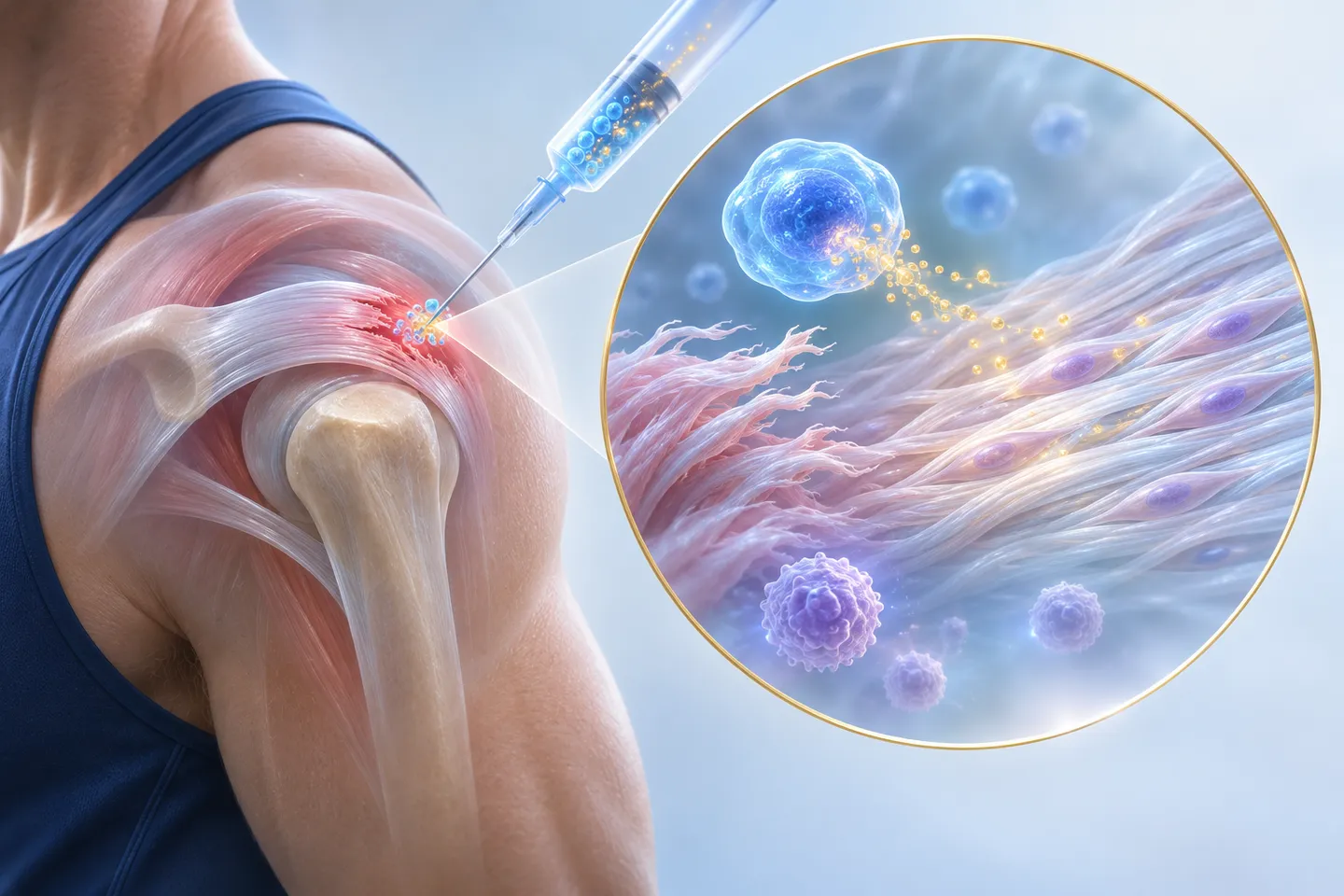
- Targeted injectionFresh Wharton’s jelly stem cells and exosomes are placed at the injured tendon, ligament, muscle or joint with a fine needle.
- Injured tendonA frayed, inflamed area of the rotator cuff tendon, a common sports and overuse injury.
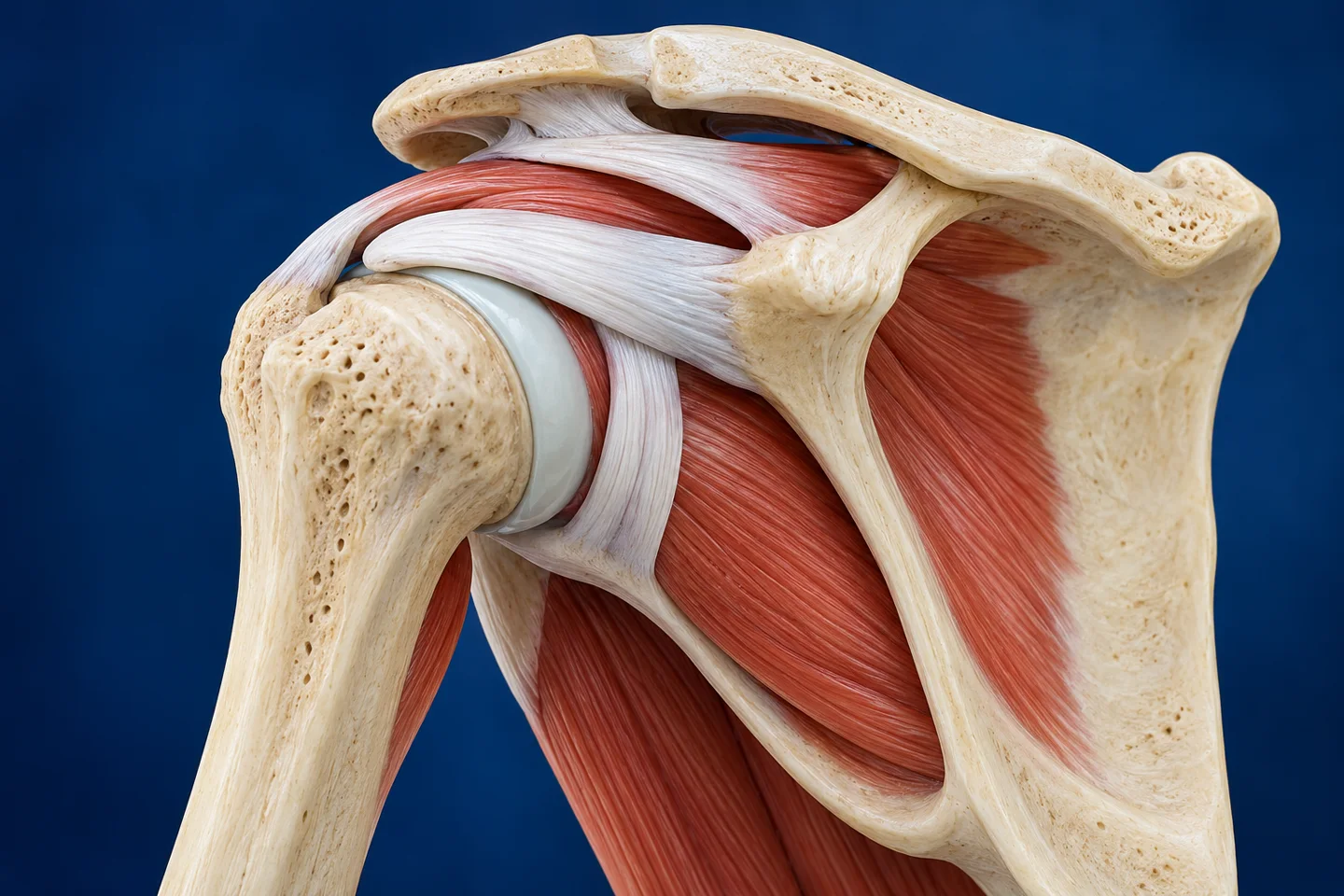
- Shoulder jointThe ball of the arm bone in its socket. The rotator cuff tendons hold it steady when you lift and throw.
- Stem cellA Wharton’s jelly MSC. It works mainly by releasing healing signals.
- ExosomesTiny messages from stem cells that tell nearby cells to calm down and rebuild.
- Frayed fibresDamaged collagen fibres. Supporting them to heal in a neater, stronger pattern is the aim, shown mainly in research models.
- Tendon cellsTenocytes, the cells that maintain the tendon and lay down new collagen.
- Calmer immune cellsLess inflammation around the injury, which in studies went with less pain.
Read the science: how the treatment aims to help injured tissue heal
Stem cells work mainly through the signals they release, and exosomes, tiny packages of proteins and RNA, are the main carriers of those signals.1 That is why your plan can include exosomes alongside the cells, or on their own. Learn more about our exosome therapy.
Calming the inflamed tissue
Seen in research models. In tendon injury models, stem cells lowered inflammation,10 and across 46 animal studies, extracellular vesicles (the family that includes exosomes) went with less of the inflammatory signal IL-6.11
New blood vessels and stronger collagen
Seen in research models. Stem cells helped new blood vessels grow and shifted healing tendon from weaker type III collagen towards the type I collagen of healthy tendon.10
Better tendon and ligament structure
Seen in people. After people’s own fat-derived stem cells were injected into partial rotator cuff tears, the defects on the outer (bursal) side of the tendon had nearly disappeared on MRI at one year in the high-dose group.12 With signals from donor umbilical cord stem cells, 11 of 12 partly torn knee ligaments looked normal or near-normal on MRI a year later.13
Exosomes: repair messages for tendons
Seen in research models. In the same review, vesicle treatment went with better tendon healing scores, more type I collagen and tendons that withstood more load.11
06
How is our stem cell therapy transplantation for sports rehabilitation and injuries performed in Istanbul?
Advancing Sports Rehabilitation with Stem Cell Therapy in Istanbul
Read the full section
Our cutting-edge sports rehabilitation treatments combine the power of mesenchymal stem cells (MSCs), exosomes, and umbilical cord stem cells to support your recovery. Designed to support healing and the repair of damaged tissue, with minimal complications, our therapies are ideal for professional athletes and active individuals aiming for a swift and safe return to their activities.
Why Our Stem Cell Therapy is the Premier Choice for Sports Rehabilitation:
-
Advanced MSC and Exosome Technology: Harnessing the regenerative power of MSCs and exosomes for optimal tissue repair and recovery.
-
Umbilical Cord Stem Cell Injections: A powerful solution to boost healing, reduce inflammation, and enhance long-term recovery.
-
Personalized Treatment Plans: Tailored to your specific injury and rehabilitation goals for the best outcomes.
-
Faster Recovery Time: Minimize downtime and get back to doing what you love with our state-of-the-art methods.
-
Safe and Effective Solutions: Treatments designed to deliver maximum results with minimal risk.
Whether you're recovering from a sports injury or living with a long-standing one, our advanced stem cell therapy offers a groundbreaking approach to sports rehabilitation. Benefit from innovative techniques that aim to ease pain, support tissue healing and help you move freely again.
07
Why Wharton’s jelly stem cells and exosomes lead our sports injury treatment
Wharton’s jelly is the soft tissue of the umbilical cord. Its stem cells come from cords donated after healthy births: young cells, with nothing taken from your body. They are prepared fresh for your treatment date, never frozen, with a batch certificate for cell count, viability and sterility. Their exosomes can be injected with them, and umbilical cord stem cells, which improved training-injured knees in a study,2 can be added to your plan.
Compare Wharton’s jelly stem cells with your own cells
| Wharton’s jelly stem cells (our cells) | Your own bone marrow or fat stem cells | |
|---|---|---|
| Age of the cells | Newborn tissue: cords donated after healthy births | As old as you are |
| A procedure for you | None | A bone marrow draw or liposuction first |
| Growth | Multiplied faster in a side-by-side laboratory comparison of 18 donors each3 | Bone marrow cells grew more slowly in the same comparison3 |
| Repair signals | More secreted signals for new blood vessels, and better vessel formation, in a laboratory comparison14 | Bone marrow cells released fewer in the same comparison14 |
08
What the studies show: stem cell therapy for sports injuries
Four human studies, each with its own cells, reported exactly as published:
- Rotator cuff: with people’s own bone marrow stem cells added to the repair, 87% of cuffs were still intact at 10 years, against 44% without them.4 See also shoulder and Achilles tendinitis.
- Knee cartilage: after training injuries, a keyhole knee check and donor umbilical cord stem cell injections raised the Lysholm knee score from 51.5 to 79.4 out of 100.2 See also cartilage disorders.
- Tennis elbow: over 52 weeks, donor fat-derived stem cells lowered pain from 66.8 to 14.8 out of 100, and the elbow performance score rose from 64.0 to 90.6.5
- Knee ligaments: a year after signals from donor umbilical cord stem cells were placed in partly torn ligaments, the IKDC knee score averaged 90.58 out of 100.13 See also ligament injuries.
Rotator cuff repair with and without bone marrow stem cells
Repairs healed by six months4
Rotator cuffs still intact at 10 years4
The studies in detail, with all 6 in one table
| Study | Design | n | Cells and route | Result with exact numbers |
|---|---|---|---|---|
| Zhao 20252 | Retrospective, matched groups; training-related knee cartilage injuries | 32 | Donor umbilical cord stem cells; two knee injections after a keyhole check | Lysholm 51.5 → 79.4, vs 51.0 → 74.6 with microfracture alone |
| Hernigou 20144 | Case-controlled, 10 years | 90 | Own bone marrow concentrate, added to rotator cuff repair | Healed by 6 months 100% vs 67%; intact at 10 years 87% vs 44% |
| Jo 202012 | Dose-escalation study; partial rotator cuff tears | 19 | Own fat-derived stem cells, into the tendon | Shoulder pain about 90% lower at 1 and 2 years (mid and high dose) |
| Lee 20155 | Pilot study; chronic tennis elbow | 12 | Donor fat-derived stem cells, into the tendon | Pain 66.8 → 14.8 out of 100; elbow score 64.0 → 90.6 at 52 weeks |
| Rhatomy 202313 | Prospective; grade 1–2 posterior cruciate ligament tears | 12 | Donor umbilical cord stem cell signals (secretome), by arthroscopy | IKDC 90.58 at 1 year; 11 of 12 normal or near-normal on MRI |
| Stein 20156 | Case series; sport-related Achilles ruptures | 27 | Own bone marrow concentrate, added to open repair | No re-ruptures; 92% (25 of 27) back to their sport at 5.9 months |
09
Who can have stem cell therapy for a sports injury?
Stem cell therapy for athletes and active people of every level starts with the same free review. Dr. Cihan Bolat decides with you from your MRI or ultrasound report, and tells you honestly if it is not right for you. For worn joints, see knee, hip and shoulder osteoarthritis.
Often suitable
- Tendon problems: rotator cuff, Achilles, patellar tendon, tennis or golfer’s elbow
- Ligament sprains and partial tears
- Muscle strains and tears that are slow to settle
- Meniscus and cartilage injuries in the knee
Considered case by case
- A complete tear or rupture: send your MRI or X-ray for a free, honest review by Dr. Cihan Bolat, including whether surgery would suit you better
- Recovery after an operation, alongside your surgeon’s plan
- Blood thinners or a bleeding disorder
- Competing under anti-doping rules: check your sport’s rules first
Not suitable for now
- Active cancer, or recent cancer treatment
- An active infection, including in the injured area
- Pregnancy
10
Expert stem cell treatment under the guidance of Uzm. Dr. Cihan Bolat, MD
Under the guidance of Uzm. Dr. Cihan Bolat, MD, Specialist in Anesthesiology & Reanimation and Regenerative Medicine, we provide specialized treatments tailored to the unique needs of athletes and sports enthusiasts. With extensive experience and access to fresh Wharton’s jelly and umbilical cord stem cells from donated cords, we offer an integrated approach for treating sports trauma and rehabilitation. At our clinic, we do not use performance-enhancing substances or components, focusing instead on creating a relaxed environment with friendly and professional staff to ensure you enjoy your experience.
Read the full section
11
How does our stem cell therapy treatment for unique sports rehabilitation work?
All our stem cell treatments in Istanbul are meticulously evaluated and performed by specialists with extensive expertise in their respective fields, trained in both the United States and Turkey, rather than by general doctors or specialists. This ensures that each treatment offers the highest level of precision and understanding of the condition, guaranteeing top-quality care for you. We prioritize clarity and honesty, which is why not everyone qualifies for our stem cell treatments. Our specialist thoroughly assesses the patient's current health status and medical history to determine the suitability of the treatment. This approach prevents false promises and unrealistic expectations, especially when the risks outweigh the benefits. Patient safety is our top priority, and therefore, every patient is evaluated by a specialist before scheduling the treatment.
Step 1. Assessment by the Specialist For unique sports rehabilitation, our specialist will evaluate your age and previous medical treatments. Additionally, the specialist will review specific medical tests based on the type of injury or condition you have sustained during your sports activities.
Step 2. Free Phone Consultation with the Specialist After the specialist has reviewed your medical records and approved your case, we will present treatment options and pricing. At this stage, we also offer a free phone consultation to discuss all your questions and concerns.
Step 3. Preparation of Stem Cells Once you decide to undergo our treatment, we will send a deposit invoice to initiate the stem cell preparation process. This ensures that the stem cells are ready for your scheduled treatment. The duration of this process may vary depending on current demand and availability but typically takes 5-10 days.
Step 4. Treatment Day On the day of the treatment, you can choose to come to our hospital location or take advantage of our free transportation to and from our clinic in Istanbul. Our driver will pick you up from your desired location, escort you to our clinic where the specialist will administer the treatment, and then safely return you home.
Step 5. Follow-Up Treatment Our follow-up treatment specialist will contact you according to our follow-up schedule to ensure you have all the necessary resources for maximum benefits. Your well-being and satisfaction are our top priorities.
12
What our patients say
Life-Changing Recovery with Stem Cell Therapy
I cannot thank the team enough for the incredible care and innovative treatment they provided for my knee injury. As a competitive runner, I was devastated when traditional therapies weren’t enough to get me back on the track. That’s when I turned to their stem cell therapy using MSCs and umbilical cord injections. The results were phenomenal. Within weeks, I noticed significant improvements in mobility and reduced pain. The personalized approach and the inclusion of exosomes in my treatment plan were game-changers. I’m now back to running and even clocking better times than before! I highly recommend this clinic to anyone serious about their recovery.
Cutting-Edge Sports Rehab That Truly Works
After a severe shoulder injury that left me unable to lift weights or even perform daily tasks comfortably, I decided to try stem cell therapy at this clinic. From the first consultation, I knew I was in good hands. The team’s expertise in using MSCs and umbilical cord stem cells for sports injuries was evident, and they explained every step of the process clearly, making me feel confident in my decision. The treatment itself was seamless, and I was particularly impressed with how exosomes were incorporated into my plan to boost healing. Within a few weeks, I began noticing improvements in pain and mobility, but the real transformation happened gradually over six months. By the end of that period, I experienced a full recovery—better than I had imagined! My shoulder now feels as strong and flexible as before the injury, and I’m back in the gym lifting weights without any discomfort. This treatment wasn’t just about a quick fix; it was about long-term healing and regeneration. The personalized care and cutting-edge technology made all the difference. If you’re an athlete or active individual struggling with an injury, this clinic offers a truly revolutionary solution that is worth every penny.
13
Sports injury stem cell therapy cost in Turkey
The cost of stem cell therapy for sports injuries depends on the areas treated and what goes into each, so injections into tendons, ligaments, muscles and joints are priced in your written plan. Both knees plus nearby tendons and ligaments can be treated in a single day. An IV infusion, where your plan includes one, follows our price list, effective 1 June 2026, with free Wharton’s jelly exosomes from 50M.
After your free review you receive a fixed, all-inclusive price in writing, and a deposit of 10% to 25% reserves your date. Our stem cell therapy cost guide explains every package.
| Cell count | USD price | Free exosomes | Free hotel |
|---|---|---|---|
| 25M | $4,950 | No | No |
| 50M | $6,950 | 10 billion exosomes | No |
| 75M | $8,950 | 10 billion exosomes | No |
| 100M | $10,500 | 20 billion exosomes | 2 nights |
| 125M | $11,850 | 20 billion exosomes | 2 nights |
| 150M | $13,550 | 30 billion exosomes | 2 nights |
| 175M | $15,000 | 30 billion exosomes | 2 nights |
| 200M | $16,500 | 30 billion exosomes | 3 nights |
| 225M | $18,000 | 30 billion exosomes | 3 nights |
| 250M | $19,500 | 30 billion exosomes | 3 nights |
What is included, and what is optional
Included
- A free MRI or ultrasound review and phone consultation
- Your injections, and any IV infusion, as set out in your plan
- Fresh Wharton’s jelly stem cells, certified count and viability
- Treatment by Dr. Cihan Bolat’s specialist team
- Ground transport; airport transfers depending on your package
- A case manager, with interpreter help when needed
- 5-star hotel nights where the price list shows them
- Follow-up at about 1, 3, 6 and 12 months
Not included / optional
- Flights
- Extra hotel nights
- Add-ons such as CD34+ exosomes, Muse cells or Muse exosomes
14
Read our full guides
Want every detail? These guides go deeper.
Does stem cell therapy work for sports injuries?
The evidence for tendons, ligaments, muscles and cartilage, and how physiotherapy fits in.
Read the guide GuideStem cell therapy for a torn meniscus
How stem cells and exosomes support the knee’s shock absorber.
Read the guide GuideStem cell knee injection
The treatment day, recovery and how long results last.
Read the guide15
Frequently asked questions
What is the success rate of stem cell therapy for sports injuries?
Results depend on the injury, how long you have had it and how much healthy tissue remains. In published studies, 25 of 27 people (92%) returned to their sport after Achilles repair with bone marrow concentrate, and long-standing tennis elbow pain fell from 66.8 to 14.8 out of 100 after donor stem cells. Dr. Cihan Bolat tells you honestly what is realistic for you.
Does stem cell therapy work for a rotator cuff tear?
Stem cell therapy for the rotator cuff has encouraging human results. When people’s own bone marrow stem cells were added to rotator cuff repair, 87% of cuffs were still intact at 10 years, against 44% without them. Injected into partial tears at the higher doses, people’s own fat-derived stem cells lowered shoulder pain by about 90% at one and two years.
How long does it take to see results?
Results build gradually over weeks and months, as inflammation calms and the tissue remodels. In the studies on this page, people with tennis elbow kept improving through 52 weeks, and people returned to their sport on average 5.9 months after Achilles repair. Keep following your physiotherapy plan; you can share your written plan with your physiotherapist.
Is a stem cell injection for a sports injury painful?
It is a minimally invasive injection given under sterile conditions, and Dr. Cihan Bolat, a specialist in anaesthesiology and reanimation, plans your comfort with you. Some people notice brief soreness or swelling where the injection was given. In the rotator cuff injection study on this page, there were no treatment-related side effects over two years.
Can stem cell therapy help me avoid surgery?
Some people use stem cell therapy to delay or avoid surgery. A complete tear or rupture is looked at case by case, and you do not need a surgeon’s opinion first: send your MRI or X-ray, and Dr. Cihan Bolat will review it free of charge and tell you honestly whether stem cell therapy suits you, or whether surgery or another option would suit you better. When surgery is needed, stem cells can sit alongside it and your physiotherapy, never instead. If you have had an operation or are planning one, Dr. Cihan Bolat can review your case; in the rotator cuff and Achilles studies on this page, the stem cells were added to the surgical repair.
How long will I need to stay in Istanbul?
Your plan sets the dates. Dr. Cihan Bolat plans the routes and timing for you, and your case manager helps you choose your travel dates. You walk out of the clinic on the day of your treatment.
What does specialized sports rehabilitation with stem cell therapy involve?
Specialized sports rehabilitation with stem cell therapy is an advanced treatment that uses stem cells to support the healing of sports-related injuries and your recovery. These stem cells promote tissue repair and reduce inflammation, which may help you return to your favorite sports activities.
Which types of sports injuries can be treated with stem cell therapy?
Stem cell therapy can be considered for a wide range of sports injuries, including sprains, muscle tears, tendon inflammation, joint problems, and even fractures. It may also help with chronic conditions such as tendinitis.
Is stem cell therapy safe for sports rehabilitation?
Yes, stem cell therapy is generally safe and carries few risks: large reviews of mesenchymal stem cell trials found it well tolerated, and the most common effect was a passing fever. It is minimally invasive, given by injection without surgery.
How do stem cells help heal sports injuries?
Stem cells have the unique ability to renew themselves and develop into different types of cells. They produce growth factors and anti-inflammatory substances that support the healing of damaged tissue.

Medical review
Uzm. Dr. Cihan Bolat
Medical Director, Istanbul Stemcell
This page was written from the published studies listed below and reviewed for medical accuracy on .
16
References
All 14 published studies, with PubMed links
- Xue Y, et al. Recent advances of exosomes in soft tissue injuries in sports medicine: A critical review on biological and biomaterial applications. J Control Release. 2023;364:90-108. PMID 37866405
- Zhao G, et al. Clinical application of human umbilical cord-derived mesenchymal stem cells for small articular cartilage defects of the knee in military training-related injuries. Pak J Med Sci. 2025;41(8):2317-2322. PMID 40980389
- Batsali AK, et al. Differential expression of cell cycle and WNT pathway-related genes accounts for differences in the growth and differentiation potential of Wharton's jelly and bone marrow-derived mesenchymal stem cells. Stem Cell Res Ther. 2017;8(1):102. PMID 28446235
- Hernigou P, et al. Biologic augmentation of rotator cuff repair with mesenchymal stem cells during arthroscopy improves healing and prevents further tears: a case-controlled study. Int Orthop. 2014;38(9):1811-8. PMID 24913770
- Lee SY, et al. Treatment of Lateral Epicondylosis by Using Allogeneic Adipose-Derived Mesenchymal Stem Cells: A Pilot Study. Stem Cells. 2015;33(10):2995-3005. PMID 26202898
- Stein BE, Stroh DA, Schon LC. Outcomes of acute Achilles tendon rupture repair with bone marrow aspirate concentrate augmentation. Int Orthop. 2015;39(5):901-5. PMID 25795246
- Wang Y, Yi H, Song Y. The safety of MSC therapy over the past 15 years: a meta-analysis. Stem Cell Res Ther. 2021;12(1):545. PMID 34663461
- Lui PPY. Mesenchymal Stem Cell-Derived Extracellular Vesicles for the Promotion of Tendon Repair - an Update of Literature. Stem Cell Rev Rep. 2021;17(2):379-389. PMID 32785869
- Bayer ML, et al. Role of tissue perfusion, muscle strength recovery, and pain in rehabilitation after acute muscle strain injury: A randomized controlled trial comparing early and delayed rehabilitation. Scand J Med Sci Sports. 2018;28(12):2579-2591. PMID 30043997
- Jiang L, et al. Mesenchymal stem cells: An efficient cell therapy for tendon repair (Review). Int J Mol Med. 2023;52(2). PMID 37387410
- Gilmer G, et al. Extracellular Vesicles Are Associated With Biological, Mechanical, and Structural Tendon Healing Metrics in Preclinical Models: A Systematic Review and Meta-Analysis. J Orthop Res. 2026;44(10):e70289. PMID 42845123
- Jo CH, et al. Intratendinous Injection of Mesenchymal Stem Cells for the Treatment of Rotator Cuff Disease: A 2-Year Follow-Up Study. Arthroscopy. 2020;36(4):971-980. PMID 31805388
- Rhatomy S, et al. Allogeneic umbilical cord mesenchymal stem cell conditioned medium (secretome) for treating posterior cruciate ligament rupture: a prospective single-arm study. Eur J Orthop Surg Traumatol. 2023;33(3):669-675. PMID 35699826
- Hsieh JY, et al. Mesenchymal stem cells from human umbilical cord express preferentially secreted factors related to neuroprotection, neurogenesis, and angiogenesis. PLoS One. 2013;8(8):e72604. PMID 23991127