
01
Can stem cells repair a spinal cord injury? The short, honest answer
In short: stem cells cannot rebuild a damaged spinal cord on their own, and no treatment can promise a full recovery. What human studies do show is that mesenchymal stem cells (MSCs) can support recovery of sensation, movement and bladder function, alongside rehabilitation, in recent and long-standing injuries.129
They work mainly as signal-givers. Instead of replacing lost nerve cells one by one, they release growth factors, calming immune signals and exosomes, tiny parcels of proteins and RNA, that help the injured area settle and protect the pathways that survived.1011 This guide gathers the favourable human studies so you can judge the evidence yourself; for our treatment page, see stem cell therapy for spinal cord injury in Istanbul.
Results at a glance
- 7 of 10 vs 36%improved in movement, self-care and muscle tension with umbilical cord stem cells, against rehabilitation alone3
- 12 of 13people moved up at least one ASIA grade six months after one IV infusion of their own stem cells12
- 3.70 timesas likely to improve by an AIS grade with stem cells, pooling 11 studies and 499 patients2
- 18 trialspooled: umbilical cord stem cells given intrathecally were the most effective combination1
02
Living with a spinal cord injury
If you live with a spinal cord injury, or love someone who does, you know it touches every part of life: getting ready in the morning, work, sleep, travel, intimacy and the small freedoms most people never think about. You are far from alone: about 27 million people worldwide live with a spinal cord injury.13
Recovery means something different to everyone. In a survey of 681 people living with spinal cord injury, those with neck-level injuries (tetraplegia) ranked arm and hand function first, those with lower injuries (paraplegia) ranked sexual function first, and both groups valued bladder and bowel function highly.14 Those priorities shape how we talk with you about your goals.
Hands and arms
For neck-level injuries, a stronger grip or an easier reach can mean eating, writing or typing on your own.
Bladder and bowel
Better control brings confidence for work, travel and evenings out.
Sensation and skin
Feeling returning to part of your body helps your balance and helps you notice pressure on your skin.
Intimacy and family
Closeness with a partner and an active role in family life matter as much as any test score.
03
What happens in a spinal cord injury? Levels, AIS grades and the second phase
Your spinal cord carries messages between the brain and the body, and the effects of an injury depend on its level and completeness. Neck-level (cervical) injuries can affect the arms, hands and breathing; chest-level (thoracic) and lower-back (lumbar) injuries mainly affect the trunk, legs, bladder, bowel and sexual function.
The injury unfolds in two phases. The first is the physical damage itself. The second is a slower cascade over the following weeks that spreads cell loss; over time, the injured area forms small fluid-filled cavities and a glial scar, which together make it hard for nerve fibres to regrow.15 Most natural recovery happens within three months, smaller gains can continue for 18 months or longer, and recovery is usually greater in incomplete injuries.16
| Grade | What it means |
|---|---|
| AIS A | Complete: no movement or sensation preserved in the lowest segments of the spinal cord |
| AIS B | Sensory incomplete: some sensation, but no movement, below the injury |
| AIS C | Motor incomplete: some movement below the injury, with fewer than half of the key muscles able to move against gravity |
| AIS D | Motor incomplete: at least half of the key muscles below the injury can move against gravity |
| AIS E | Normal movement and sensation |
04
Chronic spinal cord injury treatment today: what helps
Spinal cord injury care has come a long way. In the first hours and days, specialist teams protect the cord with careful monitoring, early surgical decompression and blood pressure support, and they work to prevent complications such as bladder problems, pressure sores and infections.15 Afterwards, rehabilitation is the foundation: physiotherapy, occupational therapy and assistive technology help you make the most of every pathway that still works.
What today’s care does not do is reliably repair the spinal cord, so regenerative medicine is studied alongside it. In research models, combining a treatment with rehabilitation training gave better recovery of movement than either approach alone.17
| Option | What it does | How it fits with stem cells and exosomes |
|---|---|---|
| Wharton’s jelly stem cells and exosomes | Aim to calm inflammation, protect surviving pathways and send repair signals | Added to your care and planned around your rehabilitation |
| Early surgery and hospital care | Stabilises the spine and protects the cord after the injury | Comes first; treatment is planned once your spine is stable |
| Rehabilitation | Builds strength, skills and independence | Stays the foundation, before and after treatment |
| Medicines and bladder care | Ease muscle stiffness and nerve pain, and protect the bladder and kidneys | Continue as your doctors prescribe |
05
Why acting early matters, and why long-standing injuries still count
Three facts explain why timing matters. The second phase of injury continues for weeks after the first,15 most natural recovery happens within the first three months,16 and in research models, umbilical cord stem cells gave their strongest recovery when they were given soon after the injury.18 The more healthy tissue and working pathways there are, the more any treatment and your rehabilitation have to build on.
Just as important, long-standing injuries are not a closed door. In a Japanese study, 7 people injured between 1.3 and 27 years earlier showed significant functional and quality-of-life improvements 90 and 180 days after IV stem cells.6 In a Turkish study, people injured 6 months to 12 years before improved in movement scores after Wharton’s jelly stem cells,5 and in a study of 41 people, umbilical cord stem cells improved nerve function whatever the age of the injury.9
06
How do stem cells and exosomes help the injured spinal cord?
Mesenchymal stem cells act as repair coordinators rather than replacement parts. Here is what the research shows, step by step, and whether each effect was seen in people or in research models. For a short version with an illustration, see our spinal cord injury treatment page.
How Wharton’s jelly stem cells and exosomes aim to support the injured spinal cord
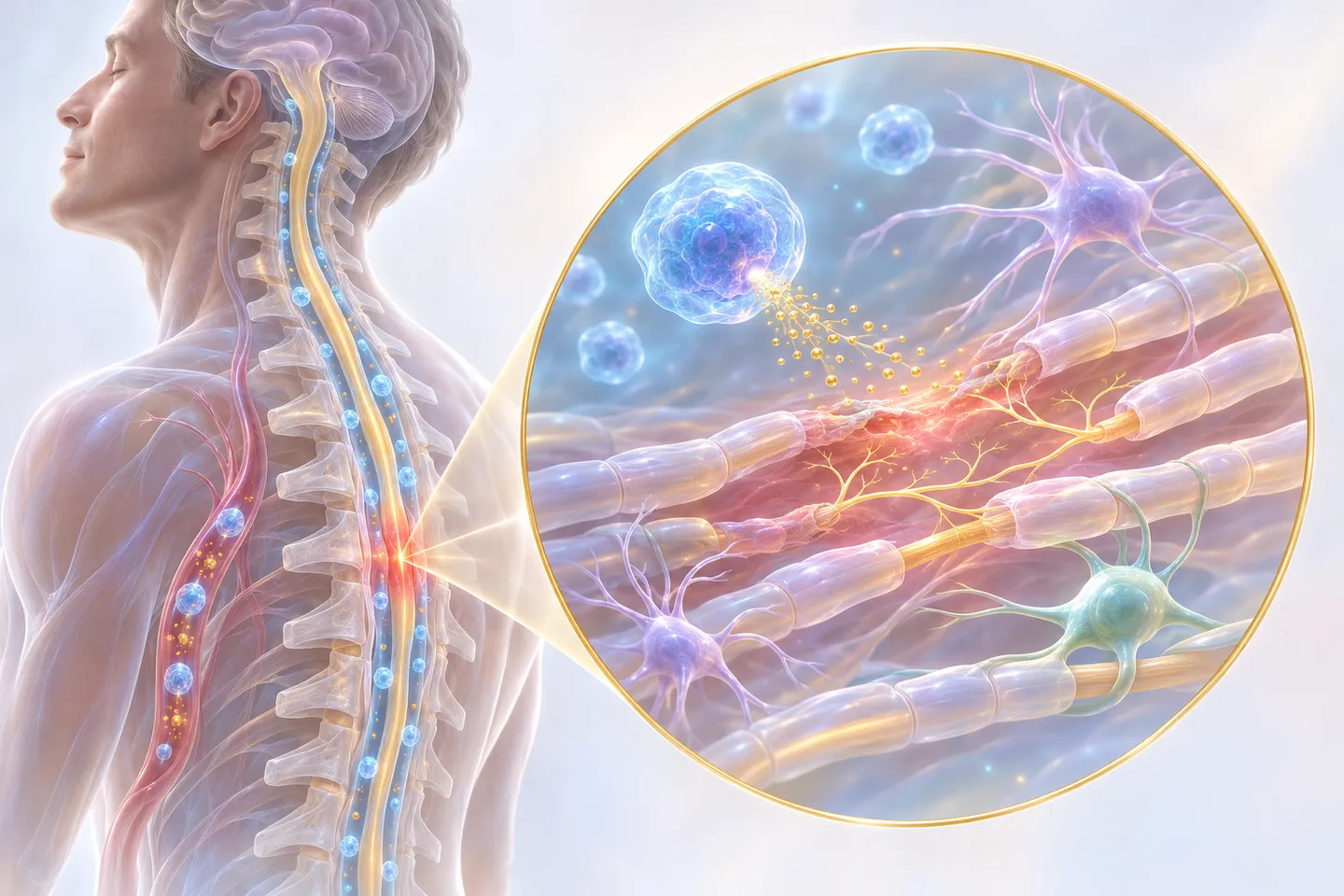
- Injured areaWhere the spinal cord was injured, signals between the brain and the body are interrupted.
- Cells in the spinal fluidIntrathecal treatment places Wharton’s jelly stem cells in the fluid around the spinal cord, close to the injury.
- Cells in the bloodstreamStem cells are also given by IV infusion and release calming signals in the body.
- Stem cellA Wharton’s jelly MSC. It does not replace nerve cells; it works mainly by releasing protective signals.
- ExosomesTiny messages from stem cells that tell nearby cells to calm inflammation and protect themselves.
- Nerve fibresLong nerve fibres wrapped in myelin carry signals. Protecting the fibres that remain is a key aim.
- New fine branchesSupport for nerve fibres to sprout new branches, seen so far mainly in research models.
- Support cellsGlial cells that protect and feed nerve fibres. Calming their scar-forming response is an aim seen in research models.
Calming the second phase of injury
Seen in research models. Stem cell exosomes given into the bloodstream shrank the injured area, lowered the inflammatory signals TNF-α and IL-1β and raised the calming signal IL-10.19
Settling the cord’s own immune cells
Seen in research models. After a complete injury, Wharton’s jelly stem cells reduced microglia and reactive astrocytes, the cells that drive inflammation and scarring in the spinal cord.10
Protecting nerve cells and blood vessels
Seen in research models and laboratory studies. Exosomes reduced cell death in the injured cord and helped new blood vessels form.19 Wharton’s jelly stem cells produced neurotrophin-3 and other growth factors in the injured cord,10 and they express more nerve-protecting factors than bone marrow stem cells.20
Regrowing fibres and new myelin
Seen in research models. Wharton’s jelly stem cells increased regrowing fibres in the main movement pathway, the corticospinal tract.10 In long-standing injuries, repeated IV stem cells increased new sprouting and fibres rewrapped in myelin, more than a single dose.21
Exosomes reaching the cord
Seen in research models. Pooling 52 studies, MSC exosomes clearly improved movement after spinal cord injury,22 and given through the nose, they travelled to the injured part of the spinal cord.23
Sensation, movement and bladder function
Seen in people. Intrathecal Wharton’s jelly stem cells improved pinprick sensation compared with placebo,4 and pooled studies show better sensory scores, less urine left in the bladder and gains in movement and daily activities.21
That is why plans combine routes: cells in the spinal fluid work close to the injury, while IV cells and exosomes calm the immune system throughout the body. Read more about our stem cell therapy and our exosome therapy.
07
Why Wharton’s jelly stem cells and exosomes for spinal cord injury?
Wharton’s jelly is the soft, protective tissue inside the umbilical cord. Its stem cells come from cords donated after healthy births, so they are among the youngest stem cells used in treatment, and nothing is taken from your body. Cells of this type were used in the double-blind trial in Barcelona and the multi-route study in Türkiye.45
Young and vigorous
In a comparison of cells from 18 donors each, Wharton’s jelly stem cells multiplied more readily than bone marrow stem cells.24
Rich in nerve-supporting signals
They express more secreted factors linked with nerve protection, new nerve cells and blood vessel growth than bone marrow stem cells.20
No donor matching
They lack CD40, CD80 and CD86, signals that alert the immune system, and did not stimulate another person’s immune cells in laboratory tests.25
Fresh, never frozen
Prepared for your date in a Ministry of Health-approved GMP laboratory. In laboratory work, cells used straight after thawing had weaker immune-calming properties than fresh cells.26
Umbilical cord MSCs and CD34+ exosomes
Your plan can also include umbilical cord MSCs, the cells of the randomised study and the study of 41 people below,39 and CD34+ exosomes for their blood-vessel-supporting signals. Every batch is certified for cell count, viability and sterility, as our stem cell quality guide explains.
08
Stem cell therapy for spinal cord injury: what human trials report
Here are the favourable human studies, each with its own cells, route and results. Many of the people in them had complete or long-standing injuries.
| Study | Design | n | Cells (their own source) and route | Result with exact numbers |
|---|---|---|---|---|
| Cheng 2014, J Transl Med3 | Randomised, three groups | 34 | Umbilical cord MSCs; two CT-guided injections into the spinal cord | 7 of 10 improved vs 5 of 14 (36%) with rehabilitation; bladder capacity and urine flow up |
| Dai 2013, Brain Res27 | Randomised, controlled; complete, chronic neck-level injuries | 40 | Own bone marrow MSCs; injected around the injury | 10 treated patients improved in movement, touch, pinprick and residual urine, and 9 changed AIS grade; no improvement in controls |
| Albu 2021, Cytotherapy (NCT03003364)4 | Randomised, double-blind, placebo-controlled crossover | 10 | Wharton’s jelly MSCs, 10 million; one intrathecal dose | Pinprick sensation below the injury significantly better than with placebo; no significant side effects |
| Awidi 2024, Cytotherapy28 | Randomised, open-label, two cell types; injuries at least 1 year old | 20 | Umbilical cord MSCs, 3 monthly intrathecal doses, or own bone marrow MSCs | Total ASIA scores significantly better in both groups; mean follow-up 22.65 months |
| Kaplan 2025, World J Stem Cells5 | Open-label phase I, Türkiye; complete injuries 6 months to 12 years old | 6 | Wharton’s jelly MSCs, 1 million per kg per route; intrathecal, intramuscular and IV | ASIA motor score significantly better over one year (P < 0.001); bladder-related quality of life better |
| Yang 2021, Cytotherapy9 | Single-arm phase 1/2 | 41 (102 for safety) | Umbilical cord MSCs, 1 million per kg; 4 monthly intrathecal doses | ASIA and function scores up whatever the level, severity or age of the injury; better bladder and bowel function |
| Honmou 2021, Clin Neurol Neurosurg12 | Phase 2, unblinded | 13 | Own MSCs; one IV infusion | 12 of 13 up at least one ASIA grade at 6 months; 5 of 6 from grade A to B or C; all 5 from grade C to D |
| Hirota 2024, J Clin Med6 | Case series; injuries 1.3 to 27 years old | 7 | Own MSCs; one IV infusion | Significant functional and quality-of-life gains at 90 and 180 days |
| Vaquero 2018, Cytotherapy29 | Phase 2; chronic injuries | 11 (9 for efficacy) | Own MSCs, 100 million; 3 intrathecal doses | 66.6% had less residual urine and better bladder compliance; gains regardless of level, age or time since injury |
| Bydon 2024, Nat Commun30 | Phase I; AIS A or B at injury | 10 | Own adipose MSCs; intrathecal | 7 of 10 improved by at least one AIS grade; no serious adverse events |
| Akhlaghpasand 2024, Stem Cell Res Ther31 | Phase I, first in human; complete subacute injuries | 9 | Umbilical cord MSC exosomes; intrathecal | Pinprick, light touch, independence and bowel scores significantly better at 12 months |
The randomised studies
In the umbilical cord study, people with long-standing mid or lower back injuries were randomly assigned to stem cells, rehabilitation or no specific treatment, and only the stem cell group showed better bladder capacity and urine flow.3 In the Barcelona trial, neither the patients nor their doctors knew who had received cells or placebo.4
What the pooled evidence says
Pooling 11 studies with 499 patients, people treated with stem cells were 3.70 times as likely to improve by an AIS grade, and 3.57 times as likely among those with complete (grade A) injuries, with better sensory scores and less urine left in the bladder.2 A 2025 analysis of 18 randomised trials found better movement, sensation and daily activities, and ranked intrathecal umbilical cord cells as the most effective strategy.1
09
Stem cell therapy for spinal cord injury success rate: what the numbers mean
“Success” after a spinal cord injury can mean feeling returning to a patch of skin, a stronger grip, better bladder control or more independence. Studies measure it with the AIS grade, ASIA movement and sensation scores, and independence scales such as SCIM-III. Beside the randomised result in the chart, these are the clearest figures:
- 12 of 13 moved up at least one ASIA grade six months after one IV infusion of their own stem cells.12
- 7 of 10 people whose injuries were grade A or B improved by at least one AIS grade after intrathecal stem cells from their own fat tissue.30
- 66.6% had less urine left in the bladder and better bladder compliance after three intrathecal doses.29
Your own result depends on the level and completeness of your injury, how long ago it happened, your general health and your rehabilitation. Dr. Cihan Bolat explains what is realistic for you after reviewing your MRI.
Significant improvement in movement, self-care and muscle tension (% of patients)
Randomised study of long-standing mid and lower back injuries3
10
Exosomes for spinal cord injury: by IV infusion and nasal spray
Exosomes are tiny vesicles, on average about 100 nanometres across, that cells use to send proteins, fats and RNA messages to one another.11 Much of the repair effect of stem cells travels in these parcels, which is why exosomes are studied as a cell-free treatment of their own.
In research models of spinal cord injury, pooling 52 studies, MSC exosomes clearly improved movement;22 given into the bloodstream, they calmed inflammation, reduced cell death and helped new blood vessels form;19 and given through the nose, they reached the injured part of the cord.23 The first human study, in 9 people with complete injuries in the first months after injury, found umbilical cord MSC exosomes safe, with significantly better pinprick, light touch, independence and bowel scores at 12 months; that study gave them intrathecally.31
In your plan, Wharton’s jelly exosomes are given by IV infusion and as a gentle nasal spray, and from 50 million cells our IV packages include free Wharton’s jelly exosomes. Learn more on our exosome therapy page.
11
What is established and what is still early
Research into spinal cord repair is moving fast. Here is where it stands today.
| Level of evidence | What it shows | Key studies |
|---|---|---|
| Shown in randomised human trials | Better movement, self-care, sensation and bladder function than with rehabilitation alone, no specific treatment or placebo; pooled trials favour intrathecal umbilical cord cells | Cheng 2014, Dai 2013, Albu 2021, Wang 202532741 |
| Seen in early human studies | Gains in AIS grade and scores, including in injuries many years old, with IV, intrathecal and multi-route treatment; first safety results for exosomes and Muse cells | Kaplan 2025, Yang 2021, Honmou 2021, Hirota 2024, Akhlaghpasand 2024, Koda 2024591263132 |
| Seen in research models only | Calmer inflammation, regrowing nerve fibres, new myelin and blood vessels, and nasal exosomes reaching the injured cord | Yang 2008, Huang 2017, Kurihara 2023, Guo 201910192123 |
The direction of travel is encouraging: researchers are now comparing cells, routes and timing, and in the largest pooled analysis, the umbilical cord and intrathecal approach that our plans are built on came out ahead.1
12
Is stem cell therapy for spinal cord injury safe?
The published record is reassuring. A 2021 meta-analysis of 62 randomised trials with 3,546 patients found MSC treatment safe, the most common effect a passing fever.7 A review of 39 studies of intrathecal MSC injections found no serious adverse events related to the injection and concluded that, properly performed, it is exceedingly safe.8
The spinal cord injury studies point the same way. Intrathecal Wharton’s jelly cells caused no significant side effects in the double-blind trial,4 the study of umbilical cord cells in 102 people reported no serious adverse events, only mild effects such as a passing fever or headache that settled with simple care,9 and pooling 11 studies, there were no serious or lasting adverse effects.2 In their first human study, exosomes caused no adverse events attributable to treatment.31
Your own care adds further layers: careful screening of your records, fresh cells with certified count and viability, and a specialist team led by Dr. Cihan Bolat, a specialist in anaesthesiology and reanimation.
13
Muse cells and Muse exosomes: an optional add-on
Muse cells, short for multilineage-differentiating stress-enduring cells, are a small group of hardy repair cells within the mesenchymal stem cell family, first described in Japan in 2010.33 In a trial in 10 people with neck-level (C4 to C7) injuries, one IV dose of a donor Muse cell product was followed by significant gains in movement scores, daily activities and quality of life, and no safety concerns were identified.32 If you choose them, Muse cells are given by IV infusion and intrathecally, and Muse exosomes by IV infusion and nasal spray, alongside the Wharton’s jelly cells that lead your plan.
14
Your treatment in Istanbul: routes, plan and step by step
Every plan starts with your records and your goals. Dr. Cihan Bolat, our medical director and a specialist in anaesthesiology and reanimation and in regenerative medicine, reviews your MRI, the level and AIS grade of your injury, your rehabilitation, medicines and general health. Dr. Cihan Bolat plans the routes and timing for you.
For spinal cord injury, the routes are intrathecal and IV Wharton’s jelly stem cells, with exosomes by IV infusion and nasal spray; only exosomes are given as a nasal spray. A typical IV range is 1–2 million cells per kilogram, and the right dose is set in your medical review. Most of our international patients come from the UK and the United States: see our guides for UK patients and US patients.
Questions worth asking any clinic
- Which cells, from which tissue, and are they fresh?
- Will I see the batch certificate?
- Which routes, and why for my injury?
- What is the total price, in writing?
Our guide on how to choose a stem cell clinic abroad explains them.
Send us your reports
Share your spinal MRI report, hospital letters, medicines and a short note on what you can do today, by our consultation form or WhatsApp on +90 534 856 92 92.
Free medical review
Dr. Cihan Bolat reviews your case free of charge and talks it through with you and your family.
Your written plan and fixed price
If treatment suits you, you receive your cells, exosomes and routes in writing, with a fixed, all-inclusive price.
Your treatment in Istanbul
Fresh cells are prepared for your date, and our team guides you calmly through each step.
Home, rehabilitation and follow-up
Back home, you continue your physiotherapy, and we follow up at about 1, 3, 6 and 12 months by phone or WhatsApp.
15
How much does stem cell therapy for spinal cord injury cost in Turkey?
Our IV stem cell packages follow one clear price list, effective 1 June 2026. All prices are in US dollars, M stands for million stem cells, and from 50M every package includes free Wharton’s jelly exosomes. Intrathecal stem cells and exosome nasal sprays are priced in your written plan, so you know the fixed price before you book. See also our guide to stem cell therapy cost in Turkey and our page on stem cell treatment for spinal cord injury in Turkey.
| Cell count | USD price | Free exosomes | Free hotel |
|---|---|---|---|
| 25M | $4,950 | No | No |
| 50M | $6,950 | 10 billion exosomes | No |
| 75M | $8,950 | 10 billion exosomes | No |
| 100M | $10,500 | 20 billion exosomes | 2 nights |
| 125M | $11,850 | 20 billion exosomes | 2 nights |
| 150M | $13,550 | 30 billion exosomes | 2 nights |
| 175M | $15,000 | 30 billion exosomes | 2 nights |
| 200M | $16,500 | 30 billion exosomes | 3 nights |
| 225M | $18,000 | 30 billion exosomes | 3 nights |
| 250M | $19,500 | 30 billion exosomes | 3 nights |
Included
- Free medical review and phone consultation
- Fresh Wharton’s jelly stem cells, with certified count and viability
- Treatment by our specialist team, led by Uzm. Dr. Cihan Bolat
- Ground transport, with airport transfers depending on your package
- A case manager, with interpreter help when needed
- Hotel nights where the price list shows them, in 5-star hotels
- Follow-up at about 1, 3, 6 and 12 months
Not included / optional
- Flights
- Intrathecal stem cells and extra exosomes, priced in your written plan
- Add-ons such as Muse cells or CD34+ exosomes
To reserve your date, a deposit of 10% to 25% of your plan is payable by any major credit or debit card, with Stripe instalments where available.
16
Frequently asked questions
Can stem cells repair a damaged spinal cord?
Not on their own, and no treatment can promise a full recovery. Stem cells send repair signals that calm inflammation and protect surviving pathways, and human studies report better sensation, movement and bladder function alongside rehabilitation, with intrathecal umbilical cord cells ranked most effective across 18 randomised trials.
What is the success rate of stem cell therapy for spinal cord injury?
It depends on how success is measured. In a randomised study, 7 of 10 people improved in movement, self-care and muscle tension with umbilical cord stem cells, against 36% with rehabilitation alone. Pooling 11 studies, treated people were 3.70 times as likely to improve their AIS grade.
Can stem cells help a chronic spinal cord injury?
Yes. People injured 1.3 to 27 years earlier showed significant functional and quality-of-life gains after IV stem cells, and umbilical cord stem cells improved nerve function whatever the age of the injury.
What is intrathecal stem cell treatment for the spinal cord?
Intrathecal means into the spinal fluid, through a very fine needle in the lower back, much like a lumbar puncture, so the cells reach the fluid around the injured cord. In pooled randomised trials, intrathecal umbilical cord cells were the most effective strategy.
Is there a cure for paralysis after a spinal cord injury?
Not today, and our treatment does not promise one. Rehabilitation helps you use every working pathway, and stem cell therapy aims to support further recovery: in studies, people regained sensation, movement or bladder control to different degrees.
Do stem cells help complete (AIS A) injuries?
Many studies included them. In a Japanese study, 5 of 6 people with grade A injuries improved to grade B or C after one IV infusion, and pooling 11 studies, grade A patients were 3.57 times as likely to improve their grade with stem cells.
What are the new treatments for spinal cord injury in 2026?
Research is moving on several fronts, from cell therapies and exosomes to electrical stimulation combined with training. Intrathecal umbilical cord stem cells rank highest in pooled randomised trials, exosomes have completed a first human safety study, and Muse cells have been tested in neck-level injuries.
How soon after treatment might I notice changes?
Changes tend to build gradually over months, and in one study gains were already significant at 90 days. Some people first notice small changes in sensation, muscle stiffness or bladder control; your rehabilitation helps you make the most of them.
Is stem cell therapy for spinal cord injury safe?
The published record is reassuring: 62 randomised trials with 3,546 patients found MSC treatment safe, the most common effect a passing fever, and 39 intrathecal studies reported no serious adverse events from the injection.
How long will I stay in Istanbul?
Your plan sets the dates, and your case manager helps you choose them. Dr. Cihan Bolat plans the routes and timing for you after your free medical review.
How much does stem cell therapy for spinal cord injury cost?
IV packages range from USD 4,950 for 25 million stem cells to USD 19,500 for 250 million, with free Wharton’s jelly exosomes from 50 million. Intrathecal treatment is priced in your written plan, with a fixed, all-inclusive price after your free review.
Medical review
Uzm. Dr. Cihan Bolat
Medical Director, Istanbul Stemcell
This page was written from the published studies listed below and reviewed for medical accuracy on .
17
References
- Wang R, et al. Assessment of mesenchymal stem cells for the treatment of spinal cord injury: a systematic review and network meta-analysis. Front Cell Neurosci. 2025;19:1532219. PMID 40308723
- Xu P, Yang X. The Efficacy and Safety of Mesenchymal Stem Cell Transplantation for Spinal Cord Injury Patients: A Meta-Analysis and Systematic Review. Cell Transplant. 2019;28(1):36-46. PMID 30362373
- Cheng H, et al. Clinical observation of umbilical cord mesenchymal stem cell transplantation in treatment for sequelae of thoracolumbar spinal cord injury. J Transl Med. 2014;12:253. PMID 25209445
- Albu S, et al. Clinical effects of intrathecal administration of expanded Wharton jelly mesenchymal stromal cells in patients with chronic complete spinal cord injury: a randomized controlled study. Cytotherapy. 2021;23(2):146-156. PMID 32981857
- Kaplan N, et al. Multiroute administration of Wharton's jelly mesenchymal stem cells in chronic complete spinal cord injury: A phase I safety and feasibility study. World J Stem Cells. 2025;17(5):101675. PMID 40503363
- Hirota R, et al. Intravenous Infusion of Autologous Mesenchymal Stem Cells Expanded in Auto Serum for Chronic Spinal Cord Injury Patients: A Case Series. J Clin Med. 2024;13(20). PMID 39458022
- Wang Y, Yi H, Song Y. The safety of MSC therapy over the past 15 years: a meta-analysis. Stem Cell Res Ther. 2021;12(1):545. PMID 34663461
- Barmada A, et al. Serious Adverse Events Have Not Been Reported with Spinal Intrathecal Injection of Mesenchymal Stem Cells: A Systematic Review. Curr Stem Cell Res Ther. 2023;18(6):829-833. PMID 35980065
- Yang Y, et al. Repeated subarachnoid administrations of allogeneic human umbilical cord mesenchymal stem cells for spinal cord injury: a phase 1/2 pilot study. Cytotherapy. 2021;23(1):57-64. PMID 33218835
- Yang CC, et al. Transplantation of human umbilical mesenchymal stem cells from Wharton's jelly after complete transection of the rat spinal cord. PLoS One. 2008;3(10):e3336. PMID 18852872
- Kalluri R, LeBleu VS. The biology, function, and biomedical applications of exosomes. Science. 2020;367(6478). PMID 32029601
- Honmou O, et al. Intravenous infusion of auto serum-expanded autologous mesenchymal stem cells in spinal cord injury patients: 13 case series. Clin Neurol Neurosurg. 2021;203:106565. PMID 33667953
- . Global, regional, and national burden of traumatic brain injury and spinal cord injury, 1990-2016: a systematic analysis for the Global Burden of Disease Study 2016. Lancet Neurol. 2019;18(1):56-87. PMID 30497965
- Anderson KD. Targeting recovery: priorities of the spinal cord-injured population. J Neurotrauma. 2004;21(10):1371-83. PMID 15672628
- Ahuja CS, et al. Traumatic spinal cord injury. Nat Rev Dis Primers. 2017;3:17018. PMID 28447605
- Fawcett JW, et al. Guidelines for the conduct of clinical trials for spinal cord injury as developed by the ICCP panel: spontaneous recovery after spinal cord injury and statistical power needed for therapeutic clinical trials. Spinal Cord. 2007;45(3):190-205. PMID 17179973
- Zhang L, et al. Combining therapeutic strategies with rehabilitation improves motor recovery in animal models of spinal cord injury: A systematic review and meta-analysis. Ann Phys Rehabil Med. 2025;68(3):101911. PMID 39798215
- Azimi A, et al. Stem cell therapy for locomotion recovery and neuropathic pain alleviation in spinal cord injury: an umbrella review and meta-analysis. Spinal Cord. 2025;63(8):393-409. PMID 40681655
- Huang JH, et al. Systemic Administration of Exosomes Released from Mesenchymal Stromal Cells Attenuates Apoptosis, Inflammation, and Promotes Angiogenesis after Spinal Cord Injury in Rats. J Neurotrauma. 2017;34(24):3388-3396. PMID 28665182
- Hsieh JY, et al. Mesenchymal stem cells from human umbilical cord express preferentially secreted factors related to neuroprotection, neurogenesis, and angiogenesis. PLoS One. 2013;8(8):e72604. PMID 23991127
- Kurihara K, et al. Repeated intravenous infusion of mesenchymal stem cells enhances recovery of motor function in a rat model with chronic spinal cord injury. Brain Res. 2023;1817:148484. PMID 37442249
- Yang Z, et al. Mesenchymal stem cell-derived extracellular vesicles therapy in traumatic central nervous system diseases: a systematic review and meta-analysis. Neural Regen Res. 2023;18(11):2406-2412. PMID 37282470
- Guo S, et al. Intranasal Delivery of Mesenchymal Stem Cell Derived Exosomes Loaded with Phosphatase and Tensin Homolog siRNA Repairs Complete Spinal Cord Injury. ACS Nano. 2019;13(9):10015-10028. PMID 31454225
- Batsali AK, et al. Differential expression of cell cycle and WNT pathway-related genes accounts for differences in the growth and differentiation potential of Wharton's jelly and bone marrow-derived mesenchymal stem cells. Stem Cell Res Ther. 2017;8(1):102. PMID 28446235
- Weiss ML, et al. Immune properties of human umbilical cord Wharton's jelly-derived cells. Stem Cells. 2008;26(11):2865-74. PMID 18703664
- Moll G, et al. Do cryopreserved mesenchymal stromal cells display impaired immunomodulatory and therapeutic properties? Stem Cells. 2014;32(9):2430-42. PMID 24805247
- Dai G, et al. Transplantation of autologous bone marrow mesenchymal stem cells in the treatment of complete and chronic cervical spinal cord injury. Brain Res. 2013;1533:73-9. PMID 23948102
- Awidi A, et al. Safety and potential efficacy of expanded mesenchymal stromal cells of bone marrow and umbilical cord origins in patients with chronic spinal cord injuries: a phase I/II study. Cytotherapy. 2024;26(8):825-831. PMID 38703153
- Vaquero J, et al. Intrathecal administration of autologous mesenchymal stromal cells for spinal cord injury: Safety and efficacy of the 100/3 guideline. Cytotherapy. 2018;20(6):806-819. PMID 29853256
- Bydon M, et al. Intrathecal delivery of adipose-derived mesenchymal stem cells in traumatic spinal cord injury: Phase I trial. Nat Commun. 2024;15(1):2201. PMID 38561341
- Akhlaghpasand M, et al. Safety and potential effects of intrathecal injection of allogeneic human umbilical cord mesenchymal stem cell-derived exosomes in complete subacute spinal cord injury: a first-in-human, single-arm, open-label, phase I clinical trial. Stem Cell Res Ther. 2024;15(1):264. PMID 39183334
- Koda M, et al. Safety and feasibility of intravenous administration of a single dose of allogenic-Muse cells to treat human cervical traumatic spinal cord injury: a clinical trial. Stem Cell Res Ther. 2024;15(1):259. PMID 39135172
- Kuroda Y, et al. Unique multipotent cells in adult human mesenchymal cell populations. Proc Natl Acad Sci U S A. 2010;107(19):8639-43. PMID 20421459