Occipital neuralgia treatment with stem cell therapy in Istanbul uses fresh Wharton’s jelly stem cells and their exosomes, tiny repair messages, placed near the irritated occipital nerve at the back of your head. The occipital nerves run from the top of your neck over the back of your head. When they are irritated, they send sharp, shooting or stabbing attacks of pain that last seconds to minutes.1 Uzm. Dr. Cihan Bolat reviews your MRI report and letters free of charge.
01
Living with occipital neuralgia: we understand
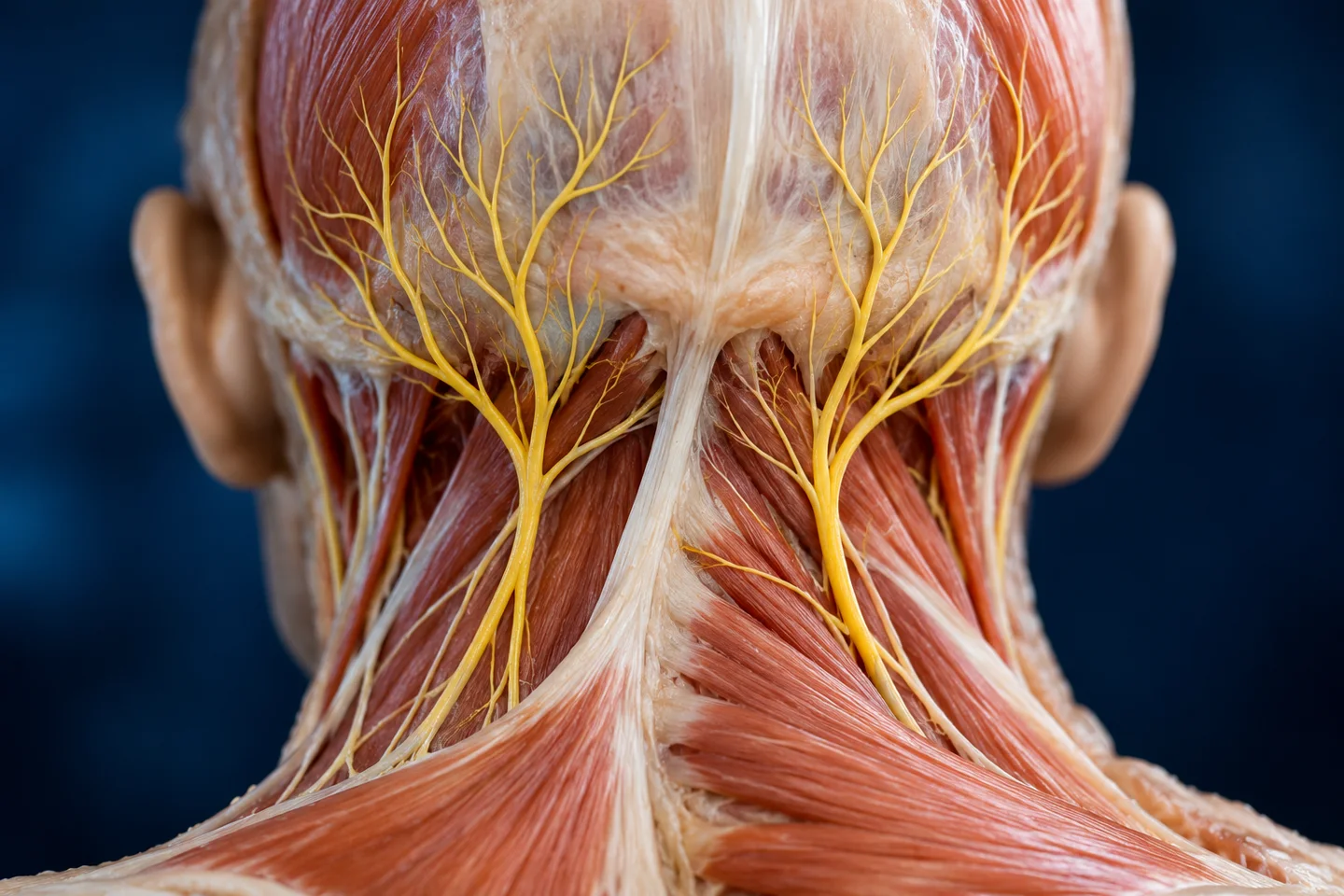
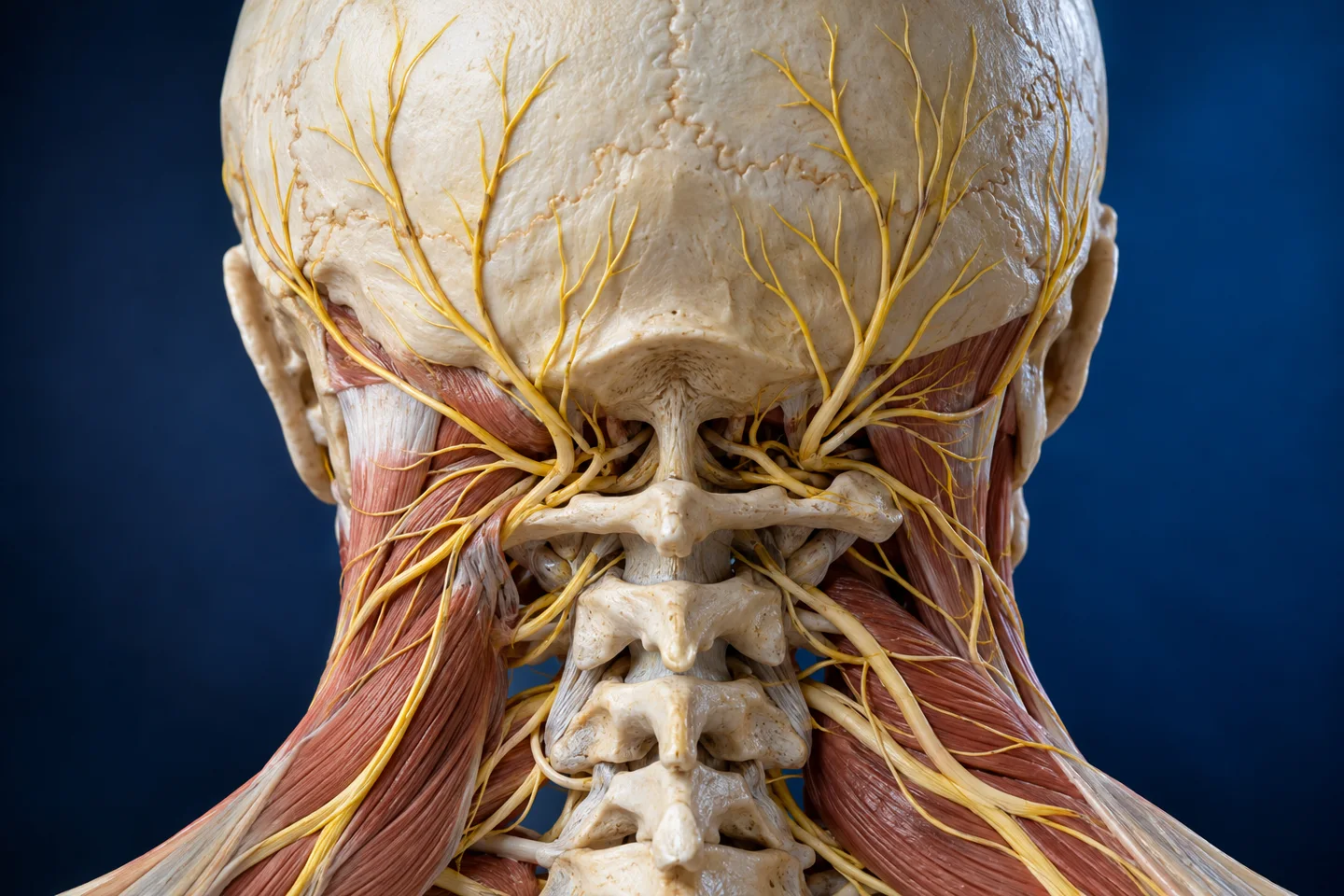
If you live with occipital neuralgia, you know the moment: a sharp, electric jolt that shoots from the base of your skull over the back of your head, sometimes all the way to your eye. It can strike out of nowhere, or after something as small as brushing your hair or resting your head on the pillow.17 Between attacks, your scalp can stay sore, tender or numb. In a review of 579 patients, 59% described the pain as stabbing, and 73% also had numb patches.8
It is rarely only about the pain. You may sleep lightly, wary of the pillow, or think twice before a long drive or a full day at your screen. Almost half of the people in that review also lived with migraine,8 so it can be hard to know which headache is which. Wanting to get through a day without bracing for the next jolt is completely natural, and it deserves a careful plan.

Sleeping on your back again
Resting your head on the pillow without waking to a jolt.
Brushing your hair without a flinch
Washing, brushing and styling it, and wearing a hat or a hood.
Looking over your shoulder
At the wheel, crossing a busy street or turning to a friend.
Clear days at work and home
Reading, screens and long conversations without bracing for the next attack.
Here is the hopeful part: occipital neuralgia treatment no longer has to stop at numbing the nerve. Stem cell therapy now aims at the irritated nerve itself, alongside your medicines, physiotherapy and nerve blocks. First, how it works, in plain words:
02
How stem cells and exosomes can help your occipital neuralgia, in plain words
Picture your occipital nerve as an electric cable that runs from your neck over the back of your head. When a tight muscle, an old injury or swelling presses on it, the cable starts to spark: that is the jolt you feel. Inflammation, the body’s alarm, keeps it sparking. Stem cells act like a calm site manager. They do not become new nerve. Instead, they turn down the alarm and send your own cells tiny text messages, called exosomes, packed with instructions. Most of the good comes from those signals.3
Calming the angry nerve
First, they help settle the inflammation around your irritated nerve. That inflammation is the alarm that keeps the nerve oversensitive, so even a light touch on your scalp can set it off.
Sending repair messages
Next, the stem cells release exosomes, tiny parcels of proteins and instructions. Your nerve cells and the cells around them read these messages and are nudged to calm down and protect themselves.
Protecting the nerve’s coating
Finally, they help protect the myelin, the nerve’s insulating coat, like the plastic around a cable. In research models, exosomes placed by an injured nerve eased nerve pain and supported this coating.9
What this could mean for you: resting your head on the pillow and sleeping through the night. Brushing your hair, or pulling on a hat, without a flinch. Turning to check the traffic, or to greet a friend, without that shooting pain. A calmer nerve may give you back these moments, and we aim to make long days at work and at home easier again.
03
Stem cell treatment for occipital neuralgia
Stem cells offer hope for recovery and symptom management in occipital neuralgia.
Read the full section
Occipital neuralgia is a nerve condition characterized by sharp, shooting or stabbing pain at the back of the head and upper neck, usually due to irritation of the occipital nerves and other health-related causes. This condition can arise from various factors, such as a tight muscle, an old neck injury or wear in the upper neck joints, and it can affect people of different ages, significantly impacting their overall well-being.
Our stem cell treatment for occipital neuralgia involves the direct administration of allogeneic mesenchymal stem cells to calm the irritated nerve and the inflammation around it, and improve overall health. By targeting the source of the pain and promoting healing, this treatment can lead to an enhancement in quality of life and a reduction in the symptoms associated with occipital neuralgia.
Utilizing advanced techniques, including the application of umbilical cord-derived stem cells, we aim to provide a comprehensive approach to managing occipital neuralgia. This innovative therapy not only focuses on alleviating pain but also on supporting the healing of the irritated nerve, through the calming and repair signals the stem cells release, with the aim of better health outcomes for our patients.
04
Why acting early can make a difference
Occipital neuralgia is pain from the greater, lesser or third occipital nerves. It often starts when a tight muscle or a nearby blood vessel irritates the nerve, or after a whiplash injury to the neck.10 Today’s care does a lot of good. Physiotherapy and medicines that calm nerve pain often help,11 and an occipital nerve block (an injection of local anaesthetic, often with a steroid, beside the nerve) can bring real relief: in a study of 44 people, average pain fell from 7.23 to 2.21 out of 10 six months after a block.12
For many people, though, the relief from an injection is only temporary, and the jolts come back.7 A block numbs and calms the nerve for a while; it is not designed to protect the nerve’s health. And when nerve pain carries on for months, the nervous system can turn up its own volume, so pain comes more easily (central sensitisation). The hopeful part is that this extra sensitivity can settle again.13 Calming an irritated nerve sooner gives any treatment, stem cell care included, a better place to begin.
05
How Wharton’s jelly stem cells and exosomes work in occipital neuralgia
An irritated occipital nerve sits in a pool of inflammatory signals that keep it oversensitive. Wharton’s jelly stem cells and their exosomes, tiny messages that carry proteins and RNA between cells, are injected near the nerve at the back of your head. There they aim to calm the inflammation, quieten the pain signals and protect the nerve and its insulating coat, the myelin.
How Wharton’s jelly stem cells and exosomes aim to calm an irritated occipital nerve
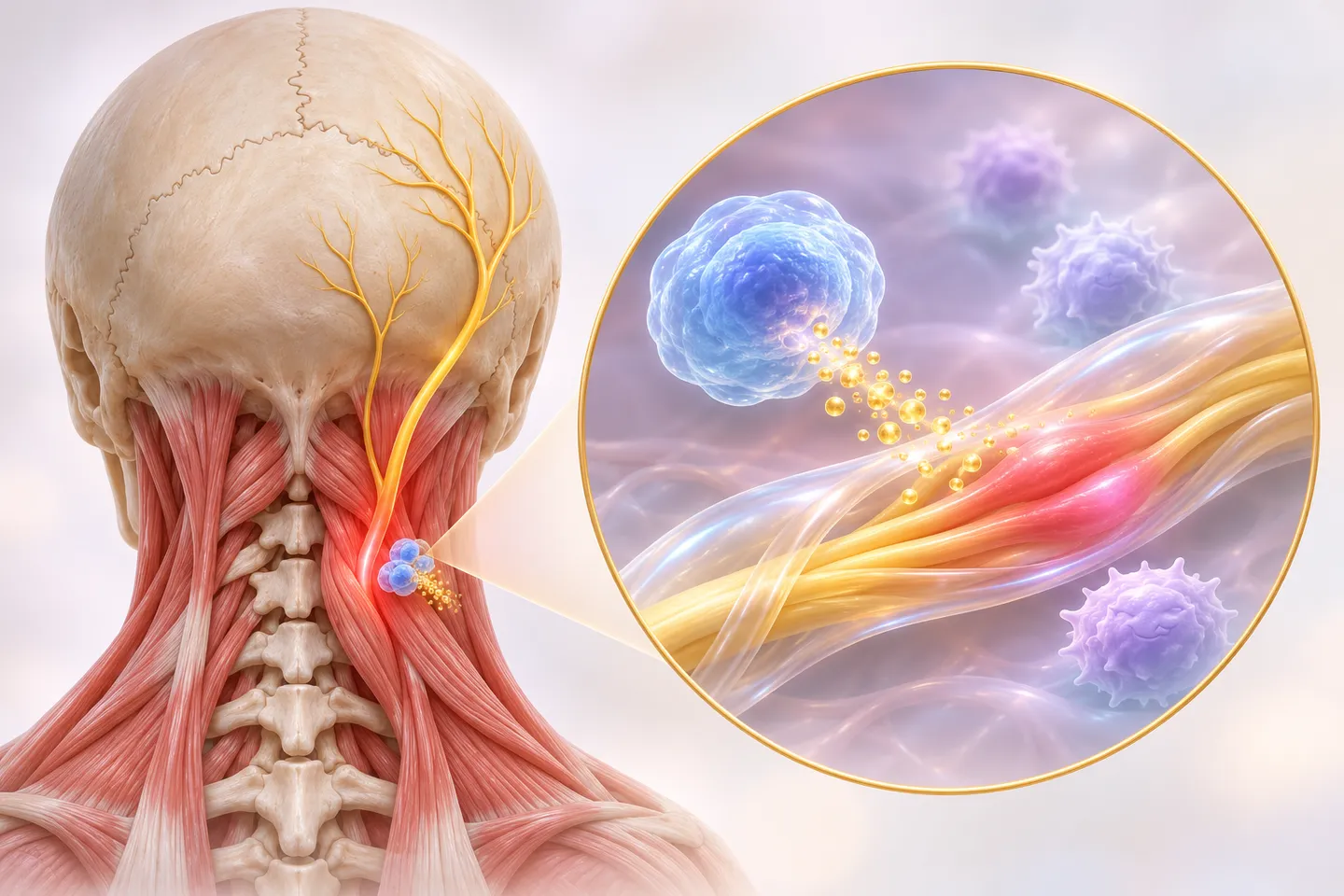
- Greater occipital nerveThe main nerve that runs from the top of the neck up over the back of the head. It is the one most often irritated in occipital neuralgia.
- Lesser occipital nerveA smaller nerve that runs up behind the ear. It can cause the same sharp pain.
- Irritated pointWhere the nerve passes through tight neck muscles it can be squeezed and inflamed. Sharp, shooting or electric pain spreads from here.
- Neck musclesThe muscles at the top of the neck. Tension here can press on the nerve.
- Nerve fibres and their coating (myelin)The fibres carry signals; the coating protects them. An irritated stretch fires pain signals too easily.
- Wharton’s jelly stem cellA fresh donor stem cell from umbilical cord tissue. It works mainly through calming and repair signals, shown mostly in research models.
- ExosomesTiny messages released by stem cells, carrying signals that calm inflammation and support repair.
- Calmer immune cellsLess inflammation, which is a main aim of treatment.
Read the science: how the treatment aims to calm an irritated nerve
Each effect below says whether it was seen in people or in research models. Read more about our stem cells and our exosomes.
Calming inflammation around the nerve
Seen in research models. After a nerve injury, human umbilical cord stem cells given into a vein calmed the immune cells that fuel nerve pain (microglia), eased pain and were followed by new myelin on the injured nerve.14
Repair messages that travel to the nerve
Seen in research models. Exosomes from human umbilical cord stem cells gathered along the injured nerve pathway, eased nerve pain, lowered inflammatory signals (TNF-α and IL-1β) and raised nerve-protecting growth factors (BDNF and GDNF).2
Protecting the nerve’s insulating coat
Seen in research models. Umbilical cord stem cell exosomes placed around an injured nerve eased pain from light pressure (the pressure needed to trigger pain was 14.1 g, against 2.1 g without exosomes) and raised myelin basic protein, a building block of the nerve’s coat.9
Wharton’s jelly cells as site managers
Seen in research models. Wharton’s jelly stem cells placed at an injured nerve did not turn into nerve tissue. They raised the nerve’s own growth and blood-vessel signals (BDNF, GDNF and VEGF), and the nerve healed with a structure close to normal.3
Nerve recovery seen in people
Seen in people. In people with a damaged optic nerve (the nerve of the eye), Wharton’s jelly stem cells placed beside the eye were followed by 83% stronger nerve signals and 32% sharper sight four months later.15 Exosomes from Wharton’s jelly stem cells, placed in a repaired arm nerve, were followed by excellent movement and good feeling six months later.16
06
How is our stem cell therapy transplant for occipital neuralgia performed in Istanbul?
Our stem cell treatments for occipital neuralgia utilize carefully sourced allogeneic mesenchymal stem cells (MSCs), specifically those derived from umbilical cord sources, prepared fresh for your treatment date and never frozen, with a viability rate of over 97% at the time of transplantation. We can combine this advanced stem cell therapy with platelet-rich plasma (PRP), free of charge with any stem cell package, to support the healing process.
Read the full section
This treatment process adheres to the highest standards: our cells are prepared fresh in a Good Manufacturing Practice (GMP) laboratory approved by the Turkish Ministry of Health, and every batch is certified for cell count, viability and sterility. By integrating umbilical cord-derived MSCs, we provide a carefully planned, specialist-led procedure in Istanbul for managing occipital neuralgia, so that patients receive top-quality care that aims to ease pain and improve overall well-being.
07
Why Wharton’s jelly stem cells and exosomes lead our occipital neuralgia treatment
Wharton’s jelly is the soft tissue inside the umbilical cord. Its stem cells come from cords donated after healthy births, so nothing is taken from your body and no donor matching is needed. They are prepared fresh for your treatment date in a Ministry of Health-approved GMP laboratory, with the cell count and viability certified (see what our lab report shows). For nerves, their signals suit the job: in a side-by-side laboratory test, they released more nerve-protecting factors than bone marrow stem cells.17
Compare Wharton’s jelly stem cells with your own cells
| Fresh Wharton’s jelly stem cells (our cells) | Stem cells from your own bone marrow or fat | |
|---|---|---|
| Age of the cells | Newborn tissue, from cords donated after healthy births | As old as you are |
| A procedure for you | None | A bone marrow draw or liposuction first |
| Ready for treatment | Prepared fresh for your date, usually within 5 to 10 days | After a harvest, often with laboratory growth |
| Nerve-protecting signals | Released more factors for nerve protection and new blood vessels in a laboratory comparison17 | Bone marrow cells released fewer of these factors in the same comparison17 |
08
Occipital neuralgia treatment with stem cells: what the studies show
Research on stem cells for nerve pain is young and growing. First, research models with umbilical cord stem cells, which come from the same source as our Wharton’s jelly cells: their exosomes eased nerve-injury pain and travelled to the injured nerve,2 and placed around an injured nerve, they supported its insulating coat.9 The human studies below each used their own cells and route, named in each line. The highlights:
- Our cell type, beside a damaged nerve: in 6 people with toxic optic neuropathy (damage to the nerve of the eye), Wharton’s jelly stem cells were followed by 83% stronger nerve signals and 32% sharper sight four months later.15
- Donor umbilical cord cells, at an injured nerve: after surgery to free an injured arm nerve, more than 80% of 12 people who also received donor umbilical cord stem cells had clear gains in strength and feeling at 12 weeks, against 55–65% of 20 people with surgery alone.4
- At the occipital nerve itself, own fat tissue: in 24 people with long-lasting occipital neuralgia or headache from the neck, cells from their own fat tissue (a different cell type from ours), placed where the nerve was trapped, gave a good response in 19 (79.2%), with less pain and fewer pain medicines.5
- Nerve pain in the face, own fat cells: in 10 women with long-lasting trigeminal nerve pain, cells from their own fat (also a different cell type) injected around the nerve lowered average pain from 7.5 to 4.3 out of 10 at six months.18
Nerve signals and sight four months after Wharton’s jelly stem cells, in people with a damaged optic nerve
Strength of the nerve signal (VEP P100 amplitude): how much higher than before15
Sharpness of sight (best-corrected visual acuity): how much better than before15
The studies in detail, with all 5 in one table
| Study | Design | n | Cells and route | Result with exact numbers |
|---|---|---|---|---|
| Özmert 2021, Stem Cell Res Ther15 | Prospective open-label study in three groups, 4 months; toxic optic neuropathy | 18 (36 eyes) | Wharton’s jelly stem cells, one injection beside the eye, with or without electromagnetic stimulation | Wharton’s jelly alone: sight 32% better, nerve signal 83% stronger; with stimulation: 47% and 105%; stimulation alone: 21% and 24% |
| Li 2013, Neural Regen Res4 | Controlled study (not randomised), 12 weeks; radial nerve injury after an arm fracture | 32 (12 + 20) | Donor umbilical cord stem cells on amniotic membrane wrapped around the nerve, plus injections into it, during surgery to free the nerve | Clear gains in strength, touch and pain sensation in more than 80%, against 55–65% with surgery alone; better muscle electrical activity at 8 and 12 weeks; no rejection |
| Civelek 2024, World J Stem Cells16 | Single-patient pilot, 6 months; complete radial nerve injury | 1 | Wharton’s jelly stem cell exosomes (5 billion), placed in both nerve ends during a nerve graft operation | Movement graded M5 (excellent) and feeling S3+ (good) at 6 months, without physiotherapy |
| Gaetani 2013, Headache5 | Observational study, 6 months; occipital neuralgia and headache from the neck | 24 | Cells from own fat tissue (stromal fraction), placed where the occipital nerve is trapped | Good response in 19 (79.2%); pain, disability and use of pain medicines significantly lower; no complications |
| Vickers 2014, J Pain Res18 | Open-label preliminary study, 6 months; trigeminal nerve pain | 10 | Cells from own fat (stromal vascular fraction), injected around the affected nerve and into the painful area | Average pain 7.5 → 4.3 out of 10 (P = 0.018); 5 of 9 cut their nerve pain medicine; well tolerated |
09
Who can have stem cell therapy for occipital neuralgia?
We treat occipital neuralgia on one or both sides, including pain that began after a neck injury, with no fixed age limit. You do not need a surgeon’s opinion first: send your MRI report, if you have one, and your doctor’s letters, including how you responded to medicines and nerve blocks. Dr. Cihan Bolat reviews them free of charge, plans the routes and timing for you, and tells you honestly whether stem cell therapy suits you or another option would suit you better. Keep your medicines, physiotherapy and nerve blocks: we work alongside them, never instead. For migraine, see headaches and migraines; for wear in the neck joints, spinal osteoarthritis; and for the discs and small joints of the neck, degenerative disc disease and facet syndrome.
Often suitable
- Sharp, shooting pain at the back of the head that keeps coming back
- Pain that eased with a nerve block but returned
- Occipital neuralgia after a neck or whiplash injury
- Pain on one or both sides, with tender or numb patches
Considered case by case
- Occipital neuralgia together with migraine or neck arthritis
- Headache that starts in the neck joints (cervicogenic headache)
- After occipital nerve surgery, or with a nerve stimulator
- Blood thinners, a bleeding disorder or diabetes
Not suitable for now
- A sudden, severe ‘worst ever’ headache, or a headache with weakness, confusion, fever or a stiff neck: please get emergency care first
- Active cancer, or recent cancer treatment
- An active infection, including of the scalp
- Pregnancy
10
Expert stem cell treatment led by Uzm. Dr. Cihan Bolat, MD
Under the guidance of Uzm. Dr. Cihan Bolat, MD, Specialist in Anesthesiology & Reanimation and Regenerative Medicine, we provide specialized treatments tailored to the unique needs of our patients suffering from occipital neuralgia. With extensive experience and a wide range of umbilical cord-derived mesenchymal stem cells (MSCs) at our disposal, we offer an integrated approach to the treatment of this condition.
Read the full section
In our clinic, we prioritize patient safety and well-being, creating a relaxing atmosphere supported by a friendly and professional team dedicated to ensuring you have a positive experience during your stay. Our commitment to utilizing advanced MSCs enhances the effectiveness of our treatments and promotes better health outcomes.
By focusing on the specific needs of patients with occipital neuralgia, we aim to provide a comprehensive and compassionate treatment experience that aims at the nerve irritation and inflammation behind the condition while supporting our patients in their journey toward improved health.
11
How does our stem cell treatment for occipital neuralgia work?
All our stem cell treatments in Istanbul are evaluated and administered by specialists in the field, trained in the United States and Turkey, rather than general practitioners or other specialists. We do this to ensure the highest level of precision, understanding of the condition, and quality of treatment for our patients. We are 100% transparent and honest with our patients. Not everyone is eligible for our stem cell treatments. Many patients are declined when our specialist evaluates their current health status and medical history, determining that the treatment is not suitable to avoid false promises or expectations when the risks outweigh the benefits. For this reason, and to ensure patient safety in all our treatments, each patient is assessed by the specialist before they can schedule their treatment.
Step 1. Specialist Assessment – For patients with occipital neuralgia, our specialist needs to know the patient's age and previous medical treatments. Additionally, specific tests related to nerve health will need to be reviewed, which you will be asked to bring.
Step 2. Free Telephone Consultation with the Specialist – Once the specialist has reviewed the medical records and approved your case, we will present treatment options and pricing tailored specifically for occipital neuralgia. At that time, we also offer a free telephone consultation to discuss any questions or concerns regarding the treatment process.
Step 3. Preparation of Stem Cells – Once you decide to proceed with our treatment, we will send an invoice for the deposit to initiate the stem cell preparation process, ensuring it is ready for your scheduled treatment. The duration of this process may vary depending on current demand and availability, but it can take 5-10 days.
Step 4. Treatment Day – On the day of treatment, you can choose to come to our hospital location or take advantage of our free transportation to and from our clinic in Istanbul. Our driver will pick you up from your desired location and escort you to our clinic, where the specialist will administer the treatment, utilizing advanced techniques such as umbilical cord-derived mesenchymal stem cells (MSCs) to optimize results. Afterward, our driver will safely return you.
Step 5. Follow-Up Treatment – Our specialist for follow-up treatment will contact you according to our follow-up schedule to ensure you have all the necessary resources for maximum benefits from your stem cell therapy. Your well-being and satisfaction are our top priorities.
By focusing on the specific needs of patients with occipital neuralgia and utilizing the latest advancements in stem cell therapy, we are committed to providing an effective and compassionate treatment experience that aims at the nerve irritation and inflammation behind the condition.
12
What our patients say
Remarkable Relief from Occipital Neuralgia!
I recently received stem cell therapy for my occipital neuralgia at this clinic, and I am thrilled with the results! The medical team provided exceptional care and expertise throughout the entire process. They took the time to explain every step, which made me feel comfortable and informed. Since undergoing the treatment, my symptoms have dramatically improved. The constant pain that once affected my daily life has significantly diminished, allowing me to enjoy my activities again. I highly recommend this clinic to anyone suffering from similar conditions; it has truly been a life-changing experience!
Professional Care and Outstanding Results!
From my very first visit to the clinic, I felt welcomed and valued. The staff was incredibly professional and attentive. The medical team thoroughly evaluated my condition and explained how stem cell therapy could help alleviate my occipital neuralgia. I appreciated the comprehensive approach they took in my treatment plan. After the procedure, I experienced a noticeable reduction in pain and discomfort, which has improved my overall quality of life. I am grateful for the care I received and can confidently say that this clinic is at the forefront of effective treatments for occipital neuralgia. Highly recommended!
13
Occipital neuralgia stem cell therapy cost in Turkey
Occipital neuralgia treatment with stem cells is a targeted injection near the irritated nerve, so it is priced in your written plan: a fixed, all-inclusive price before you book. An IV infusion, only where your plan includes one, follows our price list, effective 1 June 2026, in US dollars (M = million stem cells), with free Wharton’s jelly exosomes from 50M. See our stem cell therapy cost guide.
| Cell count | USD price | Free exosomes | Free hotel |
|---|---|---|---|
| 25M | $4,950 | No | No |
| 50M | $6,950 | 10 billion exosomes | No |
| 75M | $8,950 | 10 billion exosomes | No |
| 100M | $10,500 | 20 billion exosomes | 2 nights |
| 125M | $11,850 | 20 billion exosomes | 2 nights |
| 150M | $13,550 | 30 billion exosomes | 2 nights |
| 175M | $15,000 | 30 billion exosomes | 2 nights |
| 200M | $16,500 | 30 billion exosomes | 3 nights |
| 225M | $18,000 | 30 billion exosomes | 3 nights |
| 250M | $19,500 | 30 billion exosomes | 3 nights |
What is included, and what is optional
Included
- Free review of your MRI report and doctor’s letters, and a phone consultation
- Your injections, and any IV infusion, as set out in your plan
- Fresh Wharton’s jelly stem cells, count and viability certified
- PRP (platelet-rich plasma), free with any stem cell package
- Treatment by Uzm. Dr. Cihan Bolat’s specialist team
- Ground transport, a case manager and interpreter help
- Hotel nights as listed, in 5-star hotels
- Follow-up by phone or WhatsApp
Not included / optional
- Flights and extra hotel nights
- Extra exosomes, priced in your plan
- Add-ons such as Muse cells, Muse exosomes or CD34+ exosomes
- A repeat treatment, if you choose one
14
Read our full guides
Would you like the whole story? These guides go deeper.
Stem cell therapy for neuropathy
How stem cells and exosomes support damaged nerves, with the human studies and what you can do day to day.
Read the guide GuideStem cell therapy for back and neck pain
The discs, small joints and nerves of the neck, and how stem cell injections are planned for each.
Read the guide GuideExosome treatments explained
What exosomes are, how they carry repair signals and how each exosome treatment is given.
Read the guide15
Frequently asked questions
What is the best occipital neuralgia treatment?
There is no single best treatment for everyone. Occipital neuralgia treatment usually starts with physiotherapy, posture and neck exercises, and medicines that calm nerve pain, and an occipital nerve block can ease the pain and help confirm the diagnosis. When the pain keeps coming back, Wharton’s jelly stem cells and exosomes can be placed near the irritated nerve, alongside that care, never instead. Dr. Cihan Bolat tells you honestly what is realistic for you.
What is an occipital nerve block, and can stem cells replace it?
An occipital nerve block is an injection of local anaesthetic, often with a steroid, next to the occipital nerve. It numbs and calms the nerve, and the relief can last from days to months. Stem cell therapy is not a nerve block and does not replace one. It works differently: Wharton’s jelly stem cells and exosomes are placed near the nerve to calm inflammation and send repair signals. If your own doctor gives you nerve blocks, keep them; Dr. Cihan Bolat plans your treatment around the care you already have.
Is occipital neuralgia the same as a migraine?
No, although they can feel alike and often go together: in a review of 579 patients, almost half also had migraine. Occipital neuralgia is nerve pain, with short, sharp, shooting or electric attacks that start at the base of the skull and run over the back of the head, often with a tender spot over the nerve. Migraine is a throbbing headache that can last hours, often with sickness or sensitivity to light. Our headaches and migraines page covers that condition.
How soon will I feel a difference?
Results build gradually over weeks and months, as the nerve calms down. In the published nerve studies, improvements were measured at about 3 to 6 months. Everyone responds at their own pace, and physiotherapy and posture work help you build on every gain.
How are the injections given, and how long do I stay in Istanbul?
Wharton’s jelly stem cells and exosomes are injected near the irritated occipital nerve at the back of your head, on one or both sides, guided by imaging where needed; an IV infusion is added only if your plan includes one. PRP, made from a small sample of your own blood, can be added and is free with any stem cell package. Dr. Cihan Bolat, a specialist in anaesthesiology and reanimation, plans each injection with your comfort in mind, and you walk out the same day. Your plan sets the dates: your cells are prepared fresh, usually within 5 to 10 days of booking.
When is pain at the back of the head an emergency?
Please get emergency care straight away for a sudden, severe ‘worst ever’ headache, or a headache with weakness, confusion, fever or a stiff neck. These need urgent checks first. For pain that keeps coming back over weeks or months, send us your reports for a calm, free review.
How safe is stem cell treatment for occipital neuralgia at this clinic?
We take pride in being the safest and most honest stem cell therapy clinic in Istanbul. All our stem cell treatments are evaluated and administered by specialists in this field who have trained in both the United States and Turkey, rather than only by general physicians or specialists. This helps ensure the highest level of precision, understanding of the condition, and treatment quality for our patients. We are completely clear and honest with our patients. Not everyone qualifies for our stem cell treatments. We decline many patients when our specialist determines that treatment is unsuitable, to avoid false promises or expectations when the risks outweigh the benefits.
Is stem cell therapy for occipital neuralgia safe?
Yes, stem cell therapy is generally safe and carries few risks: large reviews of mesenchymal stem cell trials found it well tolerated, and the most common effect was a passing fever. It is minimally invasive, given by injection without surgery.
Can stem cell therapy cure my occipital neuralgia?
The benefits of stem cell treatment for occipital neuralgia may vary from patient to patient, depending on factors such as current health, medical history, the extent of damage, and other considerations. It is important to understand that, although stem cells and their signals have shown encouraging results in studies of injured and painful nerves, the goals of treatment are fewer and milder pain attacks, easier daily life and a better quality of life.
How effective is stem cell treatment for occipital neuralgia?
Patient satisfaction after stem cell treatment for occipital neuralgia is high. However, it is important to understand that treatment effectiveness depends on several factors, including the patient's age, medical history, and overall lifestyle.

Medical review
Uzm. Dr. Cihan Bolat
Medical Director, Istanbul Stemcell
This page was written from the published studies listed below and reviewed for medical accuracy on .
16
References
All 18 published studies, with PubMed links
- . Headache Classification Committee of the International Headache Society (IHS) The International Classification of Headache Disorders, 3rd edition. Cephalalgia. 2018;38(1):1-211. PMID 29368949
- Shiue SJ, et al. Mesenchymal stem cell exosomes as a cell-free therapy for nerve injury-induced pain in rats. Pain. 2019;160(1):210-223. PMID 30188455
- Shalaby SM, et al. Combined Wharton's jelly derived mesenchymal stem cells and nerve guidance conduit: A potential promising therapy for peripheral nerve injuries. Int J Biochem Cell Biol. 2017;86:67-76. PMID 28274689
- Li Z, et al. Human umbilical cord mesenchymal stem cell-loaded amniotic membrane for the repair of radial nerve injury. Neural Regen Res. 2013;8(36):3441-8. PMID 25206667
- Gaetani P, et al. Treatment of chronic headache of cervical origin with lipostructure: an observational study. Headache. 2013;53(3):507-13. PMID 23094594
- Wang Y, Yi H, Song Y. The safety of MSC therapy over the past 15 years: a meta-analysis. Stem Cell Res Ther. 2021;12(1):545. PMID 34663461
- Choi I, Jeon SR. Neuralgias of the Head: Occipital Neuralgia. J Korean Med Sci. 2016;31(4):479-88. PMID 27051229
- Melchior AG, et al. Epidemiology and clinical features of occipital neuralgia: A systematic review and meta-analysis. Cephalalgia. 2025;45(2):3331024251317595. PMID 40017062
- Hsu JM, et al. Locally Applied Stem Cell Exosome-Scaffold Attenuates Nerve Injury-Induced Pain in Rats. J Pain Res. 2020;13:3257-3268. PMID 33304105
- Narouze S. Occipital Neuralgia Diagnosis and Treatment: The Role of Ultrasound. Headache. 2016;56(4):801-7. PMID 26997206
- Dougherty C. Occipital neuralgia. Curr Pain Headache Rep. 2014;18(5):411. PMID 24737457
- Juškys R, Šustickas G. Effectiveness of treatment of occipital neuralgia using the nerve block technique: a prospective analysis of 44 patients. Acta Med Litu. 2018;25(2):53-60. PMID 30210238
- Woolf CJ. Central sensitization: implications for the diagnosis and treatment of pain. Pain. 2011;152(3 Suppl):S2-S15. PMID 20961685
- Xu X, et al. Intravenous application of human umbilical cord mesenchymal stem cells alleviate neuropathic pain by suppressing microglia activation in rats. Heliyon. 2024;10(12):e32689. PMID 38994051
- Özmert E, Arslan U. Management of toxic optic neuropathy via a combination of Wharton's jelly-derived mesenchymal stem cells with electromagnetic stimulation. Stem Cell Res Ther. 2021;12(1):518. PMID 34579767
- Civelek E, et al. Effects of exosomes from mesenchymal stem cells on functional recovery of a patient with total radial nerve injury: A pilot study. World J Stem Cells. 2024;16(1):19-32. PMID 38292440
- Hsieh JY, et al. Mesenchymal stem cells from human umbilical cord express preferentially secreted factors related to neuroprotection, neurogenesis, and angiogenesis. PLoS One. 2013;8(8):e72604. PMID 23991127
- Vickers ER, et al. A preliminary report on stem cell therapy for neuropathic pain in humans. J Pain Res. 2014;7:255-63. PMID 24855388