
01
Stem cell hair treatment vs hair transplant: what is the difference?
In short: a hair transplant moves hair. A surgeon takes healthy follicles from the back and sides of your scalp, where hair is naturally resistant to thinning, and places them where hair has gone.1 Stem cell hair treatment strengthens hair. Fresh Wharton’s jelly stem cells and their exosomes are placed where your hair is thinning, and there they release growth signals that aim to wake up shrinking follicles, keep more hairs in their growing phase and make each hair thicker.1314
Both are excellent treatments, and they answer different needs. If you are bald at the crown or the front and have a good donor area, a transplant gives you hair where there is none. If your hair is thinning but still there, as it is for most people in the early and middle stages of hair loss and for most women, a non-surgical treatment can help those follicles produce fuller, stronger hair again, without cuts, stitches or a donor scar.112
That is why the real question is rarely “one or the other”. Many people do best with both: regenerative treatment to protect and thicken their own hair, and a transplant, now or later, for areas that are already bald. Turkey is world-famous for hair transplants, and Istanbul is just as natural a place to add the regenerative part of the plan. This guide compares the two in depth; for our treatment page, see stem cell hair treatment in Istanbul.
Results at a glance
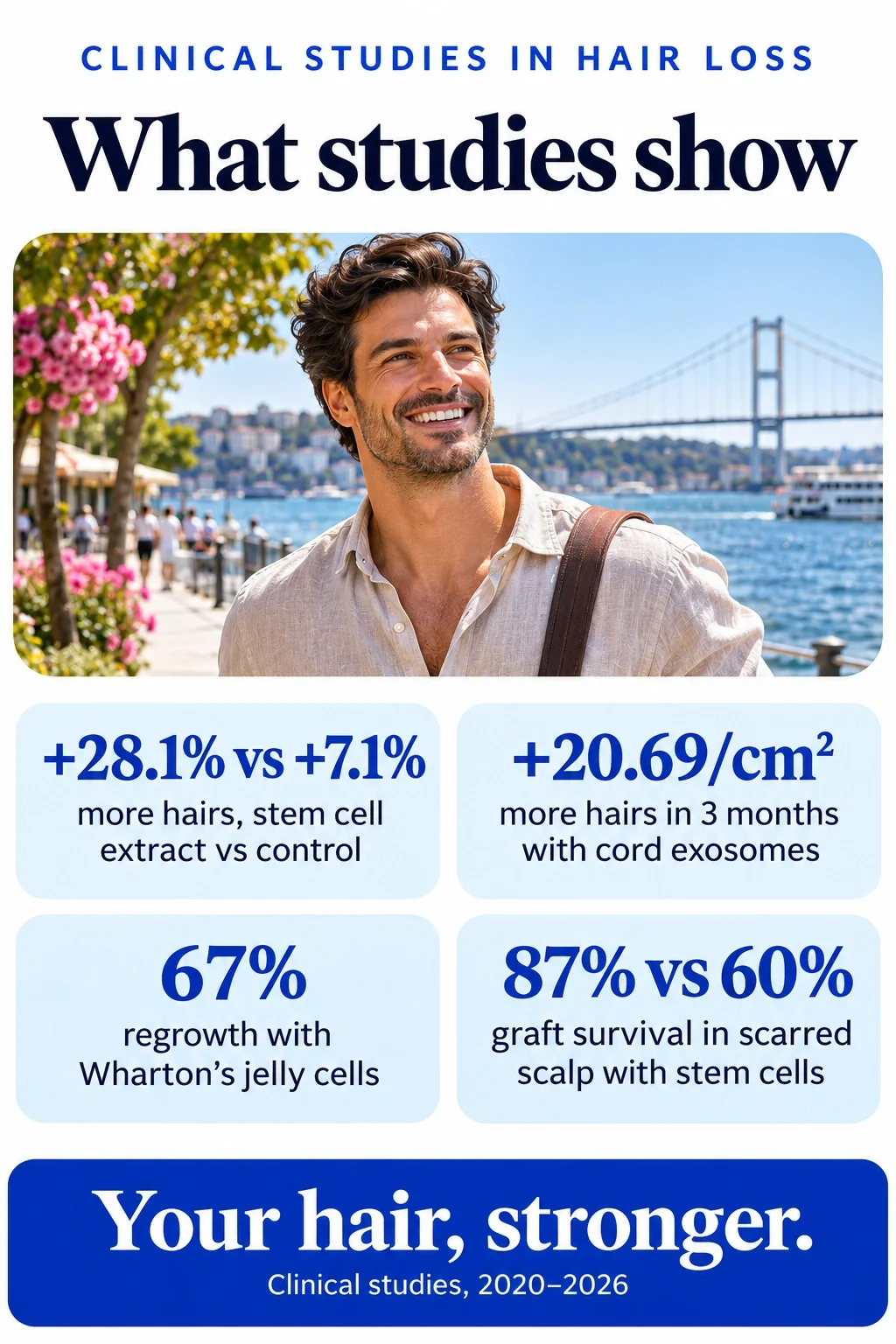
- +28.1% vs +7.1%more hairs at 16 weeks with a stem-cell-based treatment than with the control, in a double-blind trial7
- +20.69/cm²hairs in three months with umbilical cord stem cell exosomes, in men and women3
- 67%average regrowth after one injection of Wharton’s jelly stem cells in alopecia areata4
- 87% vs 60%graft survival when stem cells prepared scarred scalp before a transplant, against a transplant alone10
02
How does a hair transplant work, and who is it best for?
A hair transplant is one of the great success stories of aesthetic medicine, and Turkey has done a great deal to make it available to people from all over the world. It rests on a simple, elegant principle called donor dominance: hair from the back and sides of the head resists the hormone signals behind pattern hair loss, and it keeps that resistance after it is moved to a new place.1
FUE and FUT
Surgeons use two main techniques, and both are considered state of the art.1 In follicular unit extraction (FUE), small groups of one to four hairs are taken out one by one from the donor area. In follicular unit transplantation (FUT), a thin strip of scalp is removed and divided into grafts under the microscope. The grafts are then placed in tiny openings in the thinning or bald area, following a carefully designed hairline.
What transplants achieve
The results are impressive. In a meta-analysis of surgical hair restoration studies, pooled graft survival in pattern hair loss ranged from 84.98% to 93.11%, and patient satisfaction from 89.70% to 97.00%.5 In a prospective study of 48 people treated with FUE, quality of life and life satisfaction improved after the procedure, and stress and anxiety scores fell.6 Thoughtful hairline design and the medical care that now accompanies surgery have made results more natural and longer-lasting than ever.1
What a transplant does not do on its own
Transplants have two natural limits, and knowing them helps you plan well. First, the donor area is a fixed bank of hair: every graft moved is one fewer at the back, so the supply has to be used wisely over a lifetime. Second, a transplant relocates hair but does not change what is happening to the native hair around it. Pattern hair loss is gradual, so the surrounding hair can keep thinning after surgery.
That is why surgeons now pair transplants with ongoing medical care to maintain density,1 and why, in 751 women treated with FUT over 31 years, 18% chose a second session an average of four years later as their pattern hair loss progressed.15 This is exactly where stem cells and exosomes come in: they work on the hair that a transplant leaves in place.
03
How does stem cell hair treatment work? Strengthening the hair you still have
In pattern hair loss, follicles do not simply die. They gradually shrink, a process called miniaturisation, and each growth phase becomes shorter, so every new hair grows back a little finer and shorter than the last.16 The hopeful part of that process is that a shrinking follicle is still alive, and it still responds to the right signals.
Mesenchymal stem cells (MSCs) are rich sources of those signals. They do not turn into new hairs themselves. Instead, they release growth factors such as VEGF, IGF-1 and HGF, together with exosomes, that support the blood supply around the follicle, activate the dermal papilla at its base and move more follicles into the growing phase.13 Exosomes are tiny packages of these signals, with no living cells inside, so they deliver a concentrated dose straight to the follicles.
How stem cells and exosomes support thinning hair
How Wharton’s jelly stem cells and exosomes support hair follicles
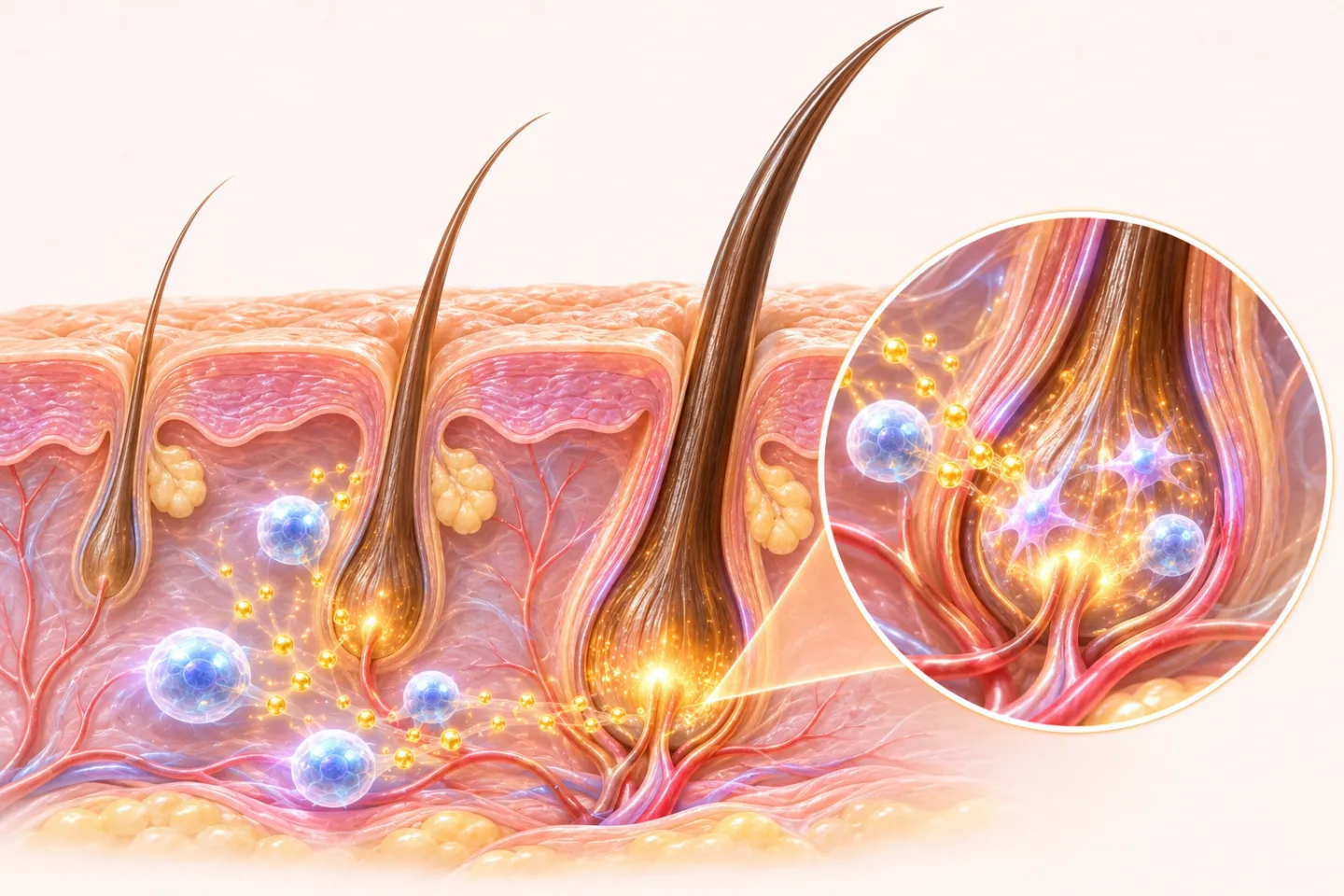
- Thinning follicleIn pattern hair loss, follicles shrink and grow finer, shorter hairs.
- Stem cellsWharton’s jelly MSCs release growth factors that support the follicles around them.
- Strengthening follicleThe aim: follicles that return to the growth phase and grow thicker hair.
- ExosomesTiny vesicles carry growth signals to the follicles, injected into the scalp or applied after microneedling.
- Healthy follicleA large bulb with a rich blood supply grows a thick, long hair.
- Active bulb cellsClose-up: golden exosomes reach the active cells at the base of the follicle (the dermal papilla).
Growth factors and blood supply
Wharton’s jelly stem cells express more of the secreted factors that build small blood vessels than bone marrow stem cells, and in laboratory studies they helped vessel-lining cells form more small vessels.18 In research models, umbilical cord stem cell secretions rich in VEGF, IGF-1, KGF and HGF promoted hair regrowth and new blood vessels in the skin.19
Waking up the dermal papilla
The dermal papilla is the control centre of each follicle. In laboratory studies, stem cell vesicles switched on its Wnt/β-catenin pathway, a master signal for hair growth, and lengthened hairs in human follicles grown in culture.20
A longer growth phase
In 40 patients, monthly stem-cell-based scalp treatments significantly increased the share of hairs in the active growth (anagen) phase, together with hair density and the thickness of the supporting dermis.14
Umbilical cord cells in pattern hair loss
In research models of pattern hair loss, umbilical cord stem cells injected into the skin increased follicle density and skin thickness and activated the growth phase,21 and umbilical cord stem cell exosomes enlarged shrunken follicles and moved them back into growth.17
A calmer scalp
In women with pattern hair loss, scalp biopsies after stem cell injections showed less inflammation around the follicles, more of the growth signal follistatin and less of the hair-cycle brake DKK-1.22
Protection from hair-loss signals
In laboratory studies, stem cell secretions protected dermal papilla cells from androgen and oxidative damage, two of the main drivers of pattern hair loss.23
A transplant changes where hair grows; these effects change how well it grows. That is why the two fit together so naturally, as our hair restoration page explains for the treatment itself.
04
Why Wharton’s jelly stem cells and exosomes for hair?
Wharton’s jelly is the soft, protective jelly around the blood vessels of the umbilical cord. Our stem cells come from cords donated after healthy births, so nothing is taken from your body: no fat harvest, no liposuction and no strip of scalp. They are young, active cells, and they lead every hair plan we make, together with the exosomes released by the very same cells.
Wharton’s jelly stem cells and hair regrowth
The most direct evidence for our cell type comes from alopecia areata, the patchy hair loss caused by the immune system. In a published study, four patients received a single intradermal injection of donor Wharton’s jelly stem cells, the same type of cells we use, into their bald patches. Every patient regrew hair, by 67% on average at the injected sites over 24 weeks, with the fastest gains in the first three months (52.2% on average). The treatment was found to be safe, and none of the patients reported side effects.4
Umbilical cord exosomes thickened hair in men and women
Exosomes from umbilical cord stem cells, the same source tissue as ours, have now been tested in people with pattern hair loss. In 22 adults, 10 men and 12 women, microneedling sessions with umbilical cord stem cell exosomes over three months increased local hair density by 20.69 hairs per cm² and hair thickness by 7.32 µm. The share of strong, terminal hairs rose by 7.85% while fine vellus hairs fell by 13.77%, and dermatologists scoring the photographs blind rated 15 of the 22 people as moderately to markedly improved.3
The same research group tested a cell-free solution made from umbilical cord stem cell secretions in 19 adults with thinning hair, nine men and ten women. Applied to the scalp three times a week for three months, it increased hair density by 6.96 hairs per cm² and hair thickness by 6.11 µm; 16 of the 19 showed moderate or marked improvement, with no adverse reactions on the scalp.24 In a double-blind, placebo-controlled study of a solution made from umbilical cord blood stem cell secretions, hair density, thickness and growth rate all increased,25 and in a pilot study of umbilical cord stem cell secretions, 86.6% of the volunteers experienced a positive hair-regrowth effect.26
Why young cord cells
Wharton’s jelly stem cells release a particularly rich mix of signals. When researchers compared the proteins secreted by stem cells from four sources, the secretome of Wharton’s jelly cells had a more diverse composition than that of fat or bone marrow cells.27 They also carry very few of the markers that trigger rejection, so no donor matching is needed.28 And because they come from a newborn’s cord, their quality does not depend on your own age or health, unlike treatments made from your own fat or blood.
Wharton’s jelly and umbilical cord cells in numbers
- 67%average regrowth at the treated patches after one injection of Wharton’s jelly stem cells, with regrowth in every patient4
- +7.32 µmthicker hairs in three months with umbilical cord stem cell exosomes, alongside 20.69 more hairs per cm²3
- 16 of 19adults improved moderately or markedly with umbilical cord stem cell secretions on the scalp24
- 6 vs 20 weeksaverage healing time for diabetic foot ulcers with Wharton’s jelly exosomes, against standard care, in a randomised trial29
Wharton’s jelly exosomes work in people
In a randomised trial in 110 people with diabetic foot ulcers, wounds treated with Wharton’s jelly exosomes healed in 6 weeks on average, against 20 weeks with standard care alone, a clear sign of how strongly these exosomes support skin repair.29
Built for blood supply
Healthy follicles depend on a rich network of tiny blood vessels. Wharton’s jelly stem cells express more of the secreted factors that grow new vessels than bone marrow cells.18
Fresh, never frozen
Our cells are prepared for your date in a Ministry of Health-approved GMP laboratory and never frozen. In laboratory comparisons, fresh MSCs kept stronger immune-calming properties than cells used straight after thawing.30
No harvest, no donor matching
Nothing is taken from your body, and Wharton’s jelly cells need no donor matching.28 That keeps your treatment day simple: no liposuction, no scalp strip and no second wound to heal.
Umbilical cord stem cells alongside
Umbilical cord stem cells, the second cell type in our plans, add their own growth signals; in research models of pattern hair loss, they increased follicle density and activated the growth phase.21
CD34+ exosomes as an extra
Your plan can also include CD34+ exosomes, which in research models carry strong signals for growing new small blood vessels.31
Why we combine cells and exosomes. Stem cells stay in the scalp and keep releasing growth signals over time; exosomes deliver a concentrated dose of those signals at once. That is why our doctors pair Wharton’s jelly stem cells with Wharton’s jelly exosomes in almost every hair plan, with umbilical cord stem cells and CD34+ exosomes added where they help. Read more on our exosome therapy page and our stem cell hair treatment page.
05
Does stem cell hair treatment work? What clinical studies report
Stem-cell-based hair treatments have now been studied in randomised trials, controlled half-head studies and meta-analyses. Here is what they report, with the cell source each study used. The Wharton’s jelly and umbilical cord studies are described in the section above.
Randomised and controlled trials
In a randomised, double-blind trial in 38 people with pattern hair loss, a topical extract of adipose (fat-derived) stem cells increased hair count by 28.1% after 16 weeks, against 7.1% in the control group, and hair thickness by 14.2% against 6.3%. The extra growth was already visible at week 8.7
In a randomised, placebo-controlled, half-head study of 27 men and women, micrografts containing hair follicle stem cells from the patients’ own scalp increased hair density by 23.3 hairs per cm² on the treated side, while the untreated side changed by −0.7, with the benefit still measured 58 weeks after treatment.32 In a half-side comparison of stem cell secretions in men and women, hair numbers rose significantly more on the treated side than on the placebo side.33
What the reviews of all the trials say
- Ten clinical trials. In a 2024 meta-analysis, stem-cell-derived treatments increased hair density by 14.93 hairs per cm² and hair thickness by 18.67 µm, and longer treatment courses gave significantly greater improvement.2
- Twelve randomised trials. A systematic review concluded that both cellular and cell-free stem cell therapies are safe and effective in improving hair regeneration and density in pattern hair loss.34
- Thirteen exosome studies. A 2026 meta-analysis found that exosome treatments increased hair density by 23.6% and hair thickness by 18.0% on average.35
| Study | Design and people | Cells and route | What improved |
|---|---|---|---|
| Czarnecka 2021, Adv Clin Exp Med4 | Case series; 4 people with alopecia areata | Donor Wharton’s jelly stem cells, one intradermal injection | Regrowth in every patient, 67% on average at 24 weeks |
| Chen 2026, J Nanobiotechnology3 | Clinical study; 22 men and women with pattern hair loss | Umbilical cord stem cell exosomes with microneedling | Density +20.69 hairs/cm², thickness +7.32 µm at 3 months |
| Zhang 2025, Stem Cell Res Ther24 | Clinical study; 19 men and women | Umbilical cord stem cell secretions, on the scalp | 16 of 19 moderately or markedly improved at 3 months |
| Tak 2020, Stem Cells Transl Med7 | Randomised, double-blind; 38 people | Adipose stem cell extract, on the scalp | Hair count +28.1% vs +7.1% at 16 weeks |
| Gentile 2020, Biomed Res Int32 | Randomised, half-head, placebo-controlled; 27 people | Own hair follicle stem cell micrografts, injected | +23.3 vs −0.7 hairs/cm², still measured at 58 weeks |
| Shin 2015, Int J Dermatol12 | Case series; 27 women | Adipose stem cell secretions | Density 105.4 → 122.7 hairs/cm² at 12 weeks |
| Ersan 2024, Aesthetic Plast Surg36 | Prospective; 30 men, Istanbul | Foreskin-derived stromal cell exosomes, scalp injections | Density up significantly at 4 and 12 weeks |
| Wan 2025, Aesthetic Plast Surg37 | Prospective; 16 men | Exosomes after microneedling | +35 hairs/cm² at 12 months; improvement in every patient |
Each study used its own cells and routes. Your treatment uses fresh Wharton’s jelly and umbilical cord stem cells and Wharton’s jelly exosomes, prepared for your date. Read how we put this evidence into practice on our stem cell hair treatment page.
06
Exosome hair treatment: what it is and what the studies show
Exosome hair treatment is the cell-free side of regenerative hair care, and for many people it is the most natural hair loss treatment without surgery to start with. Exosomes are tiny vesicles, far smaller than a cell, that stem cells release to pass growth instructions to other cells. They carry proteins and microRNAs that, in laboratory studies, switch on the dermal papilla and its Wnt/β-catenin hair-growth pathway.3820
What studies in people report
- Across 13 hair studies, exosome treatments increased hair density by 23.6% and thickness by 18.0% on average.35 A review of 11 clinical studies found gains of 9.5 to 35 hairs per cm², with no serious adverse events.39
- In Istanbul, researchers at Yeditepe University gave 30 men one session of scalp injections with exosomes from foreskin-derived stromal cells. Hair density rose significantly at 4 and 12 weeks, satisfaction grew over the study, and no complications were observed.36
- Adipose stem cell exosomes significantly increased total hair density over 24 weeks in 30 people with pattern hair loss, with better photographs and higher satisfaction.38
- Men and women together. In 30 adults, 15 men and 15 women, four sessions of a stem cell exosome complex after radiofrequency microneedling increased hair counts and reduced shedding, and investigators rated hair quality improved in 97% and hair growth in 83%.40
- Umbilical cord exosomes, from the same source tissue as ours, increased density by 20.69 hairs per cm² in three months in 22 men and women.3
How exosomes are given for hair
For the scalp, exosomes are placed with tiny, shallow subdermal and intradermal injections, or applied straight after microneedling or a laser session, which opens thousands of fine channels so that they reach the follicles. Your doctor chooses the route, or a combination, for your hair. You can see all 21 routes on our exosome therapy page.
Medical exosomes are not the same as the cosmetic serums sold as “exosomes”, some of which are made from plants. Ours are Wharton’s jelly MSC exosomes, prepared for your treatment date in a Ministry of Health-approved GMP laboratory.

07
Hair transplant alternative in Turkey: which option is right for you?
The best choice depends on where you are on your hair journey, how much donor hair you have and what you would like to achieve. This is how our doctors think about it.
Stem cells and exosomes shine when…
- Your hair is thinning but still there, in the early or middle stages of hair loss
- You are a woman with diffuse thinning across the top of the head
- You are not a transplant candidate, or you would rather avoid surgery for now
- You want thicker, stronger hair from the follicles you already have
- You have patchy hair loss from alopecia areata
- You want to protect and thicken the hair around a past or planned transplant
A hair transplant shines when…
- An area such as the crown or the front hairline has been bald for a long time
- You have a strong, dense donor area at the back and sides of the head
- Your pattern of hair loss has settled
- You want a new hairline where no follicles are left
- You are happy to have surgery and allow time for healing
When both together give the best result
For many people, especially men with a bald crown and thinning hair around it, the strongest plan uses both. Regenerative treatment protects and thickens the native hair, and the transplant fills the bald area. Because pattern hair loss is gradual, strengthening your own hair also helps you and your surgeon use the donor bank wisely.1
Why starting with stem cells can make sense
A non-surgical treatment is a gentle way to see how much your existing follicles can give back. Studies measured clear gains within three to four months,73 so you can decide about surgery later, with a fuller head of hair to work with. And if a transplant is not an option for you, for example because your donor area is thin or your hair loss is diffuse, regenerative treatment offers a positive way forward: in 140 men and women, a single session of cellular micrografts increased hair density in every region of the scalp.41
08
Exosomes and stem cells after a hair transplant, and before one
Whether you are planning a transplant in Turkey or at home, or have already had one, regenerative treatment can be a valuable partner. Surgeons increasingly treat added medical care as part of a modern transplant plan, because it helps maintain density around the new grafts.1
What studies of add-on treatments show
- Stem cells before surgery. In 60 people with scalp scars, injecting their own adipose stem cells into the scarred area four weeks before FUE raised graft survival to 87%, against 60% with FUE alone, increased hair density by 45% against 25%, and lifted satisfaction scores from 6.0 to 8.5 out of 10. Biopsies showed 70% more new blood vessels and 50% less scar tissue.10
- Growth factors around surgery. In a systematic review of three controlled studies with 217 people, adding platelet-rich plasma (PRP) to a transplant was linked with higher hair density, better follicle survival and earlier growth.8 In a randomised study of 30 people, PRP alongside medical treatment improved follicle survival, growth rate and hair strength after FUE.9 In another randomised study of 60 men, every patient given PRP during surgery reached at least 75% regrowth at six months, against 12 of 30 without it, and scalp redness settled sooner, in 24 days against 36.42
Where Wharton’s jelly exosomes fit
Exosomes carry the same kinds of growth signals that make these add-ons work, in a concentrated, cell-free form: signals for new small blood vessels, for the dermal papilla and for the growth phase.1318 That is why our doctors use Wharton’s jelly exosomes and stem cells around a transplant for three goals:
- Before surgery, to prepare the scalp and strengthen the hair around the planned area.
- After surgery, once your scalp has healed and your surgeon agrees, to support the new grafts and the native hair between them.
- In the years that follow, to keep the native hair thick, so your result stays full as time goes on.
We plan the timing with you and, if you wish, with your hair surgeon. For the treatment itself, see our hair restoration page.
09
Female hair loss: what stem cells and exosomes offer women
Pattern hair loss affects nearly half of all women at some point in their lives, and its emotional impact often exceeds that seen in men.16 It usually looks different, too: rather than a receding hairline or a bald crown, women tend to notice a widening parting and diffuse thinning across the top of the head and the temples.11
That pattern shapes the choice of treatment. Transplants can help women, and a well-chosen technique gives excellent results,15 but diffuse thinning leaves fewer clearly defined areas to fill and calls for careful use of the donor area.11 Strengthening the hair you already have is therefore often the natural first step, and it is exactly what regenerative treatment is designed to do.
What studies in women report
- In 27 women with pattern hair loss, stem cell secretions increased hair density from 105.4 to 122.7 hairs per cm² and hair thickness from 57.5 to 64.0 µm within 12 weeks.12
- In a controlled trial in 33 women, stem cell injections improved hair count and thickness at 12 and 24 weeks, with more hairs per follicular unit and calmer, less inflamed follicles.22
- In a double-blind, placebo-controlled study that included mainly women, umbilical cord blood stem cell secretions increased hair density, thickness and growth rate.25
- Umbilical cord stem cell exosomes increased hair density in a group of 22 in which 12 were women,3 and in a study of exosomes after radiofrequency microneedling, the response did not depend on sex or on how advanced the hair loss was.43
Treatment is gentle: fine scalp injections, or exosomes after microneedling, with nothing taken from your body and no donor scar.
10
How long do exosome and stem cell hair results last?
Hair grows slowly, so results build up over months rather than days. In clinical studies, the first gains in hair count were visible from week 8,7 clear improvements in density and thickness were measured at three months,324 and benefits were still present a year and more after treatment.
Results that last
- 12 months: after exosomes with microneedling, hair density was 35 hairs per cm² higher on average at 12 months, with improvement in every patient, and 87% were satisfied or highly satisfied.37
- 58 weeks: in the randomised half-head study, the treated side still had 23.3 more hairs per cm² than at the start, while the untreated side had slightly fewer.32
- Nine months and beyond: in 20 people followed for a median of 10 months after exosome treatment, hair density and thickness were significantly higher at 3, 6 and 9 months.43
Pattern hair loss is a lifelong tendency, so the aim is to build your result and then keep it. In a meta-analysis of clinical trials, longer treatment courses gave greater improvement,2 which is why many people choose a top-up session; we plan the timing with you at your follow-up reviews, using photos taken under the same conditions each time.
- 8 weeksFirst changesMore hairs visible in trials
- 3 monthsThicker hairClear gains in density and thickness
- 6 monthsFuller lookResults keep building
- 12 monthsLasting benefitStill measured at a year and beyond
- Top-upKeep it goingA top-up builds on your result
11
Muse cells and Muse exosomes: an optional add-on
Muse cells, short for multilineage-differentiating stress-enduring cells, are a small group of especially hardy repair cells within the MSC family, discovered in Japan in 2010.44 Donor Muse cells have been given without tissue matching or immune-suppressing medicines,45 and in a randomised trial in stroke, 40.0% of patients given one IV dose of a donor Muse cell product could look after their own affairs at 12 weeks, against 10.0% with placebo.46
For skin and hair, the research so far comes from the laboratory: Muse cells from human skin readily became pigment-making melanocytes,47 and in diabetic mice, Muse-rich cells healed skin ulcers faster.48 Muse exosomes carry the cells’ signals in cell-free form.49
If your hair treatment is part of a wider regenerative or longevity plan, Muse cells can be added by IV infusion, and Muse exosomes by IV infusion or with your scalp exosomes. Your Wharton’s jelly stem cells and exosomes remain the core of your plan.
12
PRP vs exosomes vs stem cells vs a transplant: the options compared
Every treatment for hair loss has its place, and the strongest plans often combine several. Before the table, a word on the options people ask about most.
Medicines
Minoxidil and finasteride help many people. In a meta-analysis of randomised trials, minoxidil, finasteride and low-level laser therapy all outperformed placebo in men, and minoxidil worked well in women.50 They are used every day, and regenerative treatment can be added alongside them.
PRP vs exosomes for hair
Platelet-rich plasma (PRP) uses growth factors from your own blood. Across 11 randomised trials, PRP injections increased hair follicle numbers, hair thickness and density compared with placebo, and patients reported high satisfaction.51 Exosomes from young umbilical cord stem cells bring a broader package of growth factors and microRNAs that does not depend on your own age or health. In a head-to-head study on facial skin, stem cell exosomes did as well as PRP,52 and across hair studies, exosomes increased density by 23.6% on average.35 The two can also be combined; our doctors advise which suits you.
| Option | How it helps | Best for | How it is given |
|---|---|---|---|
| Wharton’s jelly stem cells and exosomes | Growth signals that aim to wake thinning follicles; Wharton’s jelly cells regrew hair in every alopecia areata patient,4 and umbilical cord exosomes added 20.69 hairs/cm² in 3 months3 | Early to moderate thinning, women, people who are not transplant candidates, and support around a transplant | Fine scalp injections or exosomes after microneedling, in one treatment day |
| Umbilical cord stem cells | Umbilical cord stem cell secretions improved hair in 16 of 19 adults24 | Added to Wharton’s jelly cells where the doctor advises | The same scalp routes, in the same treatment day |
| Hair transplant (FUE or FUT) | Moves resistant donor hair; graft survival 84.98% to 93.11% across studies5 | Long-standing bald areas with a good donor area | A surgical procedure in a hair clinic |
| PRP | More follicles and thicker, denser hair than placebo across 11 randomised trials51 | Mild to moderate thinning; also used around transplants | Injections of your own concentrated platelets, usually as a series |
| Minoxidil and finasteride | Better than placebo in randomised trials50 | Daily maintenance | Daily foam, solution or tablet |
| Low-level laser therapy | Better than placebo in men in randomised trials50 | Support at home | A cap or comb used regularly at home |
These options add up rather than compete. Many of our patients continue their usual medicines, and some go on to a transplant with a fuller head of native hair. Read more on our hair restoration page.
13
Is stem cell hair treatment safe?
Safety comes first, and the published record is reassuring. A 2021 meta-analysis of 62 randomised trials with 3,546 patients found MSC treatment safe, the most common effect a passing fever.53
The hair studies point the same way. Wharton’s jelly stem cells in alopecia areata were found safe,4 umbilical cord stem cell secretions caused no adverse reactions on the scalp,24 and the Istanbul exosome study observed no complications.36 Reviews of stem cell and exosome hair studies reported no severe or serious adverse events,5439 and a review of 14 studies in pattern hair loss found no major side effects.55 When people notice anything, it is mild scalp tenderness, which settled within 48 hours in one study.37
Your own care adds further layers. Nothing is taken from your body, so there is no harvest wound and no donor scar. Wharton’s jelly cells need no donor matching,28 your cells are prepared in a Ministry of Health-approved GMP laboratory with certified count and viability, and Dr. Cihan Bolat, a specialist in anaesthesiology and reanimation, plans your comfort for the scalp injections. We screen carefully beforehand, and a specialist team treats you.
14
Why patients travel to Istanbul, Turkey for stem cell hair treatment
Istanbul is one of the best-known cities in the world for hair restoration. People come from the UK, Germany, the Netherlands, across Europe, the Middle East and the Gulf, the USA and beyond, many of them for transplants. More and more now come for the regenerative side too: fresh Wharton’s jelly stem cells and exosomes, given by a specialist team in one treatment day, as a hair transplant alternative or as its partner.

A specialist-led plan
A free medical review and phone consultation with the specialist team led by Uzm. Dr. Cihan Bolat, and a written plan before you book.
A fixed price before you travel
One all-inclusive price in writing, so you can decide calmly at home.
One treatment day
Most plans take one treatment day in Istanbul, with no second trip needed.
Help at every step
Help with the hotel, ground transport and translation, and a personal case manager who plans your stay with you.
Easy to reach
Istanbul has two international airports, with direct flights from many cities in Europe, the Middle East and beyond.
Follow-up from home
Reviews at about 1, 3, 6 and 12 months, with photos you send from home, so your care continues after you fly back.
Combining your visit
If you are having a transplant in Istanbul, we can plan your regenerative treatment around it, with the timing agreed with your surgeon. Our clinic is in Suadiye, a calm residential district on Istanbul’s Asian side near the Marmara seafront. After your treatment day, the city is yours to enjoy: a Bosphorus ferry, a walk along the shore or a long Turkish breakfast.
15
Your treatment in Istanbul, step by step
From your first message to follow-up at home, every step is planned with you in advance, whether you are travelling from London, Berlin, Amsterdam, Dubai or New York. For the fuller story, read the stem cell treatment in Turkey, step by step, or request your free consultation now.
Send us your photos and history
Share clear photos of your hairline, crown and the back of your head, tell us how your hair loss developed and which treatments or transplants you have had, through our free consultation request or by WhatsApp on +90 534 856 92 92.
Free medical review and phone call
Dr. Cihan Bolat and his specialist team review your case free of charge and talk it through with you.
Your written plan and fixed price
If treatment is a good fit, you receive a written plan with the cell count, the exosomes and the routes, and a fixed, all-inclusive price before you travel.
One treatment day in Istanbul
Fresh stem cells and exosomes are prepared for your date. Our driver brings you to the clinic, where the team gives your scalp treatment calmly and comfortably, and takes you back afterwards.
Home and follow-up
Back home, we review your progress with photos at about 1, 3, 6 and 12 months and plan a top-up session if you wish.
16
How much does stem cell hair treatment cost in Turkey?
Every plan is personal, so the price depends on the number of stem cells, the exosomes and the routes in your plan, for example scalp injections alone or combined with exosomes after microneedling, and on whether you choose a top-up session. After the free medical review, you receive a fixed, all-inclusive price in writing before you book anything, so there are no surprises.
When you compare options, compare what each one does. A transplant pays for surgery and the moving of grafts; regenerative treatment pays for the young cells and exosomes that work on the hair you already have. For many people the two belong in the same plan, at different times.
Included
- Free medical review and phone consultation
- Fresh Wharton’s jelly and umbilical cord stem cells, with certified count and viability
- Wharton’s jelly exosomes, and CD34+ exosomes if they are in your plan
- Your scalp treatment by our specialist team in one treatment day
- Ground transport to and from the clinic, and help with translation
- A personal case manager and follow-up reviews
Not included / optional
- Flights
- Hotel stay, which we can help you arrange
- A hair transplant, if you choose one
- Your usual medicines at home
- A top-up session, if you decide on one later
Read why patients choose Turkey for stem cell therapy, or see the full treatment on our hair restoration page.
17
Frequently asked questions
Is stem cell hair treatment better than a hair transplant?
They do different jobs, so neither is simply better. A transplant moves strong follicles from the back of your head to areas that are bald, and across surgical studies about 85% to 93% of grafts survived. Stem cell hair treatment strengthens the thinning hair you still have: in a double-blind trial, hair count rose by 28.1% against 7.1% with the control. Many people do best with both.
Is there a hair transplant alternative without surgery?
Yes. Stem cell and exosome hair treatment uses fine scalp injections, or exosomes applied after microneedling, with no cuts, stitches or donor scar. It works best where hair is thinning but the follicles are still present. In one study, umbilical cord stem cell exosomes increased hair density by 20.69 hairs per square centimetre in three months, in men and women.
Can stem cells regrow hair on a completely bald scalp?
Stem cell treatment works on living follicles, so it gives the best results where hair is thinning rather than gone. For areas that have been bald for many years, a transplant is the right tool, and stem cells and exosomes can support the hair around it.
What is exosome hair treatment?
Exosomes are tiny packages of growth signals released by stem cells, with no living cells inside. Placed in the scalp, they aim to activate each follicle’s control centre and lengthen the growth phase. Across 13 hair studies, exosome treatments increased hair density by 23.6% and thickness by 18.0% on average. We use Wharton’s jelly MSC exosomes, prepared in a GMP laboratory.
PRP vs exosomes for hair: which is better?
Both can help. PRP uses growth factors from your own blood, and across 11 randomised trials it increased hair density and thickness compared with placebo. Exosomes from young umbilical cord stem cells carry a broader package of growth factors and microRNAs that does not depend on your own age or health. Our doctors advise which suits you, and the two can be combined.
Can I have exosomes after a hair transplant?
Yes, many people add regenerative treatment around a transplant. In studies, add-on treatments were linked with better follicle survival and earlier growth, and stem cells placed in scarred scalp before surgery raised graft survival from 60% to 87%. We time exosome and stem cell treatment once your scalp has healed and in agreement with your surgeon, to support the new grafts and the native hair around them.
Should I have stem cell treatment before or after a hair transplant?
Both can help. Before surgery, treatment aims to prepare the scalp and strengthen the hair around the area to be transplanted; after surgery, it supports the grafts and the native hair between them. Starting first also shows how much your own follicles can give back, which helps you and your surgeon plan.
Does stem cell hair treatment work for women?
Yes, and it suits many women especially well, because female thinning is usually spread across the top of the head. In 27 women with pattern hair loss, stem cell secretions raised hair density from 105.4 to 122.7 hairs per square centimetre in 12 weeks, and exosome studies that included many women reported similar gains.
How long do exosome hair results last?
In studies, results were still present a year and more later: hair density was 35 hairs per square centimetre higher 12 months after exosome treatment, and the benefit of stem cell micrografts was still measured at 58 weeks. Pattern hair loss continues over time, so many people choose a top-up session to keep their result.
How many sessions of stem cell or exosome hair treatment will I need?
Most plans start with one treatment day in Istanbul. Clinical trials found that longer treatment courses gave greater improvement, so your plan can include a top-up session, and we advise you on the timing at your follow-up reviews at about 1, 3, 6 and 12 months.
Is stem cell hair treatment safe? What are the side effects?
The published record is reassuring. A meta-analysis of 62 randomised trials with 3,546 patients found MSC treatment safe, and reviews of hair studies found no serious adverse events. When people notice anything, it is mild scalp tenderness that usually settles within a day or two.
Does stem cell hair treatment hurt, and is there any downtime?
It uses fine scalp injections, or exosomes after microneedling, with no cuts, no stitches and no donor area to heal. Dr. Cihan Bolat, a specialist in anaesthesiology, plans your comfort with you, and any mild scalp tenderness usually settles within a day or two.
Who is a good candidate for stem cell hair treatment?
Good candidates are men and women with thinning hair whose follicles are still present, women with diffuse thinning, people with alopecia areata, people who are not transplant candidates or would rather avoid surgery, and people who want to support a past or planned transplant. Our medical team reviews your photos and history free of charge.
Does stem cell therapy work for alopecia areata?
In a published study, one injection of Wharton’s jelly stem cells, the same type of cells we use, was followed by regrowth in every patient with alopecia areata, 67% on average at the treated patches by 24 weeks.
How much does stem cell hair treatment cost in Turkey?
The price depends on the number of stem cells, the exosomes and the routes in your plan, and on whether you choose a top-up. After a free review you receive a fixed, all-inclusive price in writing, covering the treatment, fresh cells with certified count and viability, transport to and from the clinic, a case manager and follow-up reviews. Flights and the hotel are separate.
Why do people travel to Istanbul for stem cell hair treatment?
Istanbul combines world-famous hair restoration experience with easy flights from Europe, the Middle East and beyond. With us you receive a free review, a written plan with a fixed price, one treatment day with fresh Wharton’s jelly stem cells and exosomes, help with your stay, and follow-up from home. You can reach us on WhatsApp at +90 534 856 92 92.
Where do the stem cells come from?
We use fresh mesenchymal stem cells from Wharton’s jelly and umbilical cord tissue, from cords donated after healthy births. Nothing is taken from your body, no donor matching is needed, and the cells are prepared fresh for your date in a Ministry of Health-approved GMP laboratory and never frozen.
Medical review
Uzm. Dr. Cihan Bolat
Medical Director, Istanbul Stemcell
This page was written from the published studies listed below and reviewed for medical accuracy on .
18
References
- Queen D, Avram MR. Hair Transplantation: State of the Art. Dermatol Surg. 2025;51(9):874-881. PMID 40354670
- Chien WY, et al. Stem cell-derived conditioned medium for alopecia: A systematic review and meta-analysis. J Plast Reconstr Aesthet Surg. 2024;88:182-192. PMID 37983981
- Chen Q, et al. hUC-MSC-exosomes deliver Let-7b/7f-5p to dermal papilla cells for a multi-target synergistic treatment of androgenetic alopecia. J Nanobiotechnology. 2026;24(1). PMID 42363148
- Czarnecka A, et al. Wharton's jelly-derived mesenchymal stem cells in the treatment of four patients with alopecia areata. Adv Clin Exp Med. 2021;30(2):211-218. PMID 33636057
- Stoneburner J, et al. Contemporary Management of Alopecia: A Systematic Review and Meta-analysis for Surgeons. Aesthetic Plast Surg. 2020;44(1):97-113. PMID 31667549
- Maletic A, et al. Impact of Hair Transplantation on Quality of Life. Aesthetic Plast Surg. 2024;48(9):1825-1830. PMID 38123846
- Tak YJ, et al. A randomized, double-blind, vehicle-controlled clinical study of hair regeneration using adipose-derived stem cell constituent extract in androgenetic alopecia. Stem Cells Transl Med. 2020;9(8):839-849. PMID 32420695
- Sindhusen S, Tawanwongsri W, Eden C. Efficacy of Platelet-Rich Plasma as an Adjunct to Hair Transplantation: A Systematic Review. Cureus. 2025;17(10):e94116. PMID 41069573
- Xue P, et al. A Prospective and Comparative Study to Explore the Effects of Platelet-Rich Plasma in Hair Transplantation for Patients With Androgenetic Alopecia. J Cosmet Dermatol. 2025;24(2):e16665. PMID 39555738
- Popescu FM, et al. Stem cell therapy prior to follicular unit hair transplantation on scarred tissue: a novel approach to a successful procedure. J Med Life. 2024;17(6):582-587. PMID 39296433
- Queen D, Avram MR. Hair Transplantation in Women. J Drugs Dermatol. 2025;24(9):851-855. PMID 40911748
- Shin H, et al. Clinical use of conditioned media of adipose tissue-derived stem cells in female pattern hair loss: a retrospective case series study. Int J Dermatol. 2015;54(6):730-5. PMID 25777970
- Widowati W, et al. Hair regeneration in alopecia using adipose-derived mesenchymal stem cells secretome: A systematic review of experimental and clinical evidence. Tissue Cell. 2026;104(Pt 2):103872. PMID 42628189
- Narita K, et al. Sequential Scalp Assessment in Hair Regeneration Therapy Using an Adipose-Derived Stem Cell-Conditioned Medium. Dermatol Surg. 2020;46(6):819-825. PMID 31490301
- Uebel CO, et al. Female Pattern Hair Loss: Why the Follicular Unit Transplantation Surgical Technique Remains a Good Option. Plast Reconstr Surg. 2021;147(4):839-849. PMID 33710162
- Kearney CA, et al. Androgenetic Alopecia in Women: A Narrative Review of Pathophysiology, Clinical Evaluation, and Treatments. Am J Clin Dermatol. 2026;27(2):363-389. PMID 41714473
- Yu A, et al. Human umbilical cord mesenchymal stem cell-derived exosomes enhance follicular regeneration in androgenetic alopecia via activation of Wnt/β-catenin pathway. Stem Cell Res Ther. 2025;16(1):418. PMID 40751216
- Hsieh JY, et al. Mesenchymal stem cells from human umbilical cord express preferentially secreted factors related to neuroprotection, neurogenesis, and angiogenesis. PLoS One. 2013;8(8):e72604. PMID 23991127
- Ni J, et al. Promotion of hair growth by a conditioned medium from human umbilical cord mesenchymal stem cells cultivated in a 3D scaffold of gelatin sponge. Eur J Med Res. 2024;29(1):270. PMID 38704575
- Rajendran RL, et al. Application of extracellular vesicles from mesenchymal stem cells promotes hair growth by regulating human dermal cells and follicles. World J Stem Cells. 2022;14(7):527-538. PMID 36157528
- Yan W, et al. Restoration of follicular β-catenin signaling by mesenchymal stem cells promotes hair growth in mice with androgenetic alopecia. Stem Cell Res Ther. 2024;15(1):439. PMID 39563459
- Moneib H, et al. Successful Treatment of Female Pattern Hair Loss with Injection of Autologous Adipose-derived Adult Stem Cells: A Controlled Clinical, Trichoscopic, and Immunohistochemical Trial. Int J Trichology. 2025;17(2):113-120. PMID 41306847
- Won CH, et al. The Basic Mechanism of Hair Growth Stimulation by Adipose-derived Stem Cells and Their Secretory Factors. Curr Stem Cell Res Ther. 2017;12(7):535-543. PMID 28875863
- Zhang Y, et al. The human umbilical cord-mesenchymal stem cell secretome regulates hair growth and cycle transition by promoting methylthioadenosine synthesis via the PI3K/AKT/mTOR pathway. Stem Cell Res Ther. 2025;16(1):692. PMID 41287018
- Oh HA, et al. Migration Inhibitory Factor in Conditioned Medium from Human Umbilical Cord Blood-Derived Mesenchymal Stromal Cells Stimulates Hair Growth. Cells. 2020;9(6). PMID 32481584
- Mathen C, Dsouza W. In vitro and clinical evaluation of umbilical cord-derived mesenchymal stromal cell-conditioned media for hair regeneration. J Cosmet Dermatol. 2022;21(2):740-749. PMID 33780589
- Shin S, et al. Comparative Proteomic Analysis of the Mesenchymal Stem Cells Secretome from Adipose, Bone Marrow, Placenta and Wharton's Jelly. Int J Mol Sci. 2021;22(2). PMID 33467726
- Weiss ML, et al. Immune properties of human umbilical cord Wharton's jelly-derived cells. Stem Cells. 2008;26(11):2865-74. PMID 18703664
- Kishta MS, et al. The transforming role of wharton's jelly mesenchymal stem cell-derived exosomes for diabetic foot ulcer healing: a randomized controlled clinical trial. Stem Cell Res Ther. 2025;16(1):559. PMID 41084065
- Moll G, et al. Do cryopreserved mesenchymal stromal cells display impaired immunomodulatory and therapeutic properties? Stem Cells. 2014;32(9):2430-42. PMID 24805247
- Mathiyalagan P, et al. Angiogenic Mechanisms of Human CD34(+) Stem Cell Exosomes in the Repair of Ischemic Hindlimb. Circ Res. 2017;120(9):1466-1476. PMID 28298297
- Gentile P, et al. Autologous Micrografts from Scalp Tissue: Trichoscopic and Long-Term Clinical Evaluation in Male and Female Androgenetic Alopecia. Biomed Res Int. 2020;2020:7397162. PMID 32071919
- Fukuoka H, Suga H. Hair Regeneration Treatment Using Adipose-Derived Stem Cell Conditioned Medium: Follow-up With Trichograms. Eplasty. 2015;15:e10. PMID 25834689
- Gasteratos K, Kouzounis K, Goverman J. Autologous Stem Cell-derived Therapies for Androgenetic Alopecia: A Systematic Review of Randomized Control Trials on Efficacy, Safety, and Outcomes. Plast Reconstr Surg Glob Open. 2024;12(2):e5606. PMID 38352219
- Stack ER, et al. Clinical Advances in Exosome-Based Therapies for Aesthetic Medicine: A Systematic Review and Meta-analysis of Human Clinical Trials. Aesthet Surg J. 2026;46(12 Suppl 2):S13-S25. PMID 41800726
- Ersan M, et al. Effectiveness of Exosome Treatment in Androgenetic Alopecia: Outcomes of a Prospective Study. Aesthetic Plast Surg. 2024;48(21):4262-4271. PMID 39174804
- Wan J, et al. A Prospective Study of Exosome Therapy for Androgenetic Alopecia. Aesthetic Plast Surg. 2025;49(11):3151-3156. PMID 40146273
- Lee E, et al. The efficacy of adipose stem cell-derived exosomes in hair regeneration based on a preclinical and clinical study. Int J Dermatol. 2024;63(9):1212-1220. PMID 39155501
- Al Ameer MA, et al. Exosomes and Hair Regeneration: A Systematic Review of Clinical Evidence Across Alopecia Types and Exosome Sources. Clin Cosmet Investig Dermatol. 2025;18:2215-2227. PMID 40955427
- Ablon G. An Exosome Regenerative Complex Plus Microneedling Promotes Hair Growth in Subjects With Self-Perceived Thinning Hair. J Drugs Dermatol. 2025;24(10):988-994. PMID 41037530
- Zari S. Short-Term Efficacy of Autologous Cellular Micrografts in Male and Female Androgenetic Alopecia: A Retrospective Cohort Study. Clin Cosmet Investig Dermatol. 2021;14:1725-1736. PMID 34824538
- Dawane PV, et al. Efficacy of Intraoperative Platelet-Rich Plasma in Follicular Unit Extraction Hair Transplantation: A Prospective Study. J Maxillofac Oral Surg. 2026;25(4):1166-1172. PMID 42528985
- Koumprentziotis IA, et al. Microneedling radiofrequency followed by topical exosome application therapy for pattern hair loss: A scoping review and prospective study. Clin Dermatol. 2025;43(5):742-751. PMID 40744280
- Kuroda Y, et al. Unique multipotent cells in adult human mesenchymal cell populations. Proc Natl Acad Sci U S A. 2010;107(19):8639-43. PMID 20421459
- Minatoguchi S, et al. Donor Muse Cell Treatment Without HLA-Matching Tests and Immunosuppressant Treatment. Stem Cells Transl Med. 2024;13(6):532-545. PMID 38560897
- Niizuma K, et al. Randomized placebo-controlled trial of CL2020, an allogenic muse cell-based product, in subacute ischemic stroke. J Cereb Blood Flow Metab. 2023;43(12):2029-2039. PMID 37756573
- Tsuchiyama K, et al. Functional melanocytes are readily reprogrammable from multilineage-differentiating stress-enduring (muse) cells, distinct stem cells in human fibroblasts. J Invest Dermatol. 2013;133(10):2425-2435. PMID 23563197
- Kinoshita K, et al. Therapeutic Potential of Adipose-Derived SSEA-3-Positive Muse Cells for Treating Diabetic Skin Ulcers. Stem Cells Transl Med. 2015;4(2):146-55. PMID 25561682
- Rajabi A, Bonyadi M. Muse Cell-Derived Exosomes: a Hypothesis for a Cell-Free Therapeutic Platform in Regenerative Medicine. Stem Cell Rev Rep. 2025;21(6):1860-1862. PMID 40531406
- Adil A, Godwin M. The effectiveness of treatments for androgenetic alopecia: A systematic review and meta-analysis. J Am Acad Dermatol. 2017;77(1):136-141.e5. PMID 28396101
- Papakonstantinou M, et al. Autologous Platelet-Rich Plasma Treatment for Androgenic Alopecia: A Systematic Review and Meta-Analysis of Clinical Trials. Plast Reconstr Surg. 2023;151(5):739e-747e. PMID 36729475
- Estupiñan B, Ly K, Goldberg DJ. Adipose Mesenchymal Stem Cell-Derived Exosomes Versus Platelet-Rich Plasma Treatment for Photoaged Facial Skin: An Investigator-Blinded, Split-Face, Non-Inferiority Trial. J Cosmet Dermatol. 2025;24(5):e70208. PMID 40414798
- Wang Y, Yi H, Song Y. The safety of MSC therapy over the past 15 years: a meta-analysis. Stem Cell Res Ther. 2021;12(1):545. PMID 34663461
- Kang BY, et al. The safety and efficacy of autologous adipose-derived stromal vascular fraction for nonscarring alopecia: A systematic review. Arch Dermatol Res. 2022;314(4):349-356. PMID 34014340
- Krefft-Trzciniecka K, et al. Human Stem Cell Use in Androgenetic Alopecia: A Systematic Review. Cells. 2023;12(6). PMID 36980291