01
Stem cell hair treatment: what it is and how it helps
Stem cell therapy for hair restoration uses fresh mesenchymal stem cells (MSCs) from Wharton’s jelly, the soft tissue of donated umbilical cords, together with the exosomes these cells release. Placed in the scalp, they act as a rich source of growth signals for the hair follicle: they support blood supply around the roots, activate the cells that drive hair growth and help keep hairs in their growth phase for longer.910
Thicker, fuller-looking hair without surgery
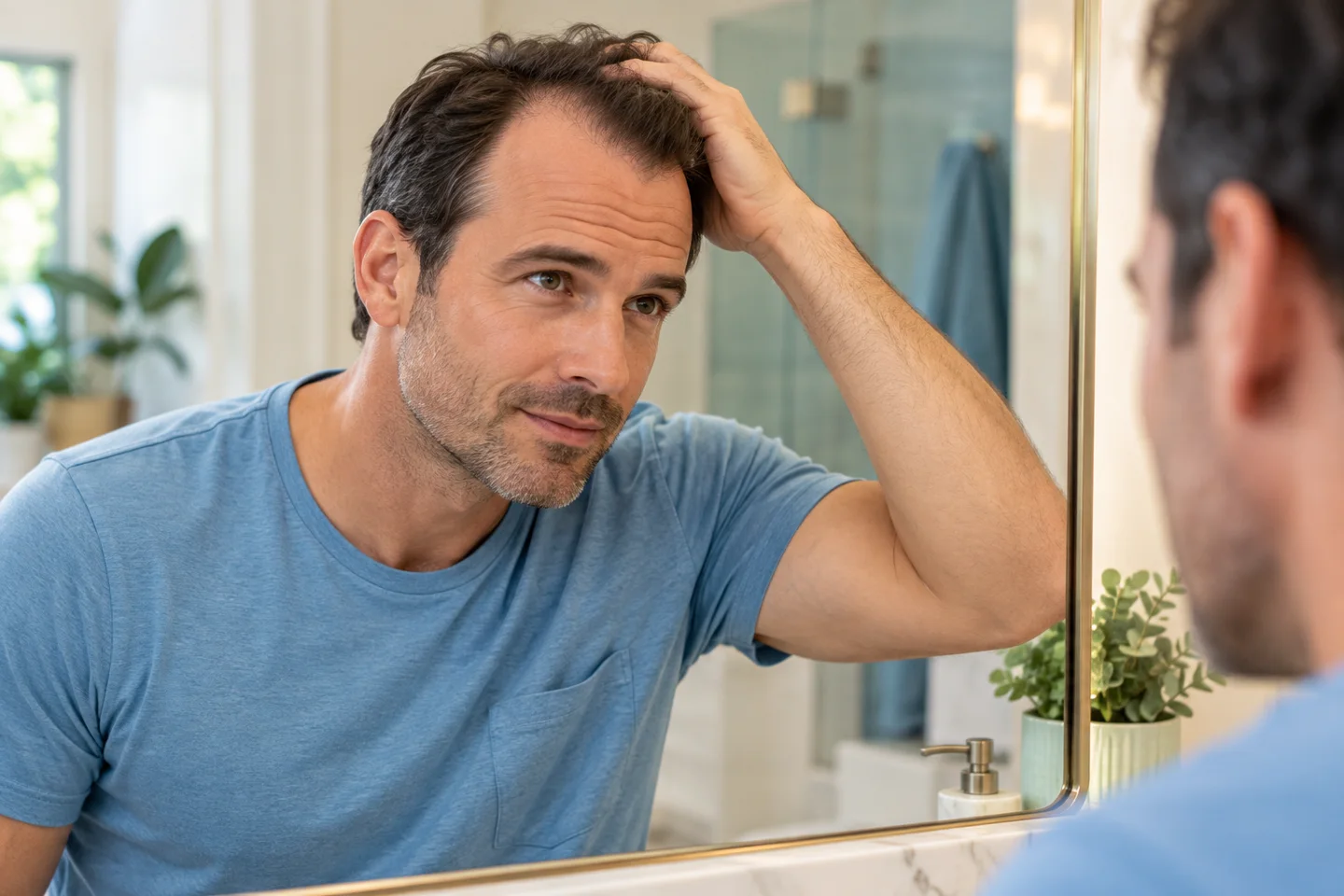
Most people with thinning hair still have living follicles that have become smaller and produce finer, shorter hairs. Stem-cell-based treatments target exactly these follicles. In clinical studies they increased hair count, hair density and hair thickness, in men and in women.122021
A strong option next to medication and transplants
If medication has not given you the result you want, or you would rather avoid surgery, stem cell hair treatment is a non-surgical option. It can also be combined with a hair transplant: reviews of randomised trials see regenerative treatments as a useful addition to transplantation.8
Results at a glance
- +28.1%more hairs after 16 weeks in a double-blind trial, against +7.1% with control1
- +15hairs per cm² on average in a 2024 meta-analysis of clinical trials2
- 67%average regrowth in alopecia areata patches after one Wharton’s jelly stem cell injection6
- 58 weeksafter treatment, the extra hair density was still measured4
02
How stem cells and exosomes support hair growth
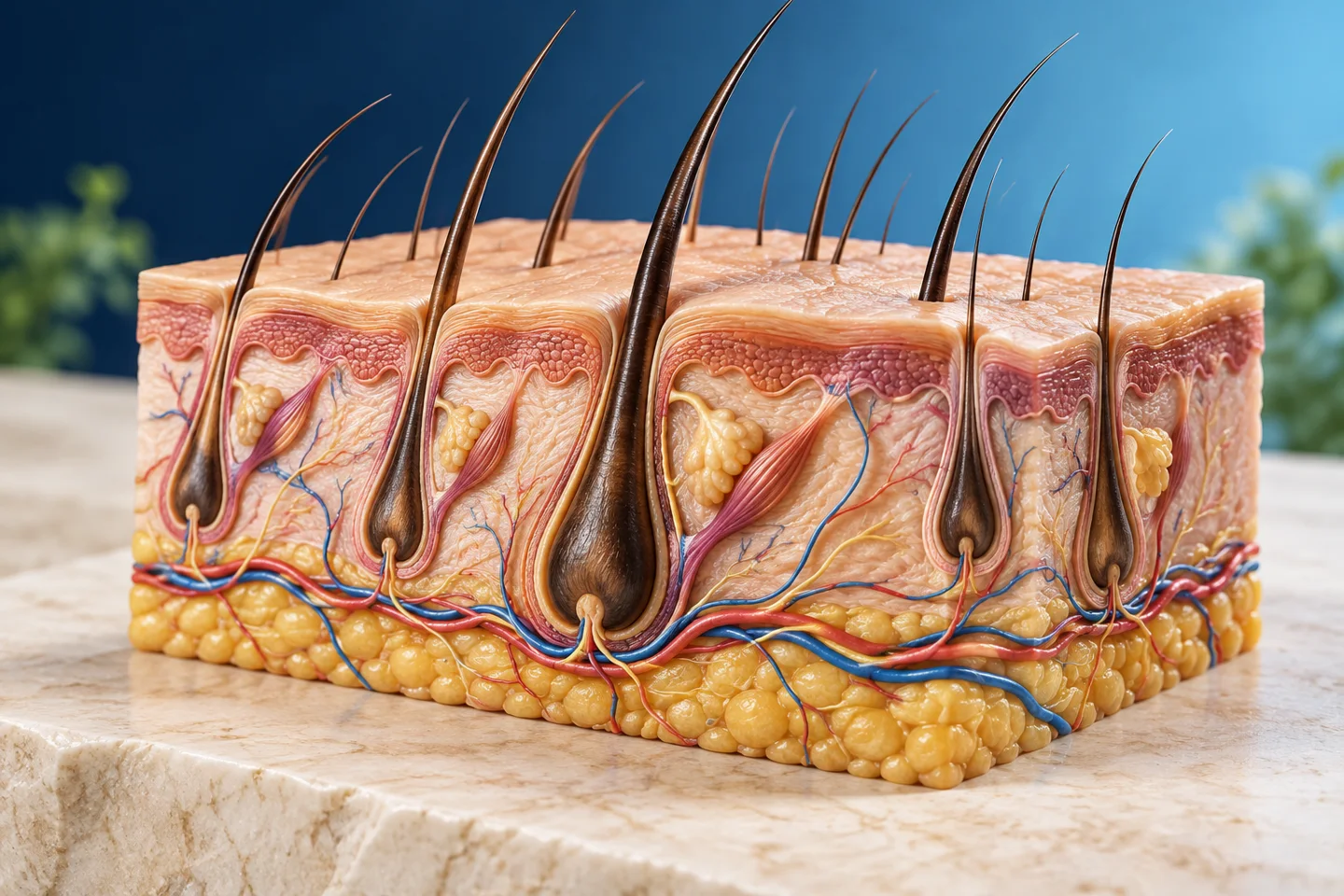
Mesenchymal stem cells do not grow new hairs themselves. They work by releasing growth factors, exosomes and other signals that switch on the follicle’s own growth programme.910 Six effects explain the results seen in studies.
How stem cell hair treatment works
Growth factors for the follicle
Stem cells release VEGF, IGF-1 and HGF, growth factors that support blood flow around the follicle and nourish the cells that build the hair.9 Umbilical cord stem cell secretions rich in these factors promoted hair regrowth and new blood vessels in research models.16
Waking up the dermal papilla
The dermal papilla is the control centre of each hair follicle. In laboratory studies, stem cell exosomes switched on its Wnt/β-catenin pathway, a key signal for hair growth, and lengthened hairs in human follicles grown in culture.14
A longer growth phase
In patients, monthly stem cell treatments increased the share of hairs in the active growth (anagen) phase and thickened the scalp’s supporting dermis.11
A calmer, healthier scalp
In women with pattern hair loss, scalp biopsies after stem cell injections showed less inflammation around the follicles, more of the growth signal follistatin and less of the hair-cycle brake DKK-1.12 In the laboratory, stem cell signals protected follicle cells from androgen and oxidative damage.10
Immune balance in alopecia areata
In alopecia areata the immune system attacks the follicle. In patients, cord-blood stem cell therapy rebalanced the immune response and built a protective TGF-β1 shield around the follicles, restoring their natural immune protection.13
Exosomes: the cells’ messengers
Exosomes are tiny packages of the stem cells’ signals, with no living cells inside. Exosomes from umbilical cord stem cells carry microRNAs that switch on the hair-growth pathway, and in research models of pattern hair loss they enlarged follicles and moved them back into the growth phase.15
Learn more about how our exosome therapy works.
03
Our stem cell hair treatment in Istanbul
Fresh Wharton’s jelly (umbilical cord) stem cells
Our stem cells come from Wharton’s jelly, collected from umbilical cords donated after healthy births. They are young, active cells that carry very few of the markers that trigger rejection, so no donor matching is needed.29 We prepare them fresh for your treatment date and never freeze them. Our cells and exosomes are prepared in a laboratory approved by the Turkish Ministry of Health and certified to GMP standards, with cell count and viability checked before every treatment.
1. Stem cells into the scalp
Fine injections place fresh stem cells in the areas where hair is thinning, so their growth signals act right at the follicles. A single scalp injection of Wharton’s jelly stem cells was followed by regrowth in every patient in a published study.6
2. Exosomes for extra growth signals
Exosomes add the stem cells’ signals in concentrated form. In a 2026 meta-analysis of human studies, exosome treatments increased hair density by 23.6% on average.5
3. One treatment day
Your treatment is given in one visit. Our driver picks you up, takes you to the clinic and brings you back afterwards.
4. Top-up sessions
Longer treatment courses gave greater improvement in clinical trials, so your plan can include a top-up session to build on and maintain your result.2
Your comfort: treatment is minimally invasive, with no cuts and no stitches. Dr. Cihan Bolat, a specialist in anaesthesiology and reanimation, plans your comfort during the scalp injections with you.
04
Does stem cell therapy for hair loss work? What studies report
Clinical studies measure hair growth by counting hairs per square centimetre and measuring hair thickness. A randomised, double-blind trial reported clear gains with a stem-cell treatment:
Hair growth with and without stem-cell treatment after 16 weeks
Increase in hair count1
Increase in hair thickness1
What improves
- Hair density. A 2024 meta-analysis of clinical trials found about 15 more hairs per cm² and 18.7 µm thicker hairs with stem-cell-derived treatments, and longer courses gave greater improvement.2 A 2026 meta-analysis of exosome studies found 23.6% more hair density and 18.0% thicker hair on average.5
- Results that last. In a randomised, placebo-controlled half-head study, the treated side gained 23.3 hairs per cm² while the untreated side changed by −0.7, with benefits still measured after 58 weeks.4 Another controlled study measured 33% more density at 23 weeks.19
- Larger groups. In 140 men and women, a single session of cell micrografts increased hair density in every scalp region, with a favourable response in 66.4% at the front of the scalp.28
- Umbilical cord cells. In a double-blind, placebo-controlled study, a treatment made from umbilical cord blood stem cell secretions increased hair density, thickness and growth rate.3 In a pilot study of umbilical cord stem cell secretions, 86.6% of people saw new hair growth.17
- Women with thinning hair. In women with female pattern hair loss, density rose from 105.4 to 122.7 hairs per cm² and hairs became thicker within 12 weeks.21 Hair numbers rose in men and women alike.20
- Alopecia areata. After a single injection of Wharton’s jelly stem cells, every patient regrew hair, with 67% regrowth in the treated areas on average by 24 weeks.6 Stem cell treatment of alopecia areata patches also increased density from 85.1 to 121.1 hairs per cm².22
- Exosomes in Istanbul. Researchers at Yeditepe University in Istanbul reported a significant increase in hair density 4 and 12 weeks after a single session of stem cell exosome injections.7 Other exosome studies reported higher hair counts, less shedding and high patient satisfaction.2324
A review of 12 randomised trials concluded that stem-cell-based treatments, with or without living cells, are safe and effective in improving hair regeneration and density.8
05
Your results timeline: when patients in studies saw thicker hair
Hair grows slowly, so results build up over months. In clinical studies, density gains were measured from 6 to 8 weeks,301 the main results at 12 to 16 weeks,211 and benefits were still present more than a year after treatment.4 We review your progress with you at about 1, 3, 6 and 12 months, with photos taken under the same conditions each time.
The hair growth cycle
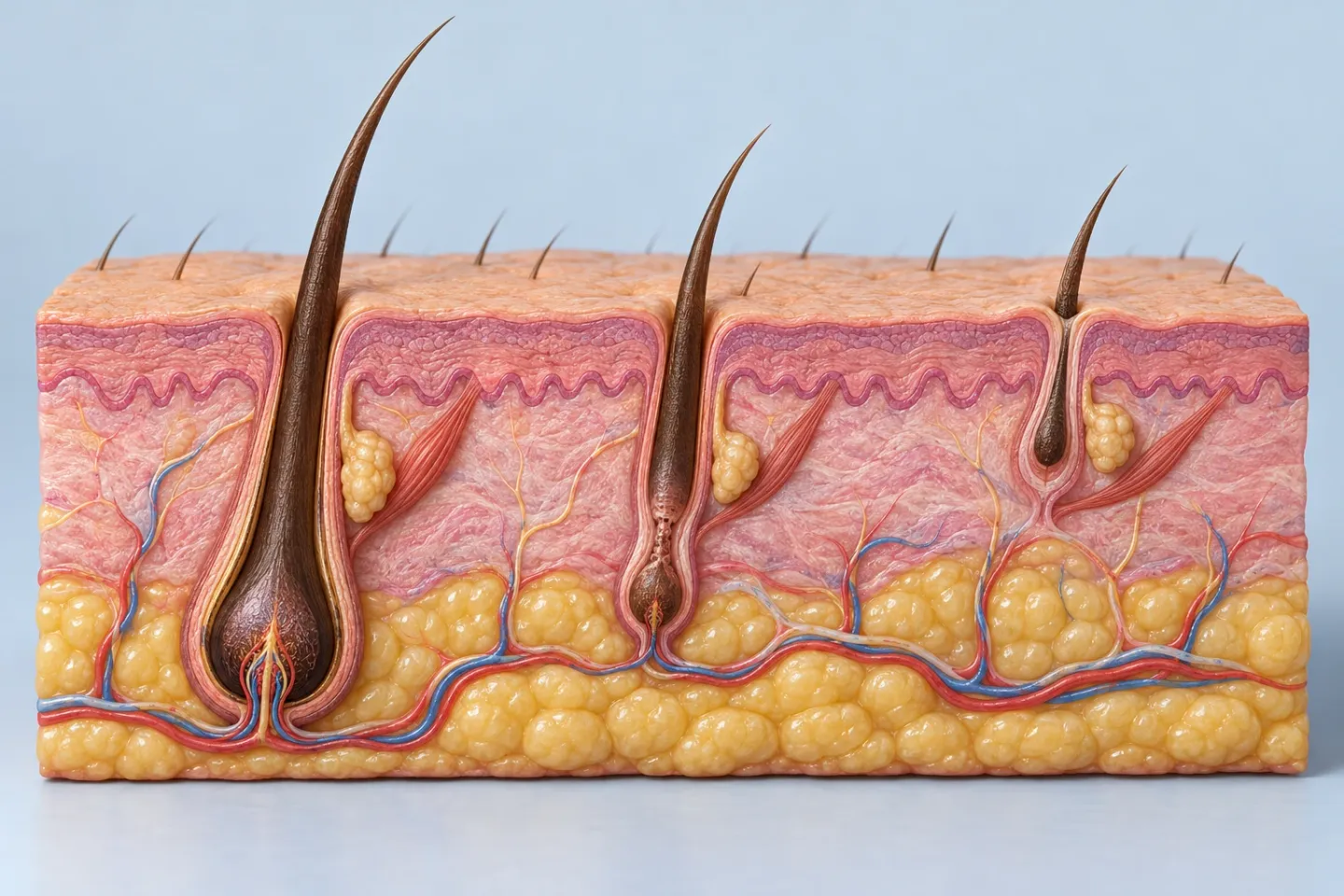
- Anagen: growth2–7 years; most hairs are in this phase
- Catagen: transitionabout 2–3 weeks
- Telogen: restabout 3 months, then the hair is shed
- In pattern hair loss the growth phase shortens and follicles shrink
- Stem cell signals keep more hairs in the growth phase
- 6–8 weeksFirst changesDensity gains measured from week 6–8
- 3–4 monthsVisibly thickerMain gains in hair count and thickness
- 6 monthsFuller hairDensity still rising in many studies
- 12 months+Lasting benefitStill measured at 58 weeks
- Top-upKeep it goingA top-up session builds on your result
06
Who stem cell hair treatment helps
Stem cell hair treatment is suitable for many men and women with thinning hair. It works best where hair is thinning but the follicles are still present, so the earlier you start, the more follicles there are to support.
- Men with pattern hair loss (androgenetic alopecia), at the crown or the hairline.147
- Women with thinning hair (female pattern hair loss).1221
- Alopecia areata, patchy hair loss caused by the immune system.622
- Before or after a hair transplant, to support the surrounding hair.8
Every patient is assessed by our specialist first, so your plan is built around your hair, your health and your goals.

07
Safety and comfort
Stem cell and exosome hair treatments have a reassuring safety record. In randomised trials, treatments were well tolerated,118 and a study of umbilical cord stem cell secretions reported no severe side effects.3 Wharton’s jelly stem cells for alopecia areata were safe, with no side effects reported,6 and the Istanbul exosome study reported no side effects or complications.7 Reviews of the published studies found no serious adverse events.252627 When people notice anything, it is mild scalp tenderness that settles within a day or two.
Your treatment is planned by our specialist after a review of your health, and given in one visit with no cuts, no stitches and no recovery time in hospital.
08
Stem cell hair treatment cost in Turkey: what’s included
Your price depends on the number of stem cells and the amount of exosomes in your plan, and on whether your plan includes a top-up session. After your free assessment you receive a fixed, all-inclusive price in writing, before you book anything.
Included
- Free assessment and phone consultation
- Fresh Wharton’s jelly stem cells and exosomes, with certified count and viability
- Treatment by our specialist
- Ground transport to and from the clinic
- A personal case manager
- Aftercare and follow-up reviews
Not included / optional
- Flights
- Hotel stay, which we can arrange for you
- Top-up sessions, if you choose them
09
Our guarantees to you
- A fixed price in writingYour all-inclusive price is confirmed in writing before you travel. No surprises.
- A guaranteed cell countThe number of fresh stem cells in your plan is guaranteed, and the count and viability are checked and certified by our GMP laboratory before treatment.
- Follow-up includedProgress reviews at about 1, 3, 6 and 12 months are part of every treatment.
- A free consultation with Dr. Cihan BolatBefore you commit, our medical director reviews your case free of charge.
10
Your stem cell hair treatment in Istanbul, step by step
Free assessment
Tell us your age, how your hair loss developed and which treatments you have tried, and send recent photos and any scalp tests. Our specialist reviews your case.
Free phone consultation and fixed price
Once your case is approved, you discuss your plan with the specialist and receive the total price in writing.
Fresh preparation
After your deposit, your stem cells are prepared fresh for your date. Preparation usually takes 5 to 10 days.
Treatment day
Our driver takes you to the clinic, where the specialist gives your stem cells and exosomes, and brings you back afterwards.
Home and follow-up
We review your progress with you at about 1, 3, 6 and 12 months and plan a top-up session if you wish.
Read more about the treatment process step by step.
11
Why patients choose Istanbul Stemcell for stem cell hair treatment in Turkey
Led by Dr. Cihan Bolat
Our medical director is a specialist in anaesthesiology and reanimation and in regenerative medicine, and leads every treatment plan.
Fresh cells, licensed laboratory
Fresh Wharton’s jelly stem cells and exosomes from a Ministry of Health-approved, GMP-certified laboratory, never frozen.
Specialist-led
Every treatment is assessed and given by specialists trained in the United States and Turkey, not by general practitioners.
Non-surgical, one day
No cuts, no stitches and no hospital stay: one treatment day, with transport to and from the clinic included.
12
Patients’ stories
Patients who chose stem cell hair treatment with us share their experience.
“The medical team took the time to explain the entire process, which made me feel confident in my decision. After just a few months, I noticed significant improvements in my hair density and overall scalp health.”
“The medical team was fantastic—very knowledgeable and attentive throughout the entire process. … The results have been incredible; my hair is fuller and healthier than I ever thought possible.”
Every person’s hair is different; we agree your goals with you before treatment.
13
Frequently asked questions
Does stem cell therapy for hair loss really work?
Yes, in clinical studies stem-cell-based treatments increased hair count, density and thickness. In a randomised, double-blind trial, hair count rose by 28.1% against 7.1% in the control group after 16 weeks, and a 2024 meta-analysis of clinical trials found about 15 more hairs per square centimetre.
How much does stem cell hair treatment cost in Turkey?
Your price depends on the number of stem cells and the amount of exosomes in your plan. After a free assessment you receive a fixed, all-inclusive price in writing, which includes the treatment by our specialist, fresh Wharton’s jelly stem cells and exosomes, ground transport, a personal case manager and follow-up reviews.
How long does it take to see results from stem cell hair treatment?
In clinical studies, the first gains in hair density were measured after 6 to 8 weeks, with the main results at 3 to 4 months. Hair grows slowly, so the result keeps building over the months after treatment.
How long do the results of stem cell hair treatment last?
In a randomised, placebo-controlled study, the extra hair density was still measured 58 weeks after treatment. Hair loss is an ongoing process, so many patients choose a top-up session to build on and maintain their result.
How many sessions of stem cell or exosome hair treatment will I need?
Your treatment starts with one treatment day. Clinical trials found that longer treatment courses gave greater improvement, so your plan can include a top-up session, and our specialist advises you on the timing at your follow-up reviews.
Is stem cell hair treatment safe? What are the side effects?
Published studies report a reassuring safety record, with no serious adverse events. When people notice anything, it is mild scalp tenderness that settles within a day or two.
What is the difference between exosome hair treatment and stem cell hair treatment?
Stem cells are living cells that release growth signals in the scalp; exosomes are tiny packages of those signals, with no living cells inside. We combine both, so your follicles receive the living cells’ ongoing signals and an extra concentrated dose of exosomes.
Exosomes vs PRP for hair loss: which is better?
PRP uses growth factors from your own blood platelets. Stem cells and exosomes come from young umbilical cord cells and carry a broad set of growth factors and microRNAs that activate the hair follicle. Our specialist advises you which approach suits your hair.
Can stem cells regrow hair on a completely bald scalp?
Stem cell hair treatment works best where hair is thinning but the follicles are still present, because it strengthens existing follicles. For areas that have been bald for a long time, a hair transplant can be combined with regenerative treatment.
Does stem cell therapy work for alopecia areata?
Yes. In a published study, a single injection of Wharton’s jelly stem cells was followed by regrowth in every patient with alopecia areata, with 67% regrowth in the treated areas on average by 24 weeks.
Does stem cell treatment work for women with thinning hair?
Yes. In women with female pattern hair loss, hair density rose from 105.4 to 122.7 hairs per square centimetre and hairs became thicker within 12 weeks of stem cell treatment.
Is stem cell hair treatment an alternative to a hair transplant?
It is a non-surgical option for thinning hair, with no cuts, no stitches and no recovery period. It can also be combined with a hair transplant: reviews see regenerative treatment as a useful addition to transplantation.
Where do the stem cells come from?
We use fresh mesenchymal stem cells from Wharton’s jelly, the soft tissue of umbilical cords donated after healthy births. Nothing is taken from you, no donor matching is needed, and the cells are prepared fresh in a Ministry of Health-approved, GMP-certified laboratory.
Does stem cell hair treatment hurt?
The treatment uses fine scalp injections, with no cuts or stitches. Dr. Cihan Bolat, a specialist in anaesthesiology, plans your comfort with you, and any mild scalp tenderness usually settles within a day or two.
How many days do I need to stay in Istanbul?
The treatment itself takes one day, and our driver takes you to and from the clinic. Many patients combine it with a short stay in Istanbul; we can arrange your hotel as part of your package.
Medical review
Uzm. Dr. Cihan Bolat
Medical Director, Istanbul Stemcell
This page was written from the published studies listed below and reviewed for medical accuracy on .
14
References
- Tak YJ, et al. A randomized, double-blind, vehicle-controlled clinical study of hair regeneration using adipose-derived stem cell constituent extract in androgenetic alopecia. Stem Cells Transl Med. 2020;9(8):839-849. PMID 32420695
- Chien WY, et al. Stem cell-derived conditioned medium for alopecia: A systematic review and meta-analysis. J Plast Reconstr Aesthet Surg. 2024;88:182-192. PMID 37983981
- Oh HA, et al. Migration Inhibitory Factor in Conditioned Medium from Human Umbilical Cord Blood-Derived Mesenchymal Stromal Cells Stimulates Hair Growth. Cells. 2020;9(6). PMID 32481584
- Gentile P, et al. Autologous Micrografts from Scalp Tissue: Trichoscopic and Long-Term Clinical Evaluation in Male and Female Androgenetic Alopecia. Biomed Res Int. 2020;2020:7397162. PMID 32071919
- Stack ER, et al. Clinical Advances in Exosome-Based Therapies for Aesthetic Medicine: A Systematic Review and Meta-analysis of Human Clinical Trials. Aesthet Surg J. 2026;46(12 Suppl 2):S13-S25. PMID 41800726
- Czarnecka A, et al. Wharton's jelly-derived mesenchymal stem cells in the treatment of four patients with alopecia areata. Adv Clin Exp Med. 2021;30(2):211-218. PMID 33636057
- Ersan M, et al. Effectiveness of Exosome Treatment in Androgenetic Alopecia: Outcomes of a Prospective Study. Aesthetic Plast Surg. 2024;48(21):4262-4271. PMID 39174804
- Gasteratos K, Kouzounis K, Goverman J. Autologous Stem Cell-derived Therapies for Androgenetic Alopecia: A Systematic Review of Randomized Control Trials on Efficacy, Safety, and Outcomes. Plast Reconstr Surg Glob Open. 2024;12(2):e5606. PMID 38352219
- Widowati W, et al. Hair regeneration in alopecia using adipose-derived mesenchymal stem cells secretome: A systematic review of experimental and clinical evidence. Tissue Cell. 2026;104(Pt 2):103872. PMID 42628189
- Won CH, et al. The Basic Mechanism of Hair Growth Stimulation by Adipose-derived Stem Cells and Their Secretory Factors. Curr Stem Cell Res Ther. 2017;12(7):535-543. PMID 28875863
- Narita K, et al. Sequential Scalp Assessment in Hair Regeneration Therapy Using an Adipose-Derived Stem Cell-Conditioned Medium. Dermatol Surg. 2020;46(6):819-825. PMID 31490301
- Moneib H, et al. Successful Treatment of Female Pattern Hair Loss with Injection of Autologous Adipose-derived Adult Stem Cells: A Controlled Clinical, Trichoscopic, and Immunohistochemical Trial. Int J Trichology. 2025;17(2):113-120. PMID 41306847
- Li Y, et al. Hair regrowth in alopecia areata patients following Stem Cell Educator therapy. BMC Med. 2015;13:87. PMID 25896390
- Rajendran RL, et al. Application of extracellular vesicles from mesenchymal stem cells promotes hair growth by regulating human dermal cells and follicles. World J Stem Cells. 2022;14(7):527-538. PMID 36157528
- Yu A, et al. Human umbilical cord mesenchymal stem cell-derived exosomes enhance follicular regeneration in androgenetic alopecia via activation of Wnt/β-catenin pathway. Stem Cell Res Ther. 2025;16(1):418. PMID 40751216
- Ni J, et al. Promotion of hair growth by a conditioned medium from human umbilical cord mesenchymal stem cells cultivated in a 3D scaffold of gelatin sponge. Eur J Med Res. 2024;29(1):270. PMID 38704575
- Mathen C, Dsouza W. In vitro and clinical evaluation of umbilical cord-derived mesenchymal stromal cell-conditioned media for hair regeneration. J Cosmet Dermatol. 2022;21(2):740-749. PMID 33780589
- Lee YI, et al. The Effect of Conditioned Media From Human Adipocyte-Derived Mesenchymal Stem Cells on Androgenetic Alopecia After Nonablative Fractional Laser Treatment. Dermatol Surg. 2020;46(12):1698-1704. PMID 32769526
- Gentile P. Autologous Cellular Method Using Micrografts of Human Adipose Tissue Derived Follicle Stem Cells in Androgenic Alopecia. Int J Mol Sci. 2019;20(14). PMID 31337037
- Fukuoka H, Suga H. Hair Regeneration Treatment Using Adipose-Derived Stem Cell Conditioned Medium: Follow-up With Trichograms. Eplasty. 2015;15:e10. PMID 25834689
- Shin H, et al. Clinical use of conditioned media of adipose tissue-derived stem cells in female pattern hair loss: a retrospective case series study. Int J Dermatol. 2015;54(6):730-5. PMID 25777970
- Anderi R, et al. Cellular therapy with human autologous adipose-derived adult cells of stromal vascular fraction for alopecia areata. Stem Cell Res Ther. 2018;9(1):141. PMID 29764513
- Lee E, et al. The efficacy of adipose stem cell-derived exosomes in hair regeneration based on a preclinical and clinical study. Int J Dermatol. 2024;63(9):1212-1220. PMID 39155501
- Ablon G. An Exosome Regenerative Complex Plus Microneedling Promotes Hair Growth in Subjects With Self-Perceived Thinning Hair. J Drugs Dermatol. 2025;24(10):988-994. PMID 41037530
- Krefft-Trzciniecka K, et al. Human Stem Cell Use in Androgenetic Alopecia: A Systematic Review. Cells. 2023;12(6). PMID 36980291
- Kang BY, et al. The safety and efficacy of autologous adipose-derived stromal vascular fraction for nonscarring alopecia: A systematic review. Arch Dermatol Res. 2022;314(4):349-356. PMID 34014340
- Al Ameer MA, et al. Exosomes and Hair Regeneration: A Systematic Review of Clinical Evidence Across Alopecia Types and Exosome Sources. Clin Cosmet Investig Dermatol. 2025;18:2215-2227. PMID 40955427
- Zari S. Short-Term Efficacy of Autologous Cellular Micrografts in Male and Female Androgenetic Alopecia: A Retrospective Cohort Study. Clin Cosmet Investig Dermatol. 2021;14:1725-1736. PMID 34824538
- Weiss ML, et al. Immune properties of human umbilical cord Wharton's jelly-derived cells. Stem Cells. 2008;26(11):2865-74. PMID 18703664
- Stevens HP, Donners S, de Bruijn J. Introducing Platelet-Rich Stroma: Platelet-Rich Plasma (PRP) and Stromal Vascular Fraction (SVF) Combined for the Treatment of Androgenetic Alopecia. Aesthet Surg J. 2018;38(8):811-822. PMID 29554209