
01
Why Americans choose stem cell therapy in Istanbul, Turkey
Most of our international patients come from the UK and the United States. What you can expect is a treatment journey that is clear from the very first message: a specialist reviews your case before you book anything, you see one fixed price in US dollars, and the treatment itself takes one day for most plans.
Travelling nine hours or more for a treatment is a big decision, so it helps to know exactly what you are travelling for. These are the strengths built into every plan we make for patients from the US.

A specialist review before you travel
Uzm. Dr. Cihan Bolat, our medical director, a specialist in anaesthesiology and reanimation and in regenerative medicine, leads the team that reviews your reports free of charge and tells you honestly whether treatment suits you, while you are still at home.
Fresh Wharton’s jelly cells
Your stem cells come from cords donated after healthy births. They are prepared fresh for your treatment date in a GMP laboratory approved by the Turkish Ministry of Health, and never frozen.
One fixed price in US dollars
Your written plan gives one fixed, all-inclusive price in US dollars, so you can budget in your own currency and decide calmly before you look at flights.
One treatment day
Most plans take one treatment day in Istanbul, and you walk out of the clinic the same day.
Exosomes in your package
From 50 million cells, every IV package includes free Wharton’s jelly exosomes, the cells’ own repair messengers, at no extra cost.
Care that follows you home
Follow-up reviews at about 1, 3, 6 and 12 months keep your care going once you are back in the US.
Our article on why patients choose stem cell therapy in Turkey tells the wider story of treatment in Turkey, and our stem cell therapy page explains the treatment itself. This guide covers the practical side for readers in the US: what to expect, what it costs in US dollars and how to plan the trip. If you live in Britain, our guide for UK patients is written for you.
02
Why Wharton’s jelly stem cells and exosomes lead every plan we make
Whatever brings you to Istanbul, from a stiff knee to blood sugar that will not settle, your plan is built on two products from the same young tissue: Wharton’s jelly mesenchymal stem cells and Wharton’s jelly exosomes. Here is what each one brings, and why they work so well together.
Young cells from the start of life
Wharton’s jelly is the soft tissue that cushions the blood vessels of the umbilical cord. Its stem cells are collected from cords donated after healthy births, so nothing is taken from your own body, and there is no wait while cells are grown from your own fat or bone marrow. For a patient flying in from the US, that matters: you arrive, you are treated, and your cells are already prepared for your date. In a side-by-side laboratory comparison, Wharton’s jelly stem cells multiplied more readily than bone marrow stem cells from adult donors,8 and in laboratory tests they did not stimulate another person’s immune cells, which is why no donor matching is needed.9
Messengers, not spare parts
Mesenchymal stem cells do most of their work by sending signals. They release growth factors and other messengers that calm inflammation, limit scarring, encourage new small blood vessels and wake up the body’s own repair cells.10 Exosomes are the tiny packages that carry many of those messages from cell to cell, loaded with proteins and RNA that change how the receiving cell behaves.11 The two complement each other: your stem cells keep releasing signals for a while after treatment, and exosomes deliver a concentrated dose of messages at once. That is why every IV package from 50 million cells includes free Wharton’s jelly exosomes.
Fresh for your date, with a batch certificate
Your cells are prepared fresh for your treatment date in a GMP laboratory approved by the Turkish Ministry of Health, and they are never frozen. In laboratory comparisons, freeze-thawed MSCs had weaker immune-balancing and blood-regulating properties than freshly harvested cells.12 The batch certificate shows the cell count, viability and sterility tests, and you receive the certificate the laboratory provides for your batch, a document you can take home and keep with your own medical records. Our guide to stem cell quality and the lab report explains what each result means.
What Wharton’s jelly stem cells and exosomes achieved in people
- A stronger heart. In a double-blind, randomised trial of 116 people after a heart attack, Wharton’s jelly stem cells given into the heart artery raised heart pumping strength by 7.8 points over 18 months, against 2.8 with placebo, and the living heart muscle in the affected area grew by 6.9%, against 3.3%, at four months.3
- Insulin production kept. In adults diagnosed with type 1 diabetes within the previous two years, one infusion of Wharton’s jelly stem cells limited the fall in the body’s own insulin production to 10% over a year, against 47% with placebo, and insulin needs stayed level while they rose by a median of 10 units a day with placebo.1
- An easier back. In 125 people with worn discs in the lower and middle back, Wharton’s jelly stem cells injected into the disc were followed by significant falls in pain and disability at three and six months, and when Wharton’s jelly exosomes were added, a meaningful gain in everyday function was about twice as likely at six months.5
- Faster healing. In a randomised trial of 110 people with diabetic foot ulcers, wounds treated with Wharton’s jelly exosomes healed fully in 6 weeks on average, against 20 weeks with standard care alone.13
Wharton’s jelly stem cells and exosomes in people
- +7.8 vs +2.8points of heart pumping strength at 18 months with Wharton’s jelly stem cells, against placebo3
- 10% vs 47%fall in the body’s own insulin production over a year in type 1 diabetes, Wharton’s jelly stem cells against placebo1
- 2.0×as likely to reach a meaningful gain in back function at six months when Wharton’s jelly exosomes joined the stem cells5
- 6 vs 20 weeksaverage time to full healing of diabetic foot ulcers with Wharton’s jelly exosomes, against standard care13
Umbilical cord stem cells, second in our plans
Umbilical cord stem cells can join your infusion where Dr. Cihan Bolat advises. In the RIMECARD trial, one IV infusion of 1 million umbilical cord stem cells per kilogram raised heart pumping strength by 7.07 points over a year, against 1.85 with placebo.4
CD34+ exosomes as an extra
CD34+ exosomes can be added alongside your Wharton’s jelly exosomes where your doctor feels they will help, and your written plan prices them.
How your cells are given
The packages on our price list are given by a relaxed IV drip. Stem cells can also be given into a joint, into a disc, around a nerve or into the fluid around the spinal cord (intrathecal), and exosomes by IV infusion or nasal spray, as Dr. Cihan Bolat plans. Stem cells are never given into the nose.
Several goals in one day
An IV infusion can be combined with targeted injections in one plan, and both knees, with the tendons and ligaments around them, can be treated in a single day.
Read more about the cells on our stem cell therapy page, and about exosomes on our exosome therapy page.
03
Stem cell therapy for knees, back pain, ageing, autism and diabetes: what studies report
Knees, backs, healthy ageing, autism and diabetes are among the topics Americans search for most when they look into stem cell therapy. Here is a short summary of what published human studies report for each, with a link to our full guide. Where a study used a different type of cell from ours, we say so.
Knees
Two injections of umbilical cord stem cells grown from Wharton’s jelly, six months apart, left knee pain at 2.4 on a 100-point scale after a year, against 22.1 with hyaluronic acid.2 In 16 people with advanced knee osteoarthritis, two Wharton’s jelly stem cell injections a month apart were followed by better pain and function at 12 and 48 months.14 Read our guide to the stem cell knee injection and our knee, hip and shoulder page.
Back and neck
In 33 people with painful worn discs in the lower back, umbilical cord stem cells injected into the disc gave excellent or good results in 30 of them about two years later, and none needed further treatment for pain from the treated disc.15 Read our guide to stem cell therapy for back and neck pain and our degenerative disc disease page.
Healthy ageing
In a double-blind, placebo-controlled trial in older adults with frailty, IV umbilical cord stem cells improved physical quality of life from the first check-up onwards, grip strength was better than with placebo at six months, and the inflammation markers TNF-α and IL-17 fell.16 Read our healthy ageing page and our guide to stem cell longevity treatment.
Autism
In a randomised trial of children aged three to seven, the number of children at the most severe level of autism fell by 48.0% after a year of treatment with cells from their own bone marrow plus education, against 8.0% with education alone, and daily-living and social skills scores rose by 8.5 points, against 1.4.17 Our autism page explains how we treat children; a complete treatment costs EUR 8,000–15,000, including your hotel and all ground transport.
Type 2 diabetes
In a double-blind trial of 91 adults with type 2 diabetes, three IV infusions of umbilical cord stem cells lowered HbA1c by 1.31 percentage points over 48 weeks, from 9.02% to 7.52%, against 0.63 with placebo, and daily insulin doses fell by 27.78%, against 15.62%.6 Read our diabetes page, and for type 1, our guide to stem cell therapy for type 1 diabetes.
Nerves, exosomes and more
If numbness, tingling or burning in your feet is your concern, read stem cell therapy for neuropathy. Our exosome therapy page covers treatments with exosomes alone, and you can browse all the conditions we treat.
04
Stem cell options compared: what each one means for a trip from the US
When you plan treatment from far away, the type of cell decides more than the biology. It decides whether anything must be taken from your body, whether cells have to be grown first and how many days your treatment needs. This table sets out the main options side by side.
| Option | Harvest from your body | Preparation | In Istanbul | What studies report |
|---|---|---|---|---|
| Fresh Wharton’s jelly stem cells, our main treatment | None: cells from cords donated after healthy births | Prepared fresh for your date, never frozen, with a batch certificate | One treatment day for most plans | Heart pumping strength +7.8 against +2.8 with placebo at 18 months3 |
| Wharton’s jelly exosomes, free from 50M | None | Released by the same young cells, given alongside your stem cells | By IV infusion or nasal spray, on the same day | Diabetic foot ulcers healed in 6 weeks on average, against 20 weeks13 |
| Umbilical cord stem cells, second in our plans | None | Added to your plan where your doctor advises | On the same day as your other cells | Heart pumping strength +7.07 against +1.85 with placebo after one IV infusion of 1 million cells per kilogram4 |
| Muse cells and Muse exosomes, an optional add-on | None: donor cells | Added to your plan if you choose them | Cells by IV or intrathecal injection; exosomes by IV or nasal spray | 40.0% against 10.0% with placebo could look after their own affairs 12 weeks after one IV dose of a donor Muse cell product in stroke18 |
| Your own bone marrow or fat stem cells | A bone marrow draw or a liposuction-type harvest | Concentrated on the day, or grown in a laboratory over several weeks | Depends on the protocol | Studied in many conditions, each trial with its own results |
For travellers from the US, young donor cells bring practical advantages on top of their biology: nothing is taken from your body, nothing has to be grown from your own tissue, and most plans fit into one treatment day. Our guide to how to choose a stem cell clinic abroad gives you good questions to ask about any option.
05
Muse cells and Muse exosomes: an optional add-on
Muse cells, short for multilineage-differentiating stress-enduring cells, were first described in 2010 as a small, unusually resilient group of repair cells within mesenchymal cell populations.19 In clinical trials, donor Muse cells have been given without tissue-matching tests or immune-suppressing medicines,20 and in a randomised, placebo-controlled stroke trial, a single IV dose of a donor Muse cell product brought 40.0% of patients to the point of looking after their own affairs at 12 weeks, against 10.0% with placebo.18
You can add Muse cells by IV infusion or intrathecal injection, and Muse exosomes by IV infusion or nasal spray. They are not on the IV price list; your written plan prices them if you choose them, alongside the Wharton’s jelly stem cells and exosomes at the heart of your plan.
06
How much does stem cell therapy cost in Turkey for Americans? Our 2026 price list in US dollars
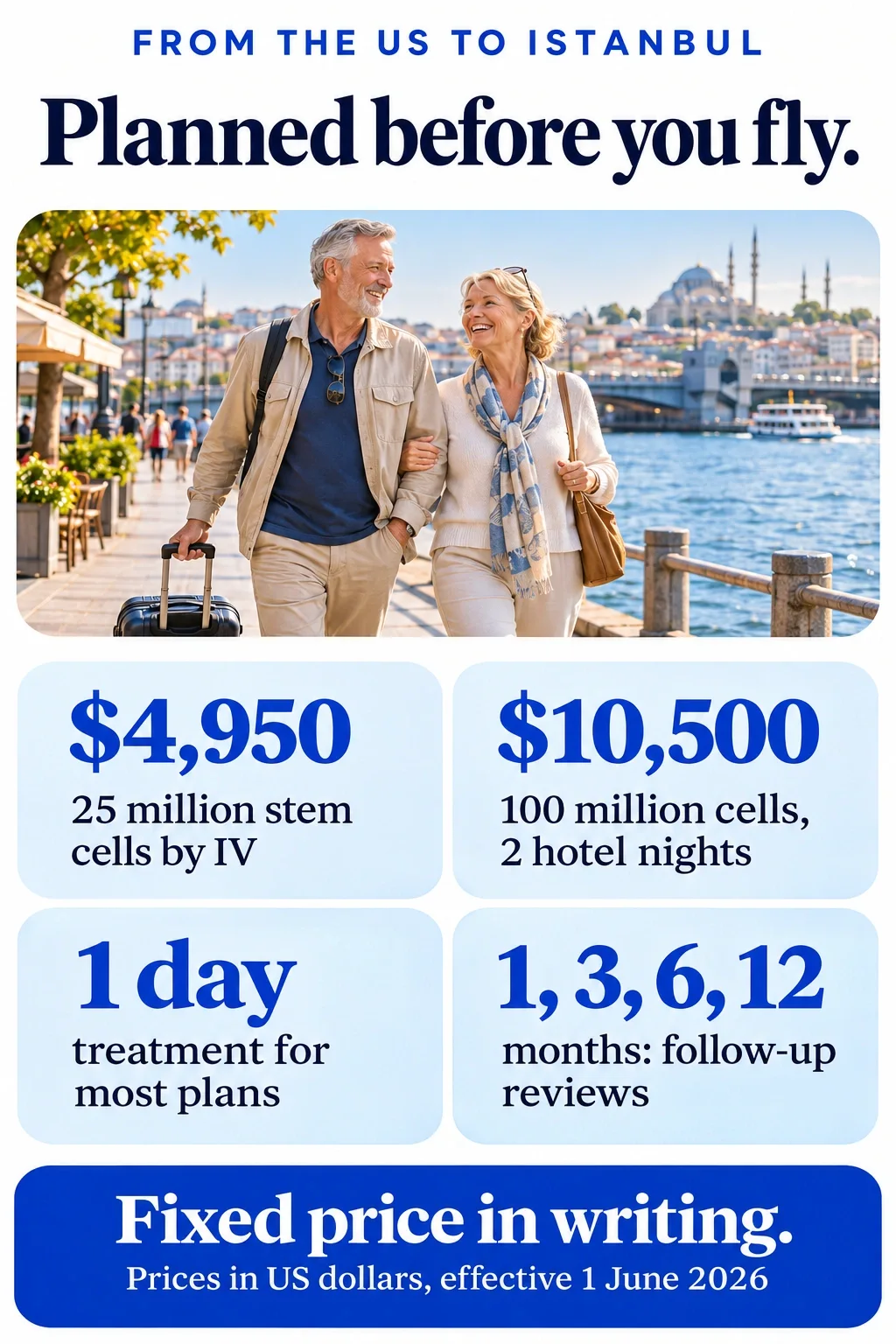
Our IV stem cell packages are priced in US dollars, so the figures below are the figures you budget for. Every package is built on fresh Wharton’s jelly mesenchymal stem cells given by a relaxed IV drip, and the list has been effective since 1 June 2026. M stands for million stem cells.
| Cell count | USD price | Free exosomes | Free hotel |
|---|---|---|---|
| 25M | $4,950 | No | No |
| 50M | $6,950 | 10 billion exosomes | No |
| 75M | $8,950 | 10 billion exosomes | No |
| 100M | $10,500 | 20 billion exosomes | 2 nights |
| 125M | $11,850 | 20 billion exosomes | 2 nights |
| 150M | $13,550 | 30 billion exosomes | 2 nights |
| 175M | $15,000 | 30 billion exosomes | 2 nights |
| 200M | $16,500 | 30 billion exosomes | 3 nights |
| 225M | $18,000 | 30 billion exosomes | 3 nights |
| 250M | $19,500 | 30 billion exosomes | 3 nights |
Package notes
- All prices are in USD.
- The free exosome amounts are complimentary and included as shown.
- Hotel nights are included only where indicated.
- Treatment plans can be customised after the medical review.
The free exosomes are Wharton’s jelly exosomes, given alongside your cells. From the 100M package, two hotel nights in Istanbul are included, and three nights from 200M, a welcome extra after a long-haul flight.
Our stem cell therapy cost guide explains the list in depth, including the cost per million cells, what dose studies show and the prices of condition plans. For erectile dysfunction, for example, most plans cost under USD 10,000.
07
How many stem cells do I need? A weight guide in pounds and kilograms
Your weight is the simplest starting point. A typical IV range is 1–2 million cells per kilogram, which is about 0.45–0.9 million per pound. The right dose for you is set in your free medical review, where Dr. Cihan Bolat looks at your condition, your goals, your age and your health as a whole.
| Your weight | Typical IV range | Packages within this range |
|---|---|---|
| 110 lb / 50 kg | 50M–100M | 50M, 75M or 100M |
| 154 lb / 70 kg | 70M–140M | 75M, 100M or 125M |
| 198 lb / 90 kg | 90M–180M | 100M, 125M, 150M or 175M |
| 243 lb / 110 kg | 110M–220M | 125M, 150M, 175M or 200M |
The ideal protocol depends on your condition, your goals, your age and the physician’s evaluation. Higher cell-count packages may suit heavier patients or more complex goals, and your written plan states your exact cell count before you travel.
The range reflects doses used in published trials. In RIMECARD, people with heart failure received one IV infusion of 1 million umbilical cord stem cells per kilogram; heart pumping strength had improved at 3, 6 and 12 months, only in the stem cell group, and everyday symptoms and quality of life improved too.4 Injections straight into a joint use far fewer cells, because the cells stay where they are needed: the knee trial described above used 20 million cells per injection.2
08
What your price includes, and what you arrange yourself
Your package covers your care from your first message to your review a year later. Flights are yours to book, and our team can help you book flights and a hotel if you would like a hand.
Included
- A free medical review by Uzm. Dr. Cihan Bolat’s team before you travel
- A written plan with a fixed, all-inclusive price in US dollars
- Fresh Wharton’s jelly stem cells, with certified count and viability
- Free Wharton’s jelly exosomes from 50M, as shown in the price list
- Treatment by our specialist team
- Ground transport in Istanbul
- A personal case manager
- Follow-up reviews at about 1, 3, 6 and 12 months
- Hotel nights where the price list shows them: 2 nights from 100M, 3 nights from 200M
Not included / optional
- Flights from the US; our team can help you book them
- A hotel stay, unless your package includes nights; we can help you book one
- Add-ons you choose, such as extra exosomes, extra routes, NAD+ IV as part of your stem cell plan, or Muse cells; your written price then includes them
- A repeat treatment, if you decide on one later
Your written plan lists your cell count, your exosomes, your routes, any add-ons and the hotel nights of your package, so you know your total before you look at a single flight. NAD+ IV is offered only as part of a stem cell plan, never on its own; read our guide to NAD+ IV therapy if it interests you.
09
Is stem cell therapy covered by insurance? Paying for treatment abroad from the US
Stem cell plans at our clinic are self-paid. Because your price is fixed, all-inclusive and in US dollars, you know the full cost of your treatment from the start, before you take time off work or book a flight.
If you would like to ask your health insurer, an employer health plan or another benefits provider about your treatment, your written plan is the document to show them. It sets out the cells, the exosomes, the routes and everything the price includes, so the conversation can be about facts rather than estimates. Questions about coverage are best put to your insurer directly.
The trip itself is a separate matter. If you usually take out travel insurance for journeys abroad, ask the provider what its policy covers for a medical trip.
Planning ahead helps your budget too. Your case manager helps you choose your dates, so you can fit the trip around work, family commitments or a quieter season, and compare flights from your nearest airport in good time.
10
Your stem cell treatment in Istanbul, step by step: from your home in the US and back
Almost all of the planning happens before you leave home, by message and by phone. Here is the journey in five steps. For the longer story, read the stem cell treatment in Turkey, step by step, or request your free consultation now.
Your journey from the US to Istanbul and back

- Free review from homeSend your reports; Dr. Cihan Bolat’s team reviews them free of charge and talks them through with you by phone.
- Your written planThe cells, your exact cell count and the routes, with one fixed, all-inclusive price, before you book.
- Fly to IstanbulDirect flights from many US cities take about 9–12 hours. Your case manager helps you choose your dates.
- One treatment dayFresh Wharton’s jelly stem cells and exosomes; for most plans one treatment day, and you walk out the same day.
- Your days in IstanbulTime for tea by the Bosphorus; hotel nights are included from 100M cells.
- Follow-up from homeReviews at about 1, 3, 6 and 12 months after your treatment.
Send your reports from home
Tell us your age, weight, health and goals, and share recent reports, scans, blood tests and a list of your medicines through our free consultation request, or on WhatsApp at +90 534 856 92 92.
Free medical review and a phone call
Dr. Cihan Bolat’s team reviews your case free of charge, talks it through with you by phone and tells you honestly whether treatment suits you.
Your written plan and fixed price
You receive a written plan with your cell count, your exosomes, your routes and any add-ons, and a fixed, all-inclusive price in US dollars, so you can decide at home without any pressure.
Choose your dates and fly
Your case manager helps you choose your dates. Our team can help you book flights and a hotel, and ground transport in Istanbul is part of your package.
Treatment day and your days in Istanbul
Your cells are prepared fresh for your date. Treatment day is a calm day, and you walk out of the clinic the same day; ask your case manager which activities suit the days that follow.
11
Flights from the US to Istanbul, and the time difference
Istanbul is a major international air hub, and there are direct flights from many US cities, taking about 9–12 hours, and from other parts of the country you can connect through a larger hub.
Two airports, two continents
Istanbul has two international airports: Istanbul Airport on the European side and Sabiha Gökçen on the Asian side. Our clinic is in Suadiye, a calm district on the Asian side, close to the Marmara seafront. Ground transport in Istanbul is part of your package, and your case manager helps you choose your dates.
The time difference
Istanbul is on UTC+3 all year round and does not change its clocks. The US moves its clocks forward on the second Sunday of March and back on the first Sunday of November, so the gap changes twice a year:
- Eastern time (New York, Boston, Atlanta, Miami): Istanbul is 7 hours ahead during US daylight saving time, and 8 hours ahead in winter.
- Central time (Chicago, Houston, Dallas): 8 hours ahead, and 9 in winter.
- Mountain time (Denver, Salt Lake City): 9 hours ahead, and 10 in winter.
- Pacific time (Los Angeles, San Francisco, Seattle): 10 hours ahead, and 11 in winter.
In practice, 5 pm in Istanbul is 9 or 10 am in New York, and 6 or 7 am in Los Angeles. It is worth remembering when you message us from home, and when you plan your follow-up reviews.
Arriving rested
A long flight east and a time change of seven hours or more ask a little of anyone. Because your case manager helps you choose your dates, you can give yourself time to settle in after you land. In your medical review, tell Dr. Cihan Bolat’s team about your medicines and anything else that matters to you on a long flight, so your plan takes it into account.

12
Do Americans need a visa for Turkey? Entry rules and what to pack
US citizens travelling on an ordinary passport can visit Türkiye without a visa for up to 90 days in any 180-day period. It is wise to travel with a passport that has at least six months of validity left from the day you arrive. Entry rules can change, so check the latest entry requirements before you book, on the websites of the Turkish Ministry of Foreign Affairs and the US Department of State.
Documents and things to bring
- Your passport, and a copy of it kept separately.
- Your written plan, and the contact details of your case manager.
- Copies of the medical reports, scans and blood tests you sent for your review.
- Your usual medicines, with a list of their names and doses.
- A travel adapter for your US plugs, and comfortable clothes for treatment day.
If you take regular medicines, keep enough for your whole trip in your carry-on bag, together with the list, so they are always within reach.
13
Money, phones and Istanbul weather: practical tips for American visitors
A few small preparations make your stay smoother, so you can concentrate on yourself rather than on the details.
Money
Turkey’s currency is the Turkish lira. Cards are widely used in Istanbul, and a little cash is handy for small purchases such as tea, snacks and ferry rides. Your treatment price is already fixed in US dollars in your written plan, and letting your bank know about your trip before you fly helps your card work smoothly abroad.
Phones and messaging
Check your carrier’s international plan before you go, or consider a travel eSIM. WhatsApp is widely used in Turkey, and it is an easy way to reach us on +90 534 856 92 92, from home and during your stay.
Power plugs
Sockets in Turkey take the round two-pin European plug, so pack a travel adapter for your US devices. Most phone and laptop chargers work on both US and European power; the small print on the charger tells you.
Summer, June to August
Warm and mostly dry, with average daytime highs of about 27–30°C (81–86°F). Shady waterfront walks and an early evening on the Bosphorus are at their best.
Spring and autumn
Mild and pleasant, with average highs of about 17°C (63°F) in April and 21°C (69°F) in October. In April, tulips fill Emirgan Park.
Winter, December to February
Mild and wet, with average highs of about 10–12°C (49–53°F) and more rainy days. Pack a waterproof jacket and enjoy a quieter, cosy city.
The temperatures are long-term monthly averages for Istanbul. For ideas for the days around your treatment, from a Bosphorus cruise to the calm streets of Kadıköy and Moda, read things to do in Istanbul during treatment, and ask your case manager which activities suit the days after your treatment.
14
Is stem cell therapy abroad safe? What the research shows
It is a natural question when you are planning treatment far from home, and the published record is reassuring. When researchers pooled 62 randomised trials with 3,546 patients across about 20 conditions, MSC treatment was safe, and the most common effect was a passing fever.7 Treatments with exosomes and related vesicles have a reassuring record as well, with serious adverse events in 0.7% across 21 clinical reports.21
The trials in this guide tell the same story. Over 18 months after Wharton’s jelly stem cells, side effects and laboratory tests were no different from placebo.3 After an IV infusion of umbilical cord stem cells, patients had no adverse events related to the infusion, and none of those tested developed antibodies to the donor cells.4 In older adults given IV umbilical cord stem cells, side effects were no more common than with placebo.16
Your own care adds further layers. Nothing is taken from your body, Wharton’s jelly cells need no donor matching,9 every batch certificate shows the cell count, viability and sterility tests, and Dr. Cihan Bolat reviews your health, blood tests and medicines before any plan is made. Our guide to choosing a stem cell clinic abroad sets out the signs of quality to look for, and our stem cell therapy page explains how treatment is given.

15
Flying home and follow-up after returning to the US
Your care does not end at the airport. Back in the US, we review your progress with you at about 1, 3, 6 and 12 months, and we stay available for your questions in between.
Those reviews follow the rhythm of the research. In the RIMECARD trial, heart pumping strength had improved at 3, 6 and 12 months after one IV infusion of umbilical cord stem cells;4 in older adults, gains in physical quality of life began at the first check-up and lasted through six months;16 and in the knee trial, the difference from hyaluronic acid was measured at 12 months.2
Keeping your doctor at home in the picture
Stem cell therapy is designed to complement the care you already receive. You may like to share your written plan and your batch certificate with your own doctor in the US. Between reviews, keep simple notes on whatever matters for your goals, such as your walking, your sleep, your energy, your pain scores or your blood sugar readings. Those notes make every review more useful.
Planning a next step together
At your reviews, you and Dr. Cihan Bolat’s team can decide together whether a further treatment would help. For some goals, such as a knee, a second dose can be part of your plan; in the knee trial, two injections did better than one.2
- Day 0Treatment dayA calm day; you walk out the same day
- 1 monthFirst reviewHow you feel, once you are home
- 3 monthsSecond reviewProgress against your goals
- 6 monthsThird reviewA fuller picture of your gains
- 12 monthsOne-year reviewYour results and next steps
16
Frequently asked questions
Is stem cell therapy in Turkey a good option for Americans?
For many people it is a practical one. You receive a free medical review by Uzm. Dr. Cihan Bolat’s team before you travel, a written plan with a fixed price in US dollars, fresh Wharton’s jelly stem cells that are never frozen, and one treatment day in Istanbul for most plans, with follow-up reviews after you are home. Most of our international patients come from the UK and the United States.
How much does stem cell therapy cost in Turkey for Americans?
Our IV packages, in US dollars and effective 1 June 2026, run from USD 4,950 for 25 million fresh Wharton’s jelly stem cells to USD 19,500 for 250 million. From 50 million cells, free Wharton’s jelly exosomes are included, and from 100 million, free hotel nights. You receive a fixed, all-inclusive price in writing after your free medical review.
Are your prices in US dollars?
Yes. Every price on our list is in US dollars, so you can budget in your own currency, and your written plan states one fixed total in US dollars before you book anything.
What is included in the price?
The free medical review, your written plan, fresh Wharton’s jelly stem cells with certified count and viability, the free exosomes of your package, treatment by our specialist team, ground transport in Istanbul, a personal case manager, follow-up reviews at about 1, 3, 6 and 12 months, and hotel nights where the price list shows them: 2 nights from 100M and 3 nights from 200M. Flights are not included, but our team can help you book them.
Is stem cell therapy covered by insurance?
Stem cell plans at our clinic are self-paid. If you would like to ask your health insurer or benefits provider about your treatment, your written plan sets out exactly what it includes, so you have all the details in one document.
Do US citizens need a visa for Turkey?
US citizens with an ordinary passport can visit Türkiye without a visa for up to 90 days in any 180-day period. It is wise to have at least six months of validity left on your passport when you arrive. Entry rules can change, so check the latest entry requirements before you book.
How long is the flight from the US to Istanbul?
There are direct flights from many US cities, taking about 9–12 hours. Istanbul has two international airports: Istanbul Airport on the European side and Sabiha Gökçen on the Asian side. Our clinic is in Suadiye, on the Asian side.
What is the time difference between the US and Istanbul?
Istanbul is on UTC+3 all year and does not change its clocks. It is 7 hours ahead of New York during US daylight saving time and 8 hours ahead in winter, and 10 hours ahead of Los Angeles in summer and 11 in winter.
How long do I need to stay in Istanbul?
Most plans take one treatment day, and you walk out of the clinic the same day. Your case manager helps you choose your dates. Packages from 100M include 2 hotel nights, and packages from 200M include 3 nights.
Which stem cells do you use?
Our main treatment is fresh Wharton’s jelly mesenchymal stem cells from cords donated after healthy births, prepared for your treatment date in a GMP laboratory approved by the Turkish Ministry of Health and never frozen. Umbilical cord stem cells come second in our plans, and Muse cells are an optional add-on.
What are exosomes, and are they included?
Exosomes are tiny packages of repair messages that stem cells release. From the 50M package, your plan includes free Wharton’s jelly exosomes: 10 billion with 50M and 75M, 20 billion with 100M and 125M, and 30 billion from 150M. They can be given by IV infusion and by nasal spray, and CD34+ exosomes can be added to your plan.
How many stem cells do I need?
A typical IV range is 1–2 million cells per kilogram, about 0.45–0.9 million per pound: 50M–100M at 110 lb (50 kg), 70M–140M at 154 lb (70 kg), 90M–180M at 198 lb (90 kg) and 110M–220M at 243 lb (110 kg). The right dose for you is set in your free medical review.
What should I bring to Istanbul?
Your passport, your written plan, copies of the reports and tests you sent for your review, and your usual medicines with a list of their names and doses. Pack a travel adapter for your US plugs, and a waterproof jacket in winter.
What happens after I fly home to the US?
We review your progress with you at about 1, 3, 6 and 12 months and stay available for your questions. You may like to share your written plan and batch certificate with your own doctor, and at your reviews we can decide together whether a further treatment would help.
Is stem cell therapy abroad safe?
The published record is reassuring. A meta-analysis of 62 randomised trials with 3,546 patients found MSC treatment safe, the most common effect a passing fever. Your batch certificate shows the cell count, viability and sterility tests, and Dr. Cihan Bolat reviews your health before any plan is made.
Can I add Muse cells or NAD+ IV to my plan?
Yes. Muse cells can be added by IV infusion or intrathecal injection, and Muse exosomes by IV infusion or nasal spray. NAD+ IV is offered only as part of a stem cell plan, never on its own. Your written plan prices any add-ons you choose.
What is the weather like in Istanbul?
Summers are warm, with average highs of about 27–30°C (81–86°F) from June to August. Spring and autumn are mild, about 17°C (63°F) in April and 21°C (69°F) in October, and winters are mild and wet, with average highs of about 10–12°C (49–53°F).
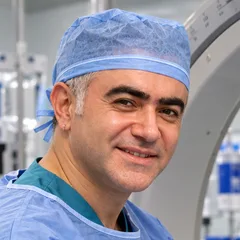
Medical review
Uzm. Dr. Cihan Bolat
Medical Director, Istanbul Stemcell
This page was written from the published studies listed below and reviewed for medical accuracy on .
17
References
- Carlsson PO, et al. Umbilical cord-derived mesenchymal stromal cells preserve endogenous insulin production in type 1 diabetes: a Phase I/II randomised double-blind placebo-controlled trial. Diabetologia. 2023;66(8):1431-1441. PMID 37221247
- Matas J, et al. Umbilical Cord-Derived Mesenchymal Stromal Cells (MSCs) for Knee Osteoarthritis: Repeated MSC Dosing Is Superior to a Single MSC Dose and to Hyaluronic Acid in a Controlled Randomized Phase I/II Trial. Stem Cells Transl Med. 2019;8(3):215-224. PMID 30592390
- Gao LR, et al. Intracoronary infusion of Wharton's jelly-derived mesenchymal stem cells in acute myocardial infarction: double-blind, randomized controlled trial. BMC Med. 2015;13:162. PMID 26162993
- Bartolucci J, et al. Safety and Efficacy of the Intravenous Infusion of Umbilical Cord Mesenchymal Stem Cells in Patients With Heart Failure: A Phase 1/2 Randomized Controlled Trial (RIMECARD Trial [Randomized Clinical Trial of Intravenous Infusion Umbilical Cord Mesenchymal Stem Cells on Cardiopathy]). Circ Res. 2017;121(10):1192-1204. PMID 28974553
- Toro-Rivera A, et al. Mechanisms of Exosome-Supplemented WJ-MSC Therapy in Degenerative Disc Disease: Integrating Proteomic Profiling with Clinical Functional Recovery. Biomedicines. 2026;14(10). PMID 42940041
- Zang L, et al. Efficacy and safety of umbilical cord-derived mesenchymal stem cells in Chinese adults with type 2 diabetes: a single-center, double-blinded, randomized, placebo-controlled phase II trial. Stem Cell Res Ther. 2022;13(1):180. PMID 35505375
- Wang Y, Yi H, Song Y. The safety of MSC therapy over the past 15 years: a meta-analysis. Stem Cell Res Ther. 2021;12(1):545. PMID 34663461
- Batsali AK, et al. Differential expression of cell cycle and WNT pathway-related genes accounts for differences in the growth and differentiation potential of Wharton's jelly and bone marrow-derived mesenchymal stem cells. Stem Cell Res Ther. 2017;8(1):102. PMID 28446235
- Weiss ML, et al. Immune properties of human umbilical cord Wharton's jelly-derived cells. Stem Cells. 2008;26(11):2865-74. PMID 18703664
- Caplan AI, Dennis JE. Mesenchymal stem cells as trophic mediators. J Cell Biochem. 2006;98(5):1076-84. PMID 16619257
- Kalluri R, LeBleu VS. The biology, function, and biomedical applications of exosomes. Science. 2020;367(6478). PMID 32029601
- Moll G, et al. Do cryopreserved mesenchymal stromal cells display impaired immunomodulatory and therapeutic properties? Stem Cells. 2014;32(9):2430-42. PMID 24805247
- Kishta MS, et al. The transforming role of wharton's jelly mesenchymal stem cell-derived exosomes for diabetic foot ulcer healing: a randomized controlled clinical trial. Stem Cell Res Ther. 2025;16(1):559. PMID 41084065
- Samara O, et al. Ultrasound-guided intra-articular injection of expanded umbilical cord mesenchymal stem cells in knee osteoarthritis: a safety/efficacy study with MRI data. Regen Med. 2022;17(5):299-312. PMID 35546314
- Lewandrowski KU, et al. Pain Relief After Allogenic Stem Cell Disc Therapy. Pain Physician. 2023;26(2):197-206. PMID 36988365
- Zhu Y, et al. Safety and efficacy of umbilical cord tissue-derived mesenchymal stem cells in the treatment of patients with aging frailty: a phase I/II randomized, double-blind, placebo-controlled study. Stem Cell Res Ther. 2024;15(1):122. PMID 38679727
- Nguyen LT, et al. Outcomes of autologous bone marrow mononuclear cell administration combined with educational intervention in the treatment of autism spectrum disorder: a randomized, open-label, controlled phase II clinical trial. Stem Cell Res Ther. 2025;16(1):268. PMID 40442857
- Niizuma K, et al. Randomized placebo-controlled trial of CL2020, an allogenic muse cell-based product, in subacute ischemic stroke. J Cereb Blood Flow Metab. 2023;43(12):2029-2039. PMID 37756573
- Kuroda Y, et al. Unique multipotent cells in adult human mesenchymal cell populations. Proc Natl Acad Sci U S A. 2010;107(19):8639-43. PMID 20421459
- Minatoguchi S, et al. Donor Muse Cell Treatment Without HLA-Matching Tests and Immunosuppressant Treatment. Stem Cells Transl Med. 2024;13(6):532-545. PMID 38560897
- Van Delen M, et al. A systematic review and meta-analysis of clinical trials assessing safety and efficacy of human extracellular vesicle-based therapy. J Extracell Vesicles. 2024;13(7):e12458. PMID 38958077