
01
Can stem cells help COPD? The short, honest answer
In short: yes, stem cells can help many people with COPD feel better day to day, and the research is encouraging. In human studies, they were followed by fewer flare-ups, lower symptom scores and longer walks,3104 and inhaled stem cell vesicles improved lung function in a randomised trial.8 They do not replace your inhalers: the aim is calmer airways and easier everyday breathing, alongside your lung specialist’s care.
COPD is one of the most common long-term conditions in the world: in 2019, about 391.9 million people aged 30 to 79 were living with it, 10.3% of that age group.11 If you are one of them, or you care for someone who is, this guide is for you. For the treatment page itself, with prices and booking, see stem cell therapy for COPD in Istanbul.
COPD research at a glance
- 2 → 0median flare-ups six months after one IV infusion of umbilical cord stem cells3
- +52 mon the six-minute walk, pooled across 11 studies with 371 people with COPD4
- 78.2 → 39.8SGRQ symptom score after four IV doses of umbilical cord stem cells in a Turkish study10
- 62 trialswith 3,546 patients found MSC treatment safe9
02
What is COPD? Emphysema, chronic bronchitis and the small airways
COPD (chronic obstructive pulmonary disease) is a long-term lung condition in which air flows out of the lungs more slowly than it should. Doctors confirm it with spirometry, a simple breathing test: when the air you can blow out in the first second (FEV1) is less than 70% of all the air you can blow out (FVC), airflow is limited.11 Smoking is the best-known cause; dust and fumes at work and smoke from wood or other fuels used for cooking and heating also play a part.11
The small airways
Long-lasting inflammation thickens the walls of the smallest airways and fills them with mucus, so air takes longer to get out.
Emphysema: the air sacs
The thin walls between the alveoli break down, the air spaces grow larger, and less surface is left for oxygen to pass into the blood.
Chronic bronchitis
A cough with phlegm on most days, from inflamed larger airways.
Flare-ups (exacerbations)
Days when breathing, cough and phlegm get worse, often after a chest infection. Fewer flare-ups is a main aim of every treatment.
03
Living with COPD: the everyday side
COPD is measured in litres and percentages, but it is lived in mornings, stairs and conversations. A review of 56 studies found that symptoms weigh most heavily in the morning, especially on waking, and that these morning symptoms shape how well people manage the rest of the day.12 Many people learn to plan around breathlessness: the slower walk, the lift instead of the stairs, the rest after a shower. If that sounds familiar, you are far from alone, and each of these moments can be improved.
Mornings
Getting washed and dressed at your own pace, without stopping to catch your breath.
Sleep
A full night without waking to cough or sitting up to breathe more easily.
Family and friends
Keeping up on a walk, at a family celebration or on a trip to see the grandchildren.
Work and independence
Shopping, cooking, travelling and working on your own terms.
04
Why acting early matters in COPD
COPD tends to change slowly, and it changes most in the earlier years. In large trials, lung function (FEV1) fell by 47 to 79 ml a year in moderate COPD (GOLD stage II) and by 56 to 59 ml in severe COPD (stage III), against less than 35 ml a year in very severe COPD (stage IV), so the researchers saw the most to gain from treatment in the earlier stages.13
The course is also far from fixed. In a three-year study of 2,163 people with COPD, the yearly change in lung function varied widely: in 23% it stayed within 20 ml a year either way, and in 8% it even improved by more than 20 ml a year.14 What you do matters, too. In the Lung Health Study, people who stopped smoking gained an average of 47 ml of lung function in the year after quitting, and afterwards it declined at half the rate seen in people who kept smoking.5
Today’s treatments ease symptoms and reduce flare-ups; they are not designed to rebuild lung tissue.4 That is why regeneration interests researchers, with real reason for hope: in a detailed scan study, an adult’s lung grew new air sacs over 15 years.15 The more healthy tissue you have today, the more there is to protect and support.
05
Is there a cure for COPD? Today’s care and the new treatments of 2026
There is no cure for COPD today, but a great deal can be done, and the field is moving quickly. Your lung specialist builds your care from proven layers:
- Inhalers (bronchodilators, sometimes with an inhaled steroid) open the airways, ease breathlessness and help prevent flare-ups.
- Pulmonary rehabilitation, an exercise and education programme: across 65 randomised trials with 3,822 people, it eased breathlessness and fatigue, added 43.93 metres to the six-minute walk and improved the SGRQ score by 6.89 points.6
- Stopping smoking slows the loss of lung function, even after many years of smoking.5
- Vaccines, oxygen when needed, and lung valves or surgery for selected people complete the picture.
COPD new treatments in 2026
Where COPD involves type 2 inflammation, shown by raised eosinophils (a type of white blood cell) in the blood, biologic medicines have shown clear results. In a randomised trial of 939 people, dupilumab lowered moderate or severe flare-ups by 30% compared with placebo and improved lung function by 83 ml,16 and in a trial of 804 people, mepolizumab lowered the yearly flare-up rate from 1.01 to 0.80.17 Regenerative medicine is the other fast-moving area, and the rest of this guide explains where it stands.
06
Can stem cells repair lungs?
The adult lung was long thought to have little ability to renew itself. That picture has changed: the respiratory system can respond to injury and replace lost or damaged cells, as resting progenitor cells wake up after an injury,7 and an adult human lung can even grow new air sacs, as scans of a woman’s remaining lung showed over 15 years.15
Mesenchymal stem cells (MSCs) aim to support this natural capacity rather than to rebuild the lung cell by cell. Across 20 studies in research models of COPD, MSCs reduced lung damage and the loss of lung cells, stimulated lung tissue repair and improved lung function, mainly by calming airway inflammation and raising repair-related signals.1 In people with severe emphysema, a marker of the cells that line the tiny blood vessels of the air sacs was three times higher after two IV infusions of stem cells, given between two lung volume reduction operations.18 A different approach, not part of our treatment, shows how far lung repair research has come: when people’s own lung progenitor cells were grown in the laboratory and returned into their lungs, gas transfer (DLCO) rose by 18.2% at 24 weeks, while it fell by 17.4% in the control group.19
So can stem cells repair lungs? In research models, they clearly support repair. In people, the results show calmer inflammation, fewer flare-ups, better symptom scores and longer walks, which matter most in daily life; rebuilding large areas of lung is the field’s long-term goal.
07
How do stem cells and exosomes act in the lungs?
After years of smoke or pollution, immune cells in the airways, such as macrophages and neutrophils, stay switched on. Their signals and enzymes thicken the small airways, raise mucus and slowly break down the walls of the air sacs. MSCs act on several of these steps at once, mostly through the signals they release (their paracrine effect) and through their exosomes. Each mechanism below says whether it was seen in people or in research models. Our COPD treatment page shows how this becomes a treatment plan.
How Wharton’s jelly stem cells and exosomes aim to calm the lungs in COPD
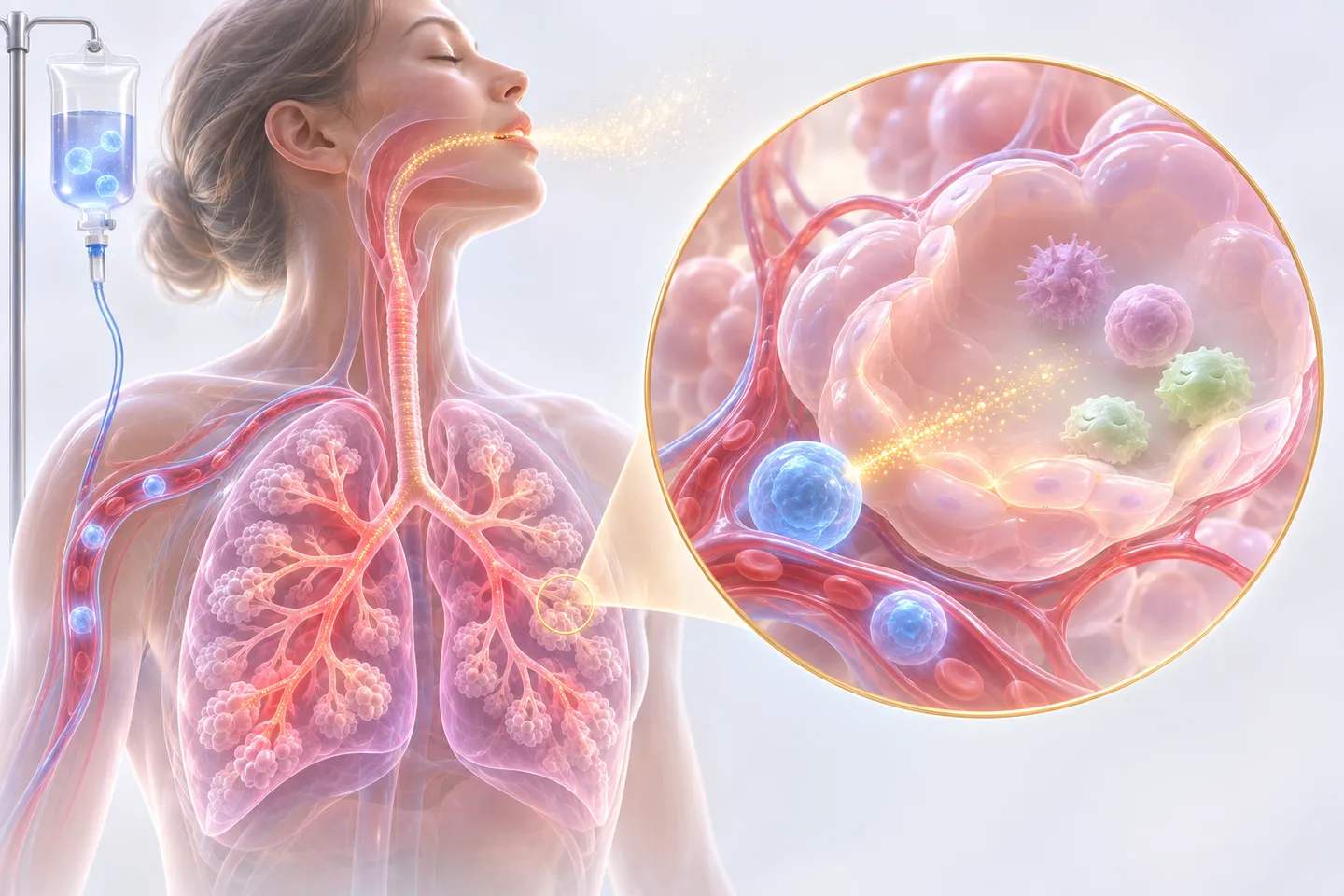
- IV dripFresh Wharton’s jelly stem cells are given by IV infusion. Many of them pass through the lungs first.
- Stem cells in the bloodstreamThe cells travel with the blood and release calming signals on their way.
- Inhaled exosomesWharton’s jelly exosomes can also be breathed in as a fine mist, so they reach the airways directly.
- Inflamed airwaysIn COPD the airways stay irritated and narrowed, which makes breathing out harder.
- Air sacsThe tiny air sacs (alveoli) where oxygen passes into the blood. In emphysema their walls are damaged.
- Stem cellA Wharton’s jelly MSC. It works mainly by releasing signals, not by turning into new lung tissue.
- ExosomesTiny messages that tell nearby cells to calm down and protect themselves.
- Calmer immune cellsThe aim is less lung inflammation. Lower inflammation markers were seen in people; tissue repair mainly in research models.
The IV route: the lungs come first
Seen in research models. After an IV drip, blood from the veins passes through the lungs before anywhere else. When MSCs were infused into a vein, most of them were held in the lungs, where they switched on TSG-6, a natural anti-inflammatory protein, and calmed inflammation elsewhere in the body.20
Calming inflammation
Seen in people. In a placebo-controlled trial in 62 people with moderate to severe COPD, CRP, a blood marker of inflammation, fell early and significantly after IV stem cells in those who started with raised levels.2 When stem cells were placed in the airways during lung valve treatment for severe emphysema, CRP fell at 30 and 90 days.21
Protecting the air sacs
Seen in research models. In emphysema, the walls between air sacs break down and the air spaces grow larger. In a research model of COPD, IV Wharton’s jelly stem cells significantly reduced this enlargement, measured as the mean linear intercept: 123.59 with stem cells against 163.05 without treatment.22
Supporting the tiny blood vessels
Seen in people and laboratory studies. In severe emphysema, CD31, a marker of the cells lining the capillaries, was three times higher in the air-sac walls after IV stem cells.18 Wharton’s jelly stem cells release more blood-vessel-building signals than bone marrow stem cells, and in laboratory tests they helped vessel-lining cells form new microvessels.23
Energy for stressed cells
Seen in research models. Cigarette smoke strains the mitochondria, the cells’ energy factories. In a research model of smoke exposure, MSCs combined with their exosomes protected the lungs against inflammation and supported healthy mitochondria.24
Exosomes: the messages, concentrated
Seen in people and research models. Exosomes are tiny vesicles, on average about 100 nanometres across, that carry proteins, fats and RNA messages between cells.25 Breathed in as a mist, they go straight to the airways: in a research model of COPD, inhaled stem cell exosomes improved lung function and reduced inflammation, mucus and scar tissue in the airways,26 and in people, inhaled umbilical cord stem cell vesicles improved lung function in a randomised trial.8
That is why our COPD plans combine stem cells by IV with exosomes by IV and inhalation: the cells reach the lungs first, and the exosomes deliver concentrated messages, including straight into the airways. Learn more about our stem cell therapy and our exosome therapy.
08
Why Wharton’s jelly stem cells and exosomes for COPD?
Wharton’s jelly is the soft, protective tissue inside the umbilical cord. Its mesenchymal stem cells come from cords donated after healthy births, so they are among the youngest stem cells used in treatment, and nothing is taken from your own body. A review of their biology for COPD highlighted their immune-calming properties as a promising match for the long-lasting inflammation behind the condition.27
Young and vigorous
In a side-by-side comparison of cells from 18 donors each, Wharton’s jelly stem cells multiplied more readily than bone marrow stem cells.28
No donor matching
They lack CD40, CD80 and CD86, signals that alert the immune system, and did not stimulate another person’s immune cells in laboratory tests.29
Better for scarred lungs
In a research model of lung scarring, they brought much better air-sac volume and lung function than stem cells from fat.30
Fresh, never frozen
Prepared for your date in a Ministry of Health-approved GMP laboratory. Stem cells used straight after thawing had weaker immune-calming properties than fresh cells in laboratory work.31
Your plan can also include umbilical cord MSCs, the type of cells used in the COPD studies from Vietnam and Turkey,310 and CD34+ exosomes for their blood-vessel-supporting signals.
09
Mesenchymal stem cells in COPD: every clinical trial in detail
Here are the favourable human studies of stem cells in COPD and emphysema, each with its own cells and route. The CAT (COPD Assessment Test, 0 to 40) and SGRQ (St George’s Respiratory Questionnaire, 0 to 100) measure how much COPD affects daily life, and lower is better; the mMRC scale scores breathlessness from 0 to 4.
| Study | Design | n | Cells (their own source) and route | Result with exact numbers |
|---|---|---|---|---|
| Le Thi Bich 2020, Stem Cell Research & Therapy3 | Pilot clinical study; moderate to severe COPD (GOLD C and D) | 20 | Donor umbilical cord MSCs; one IV infusion | Medians at 6 months: CAT 10.5 → 2.0, mMRC 1.0 → 0, flare-ups 2 → 0; no serious side effects linked to the cells |
| Karaoz 2020, Bratislava Medical Journal10 | Phase 1/2 (Turkey) | 5 | Umbilical cord tissue MSCs; four IV doses, two weeks apart | At 3 months: SGRQ symptoms 78.2 → 39.8, activity 83.8 → 60.98, impact 58.02 → 45.18; walk 307 → 362 m; FEV1/FVC 66.9% → 69.58% |
| Weiss 2013, Chest2 | Randomised, double-blind, placebo-controlled; six centres | 62 | Donor bone marrow MSCs; four monthly IV infusions of 100 million cells | Well tolerated over 2 years; early, significant fall in CRP in people with raised CRP |
| Weiss 2021, Respiratory Research32 | Analysis of the same randomised trial by baseline CRP | 29 with CRP ≥ 4 mg/L | As above | FEV1, FVC and six-minute walk significantly better than placebo at 120 days, with differences from day 10 |
| de Oliveira 2017, Stem Cells Translational Medicine21 | Randomised, patient-blinded, placebo-controlled phase I; severe emphysema | 10 | Donor bone marrow MSCs (100 million) into the airways, with lung valves | Quality of life better than with valves alone; CRP, BODE index and mMRC lower at 30 and 90 days |
| Squassoni 2021, International Journal of COPD33 | Randomised, controlled phase I | 20 | Own bone marrow cells and/or fat-derived MSCs; IV | FEV1 and gas transfer (DLCO) up with bone marrow cells; better gas exchange and quality of life with the combined infusion |
| Stolk 2016, QJM18 | Phase I, open label; severe emphysema | 7 treated | Own bone marrow MSCs; two IV infusions, with lung volume reduction surgery | CD31 in the air-sac walls 3 times higher; no adverse events related to the infusions |
| Ribeiro-Paes 2011, International Journal of COPD34 | Phase I, open label; advanced COPD | 4 | Own bone marrow mononuclear cells; IV | Significant improvement in quality of life and a stable condition over 12 months |
| Calzetta 2022, Cells4 | Systematic review and meta-analysis | 11 studies, 371 | Stem cell-based treatments and their products; several routes | Six-minute walk +52 m vs baseline or control (significant) |
One infusion, fewer flare-ups
In the umbilical cord study from Vietnam, 20 men with moderate to severe COPD, average age 67, received one IV infusion of donor umbilical cord MSCs. Their breathlessness and CAT scores fell significantly within a month, and at six months the median CAT score was 2.0, against 10.5 before, with flare-ups down from 2 to 0. The authors concluded that it can significantly improve quality of life.3
Clearer benefits where inflammation is high
The largest placebo-controlled trial gave 62 people four monthly IV infusions of donor bone marrow MSCs, well tolerated over two years.2 Among the 29 people with clearly raised CRP, those given stem cells had significantly better FEV1, FVC and six-minute walks at 120 days than those given placebo, with differences visible from day 10.32 People with active inflammation may gain the most.
10
Stem cell therapy for COPD success rate: the numbers
“Success” in COPD can mean fewer flare-ups, less breathlessness, a longer walk or better lung function. This is how the CAT score changed after one IV infusion of umbilical cord stem cells.
CAT score after one IV infusion of umbilical cord stem cells (median, 0–40; lower is better)
After 1 month3
After 3 months3
After 6 months3
Results depend on how advanced your COPD is, how active the inflammation is, and on the cells and routes used, which is why Dr. Cihan Bolat reviews your tests before recommending a plan.
11
Exosomes for COPD: inhaled and IV exosome therapy
Exosomes contain no living cells, so they can be breathed in as a fine mist from a nebuliser, straight into the airways and air sacs, or given by IV drip to reach the lungs through the bloodstream.
- Randomised trial, inhaled: in 24 people with lung scarring (pulmonary fibrosis), half of whom also had COPD or emphysema, inhaled umbilical cord MSC vesicles twice a day for seven days, added to routine treatment, significantly improved lung function (FVC and maximal voluntary ventilation) and quality of life (SGRQ and cough scores), with no serious adverse events.8
- Wharton’s jelly vesicles, inhaled: in 80 people with a lasting cough after COVID-19, inhaling Wharton’s jelly MSC vesicles twice a day for five days brought a total response of 67.5% at day 6, against 47.5% without them, and the cough cleared sooner, after 13.83 days on average against 19.90, with no safety concerns.35
- Inhaled, in asthma and COPD: in a first report of three people, five weekly inhaled umbilical cord MSC exosome treatments raised the FEV1/FVC ratio from 82.57% to 92.9%, with no adverse reactions reported.36
- Research models of COPD: inhaled stem cell exosomes improved lung function and reduced airway inflammation, mucus and scarring,26 and IV umbilical cord stem cell exosomes improved lung function and calmed inflammation.37
At our clinic, Wharton’s jelly exosomes are given by IV drip and by inhalation. Read more in exosome treatments explained or on our exosome therapy page.
12
What is established, and what is still early
Research is moving quickly, and you deserve to know where each finding stands: randomised human trials are the strongest evidence, early human studies point the way, and research models explain how the treatment works.
| Level of evidence | What has been seen | Key studies |
|---|---|---|
| Shown in randomised human trials | IV stem cells well tolerated over two years in COPD, with an early fall in CRP, and better lung function and walks where CRP was high; better quality of life with stem cells added to lung valves; better lung function with bone marrow cell infusions; inhaled umbilical cord vesicles improving lung function and quality of life in lung scarring, half the patients with COPD or emphysema; MSC treatment safe across 62 randomised trials | Weiss 2013 and 2021; de Oliveira 2017; Squassoni 2021; Li 2025; Wang 2021232213389 |
| Seen in early human studies | Fewer flare-ups and lower CAT scores after umbilical cord MSCs; better SGRQ scores and longer walks; a longer six-minute walk across 11 studies; more vessel-lining cells in emphysema; inhaled exosomes in asthma and COPD, and inhaled Wharton’s jelly vesicles easing a lasting cough | Le Thi Bich 2020; Karaoz 2020; Calzetta 2022; Stolk 2016; Yusof 2026; Du 20263104183635 |
| Seen in research models only | Smaller emphysema air spaces with Wharton’s jelly stem cells; lung repair across 20 studies; protection of mitochondria from cigarette smoke; better lung repair than fat-derived cells in lung scarring; inhaled and IV exosomes improving lung function in COPD | Cho 2019; Liu 2016; Maremanda 2019; Chu 2023; Wang 2025; Zhou 202622124302637 |
The safety of MSC treatment and its calming effect on inflammation have been seen in people with COPD, symptom scores and flare-ups have improved in early studies, and inhaled exosomes are moving quickly from research models into the clinic. We update this guide as the evidence grows.
13
Is stem cell therapy for COPD safe?
Safety comes first, and the published record is reassuring. A 2021 meta-analysis of 62 randomised trials with 3,546 patients found MSC treatment safe compared with placebo, the most common effect a passing fever.9
The COPD studies agree. In the placebo-controlled trial, four monthly IV infusions caused no infusion reactions and no serious adverse events linked to the cells over two years.2 There were no infusion-related toxicities or severe adverse events linked to umbilical cord MSCs,3 all patients tolerated inhaled umbilical cord vesicles well,8 and no adverse events were seen immediately after bone marrow and fat cell infusions.33
At our clinic, we review your lung tests, heart health and medicines before you travel, Wharton’s jelly cells need no donor matching,29 the GMP laboratory certifies the count, viability and sterility tests of your batch, and a specialist team led by Dr. Cihan Bolat treats you. Read more in how to read a stem cell lab report.
14
Muse cells and Muse exosomes: an optional add-on
Muse cells (multilineage-differentiating stress-enduring cells) are a small, hardy group within the MSC family, about 1% to several percent of MSCs, and donor Muse cells have been given without tissue matching or immune-suppressing medicines.38 In a research model of lung injury, umbilical cord Muse cells given by IV homed to the injured lung and brought better oxygen levels and lung injury scores than bone marrow Muse cells,39 and in a randomised stroke trial, 40.0% of patients could look after their own affairs 12 weeks after one IV dose of a donor Muse cell product, against 10.0% with placebo.40 If you wish, Muse cells and Muse exosomes can be added by IV to your Wharton’s jelly plan after your medical review.
15
COPD treatments compared: where stem cells and exosomes fit
Stem cells and exosomes add a regenerative layer to proven care; they never replace what your lung specialist prescribes.
| Option | What it does well | How it fits with regenerative care |
|---|---|---|
| Wharton’s jelly stem cells and exosomes | Aim to calm inflammation and support lung tissue and small blood vessels; fewer flare-ups and better symptom scores in early studies3 | Added to your usual care, by IV drip and inhalation |
| Inhalers | Open the airways, ease breathlessness and help prevent flare-ups | Keep using them exactly as prescribed |
| Pulmonary rehabilitation | +43.93 m on the six-minute walk, with less breathlessness and fatigue6 | A natural partner, before and after treatment |
| Biologic medicines | 30% fewer moderate or severe flare-ups with dupilumab in COPD with raised eosinophils16 | Prescribed by your lung specialist for suitable patients |
| Stopping smoking | Later decline in lung function half that of people who keep smoking5 | Helps every other treatment |
| Lung valves or surgery | Help selected people with severe emphysema | Your specialist’s advice comes first |
16
Your COPD treatment in Istanbul
Every plan starts with your own results. Dr. Cihan Bolat, our medical director and a specialist in anaesthesiology and reanimation and in regenerative medicine, reviews your spirometry, any CT scan, your oxygen levels, recent flare-ups, your medicines, your heart health, whether you smoke, and your goals.
What you receive, and how
- Wharton’s jelly stem cells by IV drip, which reaches the lungs first; umbilical cord MSCs can be added.
- Wharton’s jelly exosomes by IV drip and inhalation, as a fine mist from a nebuliser; CD34+ exosomes can be added.
- Muse cells and Muse exosomes by IV, as optional add-ons.
A typical IV range is 1–2 million cells per kilogram of body weight, and your dose is set in your medical review. Dr. Cihan Bolat plans the routes and timing for you. You keep using your inhalers, and you can share your written plan with your lung specialist.
Send your lung tests
Share your spirometry report, any CT scan, your medicines and your goals, through our free consultation request or by WhatsApp on +90 534 856 92 92.
Free medical review and phone call
Dr. Cihan Bolat’s team reviews your case free of charge and tells you honestly whether treatment suits you.
Your written plan and fixed price
If treatment is a good fit, you receive a written plan with your cell count, exosomes and routes, and a fixed, all-inclusive price.
Fresh preparation and treatment
Your cells are prepared fresh for your date, usually within 5 to 10 days. Your case manager helps you choose your dates, and our driver brings you to the clinic.
Home and follow-up
Back home, you continue your usual care, and we follow your progress at about 1, 3, 6 and 12 months, by phone or WhatsApp.
Questions to ask any clinic
Which cells, from which source? Fresh or frozen? What does the batch certificate show? Which routes, and why? What is the fixed price? Our guide on how to choose a stem cell clinic abroad explains what to look for. Most of our international patients come from the UK and the United States; see our guides for UK patients and US patients, and calm things to do in Istanbul. To start, visit our page on COPD treatment in Turkey.
17
How much does stem cell therapy for COPD cost in Turkey?
Our IV packages follow one price list, effective 1 June 2026, in US dollars (M = million stem cells). Each is built on fresh Wharton’s jelly stem cells, with free Wharton’s jelly exosomes from 50M. A typical IV range is 1–2 million cells per kilogram, and higher cell-count packages may suit heavier patients or more complex goals. Inhaled and extra exosomes are priced in your written plan.
| Cell count | USD price | Free exosomes | Free hotel |
|---|---|---|---|
| 25M | $4,950 | No | No |
| 50M | $6,950 | 10 billion exosomes | No |
| 75M | $8,950 | 10 billion exosomes | No |
| 100M | $10,500 | 20 billion exosomes | 2 nights |
| 125M | $11,850 | 20 billion exosomes | 2 nights |
| 150M | $13,550 | 30 billion exosomes | 2 nights |
| 175M | $15,000 | 30 billion exosomes | 2 nights |
| 200M | $16,500 | 30 billion exosomes | 3 nights |
| 225M | $18,000 | 30 billion exosomes | 3 nights |
| 250M | $19,500 | 30 billion exosomes | 3 nights |
Included
- Free medical review and phone consultation
- Fresh Wharton’s jelly stem cells, with certified count and viability
- Free Wharton’s jelly exosomes from 50M
- Treatment by our specialist team, led by Uzm. Dr. Cihan Bolat
- Ground transport, with airport transfers depending on your package
- A personal case manager, with interpreter help when needed
- Hotel nights as listed (2 from 100M, 3 from 200M), in 5-star hotels chosen by our team
- Follow-up at about 1, 3, 6 and 12 months, by phone or WhatsApp
Not included / optional
- Flights
- Extra hotel nights; we can help you arrange them
- Inhaled and extra exosomes, priced in your written plan
- Optional add-ons: Muse cells, Muse exosomes, CD34+ exosomes
- A repeat treatment, if you choose one later
After your free medical review, you receive a fixed, all-inclusive price in writing. To reserve your date, a deposit of 10% to 25% of your plan is payable by any major credit or debit card, with Stripe instalments where available. See every package in our guide to stem cell therapy cost in Turkey, or go to our page on stem cell therapy for COPD in Istanbul.
18
Frequently asked questions
Can stem cells repair lungs damaged by COPD?
Stem cells support the lung’s own repair rather than rebuilding it cell by cell. In research models, they reduced lung damage and stimulated repair, and in people with COPD they were followed by fewer flare-ups, lower symptom scores and longer walks.
What is the success rate of stem cell therapy for COPD?
It depends on what you measure. After one IV infusion of umbilical cord stem cells, median flare-ups fell from 2 to 0 within six months and the CAT score from 10.5 to 2.0, and across 11 studies with 371 people, the six-minute walk rose by 52 metres. Results differ from person to person.
Is there a cure for COPD?
There is no cure for COPD today, but it can be managed well. Inhalers, rehabilitation and stopping smoking make a real difference, new biologic medicines reduce flare-ups in some people, and stem cells and exosomes aim to calm inflammation and support lung tissue.
Can stem cells help emphysema?
In people with severe emphysema, a marker of the cells lining the tiny vessels of the air sacs was three times higher after IV stem cells, and quality of life was better when stem cells were added to lung valves. In research models, Wharton’s jelly stem cells reduced the enlargement of the air sacs.
Do exosomes help COPD?
Early results are encouraging. Inhaled umbilical cord stem cell vesicles improved lung function and quality of life in a randomised trial in which half the patients had COPD or emphysema, and in research models of COPD, inhaled exosomes reduced airway inflammation and mucus.
How is inhaled exosome therapy given?
A nebuliser turns the exosomes into a fine mist, and you breathe it in while you sit comfortably, so it goes straight to your airways and air sacs.
What are the new COPD treatments in 2026?
Biologic medicines for COPD with raised eosinophils reduced flare-ups in large trials: dupilumab by 30% against placebo, and mepolizumab from 1.01 to 0.80 a year. Regenerative medicine with stem cells and inhaled exosomes is the other fast-moving area.
Are there clinical trials of mesenchymal stem cells in COPD?
Yes. The best known is a placebo-controlled trial in which 62 people received four monthly IV infusions, well tolerated over two years. Others include an umbilical cord study in 20 people, a Turkish study, emphysema studies and a 2022 analysis of 11 studies.
Is stem cell therapy for COPD safe?
The safety record is reassuring. Across 62 randomised trials with 3,546 patients, MSC treatment was safe, the most common effect a passing fever, and the COPD trials found IV infusions and inhaled vesicles well tolerated.
Do I keep using my inhalers?
Yes. Keep using everything your lung specialist prescribes and keep up your rehabilitation. Stem cells and exosomes are added to your care, never used instead of it.
Can I have stem cell therapy if I still smoke?
You can still ask for a review. Stopping smoking helps any lung treatment, and lung function improved in the year after quitting in a large study. Dr. Cihan Bolat talks it through with you kindly.
How much does stem cell therapy for COPD cost in Turkey?
IV packages start at USD 4,950 for 25 million cells; the 100 million cell package (USD 10,500) includes 20 billion exosomes and two hotel nights. Inhaled exosomes are priced in your written plan, with a fixed price after your free review.

Medical review
Uzm. Dr. Cihan Bolat
Medical Director, Istanbul Stemcell
This page was written from the published studies listed below and reviewed for medical accuracy on .
19
References
- Liu X, Fang Q, Kim H. Preclinical Studies of Mesenchymal Stem Cell (MSC) Administration in Chronic Obstructive Pulmonary Disease (COPD): A Systematic Review and Meta-Analysis. PLoS One. 2016;11(6):e0157099. PMID 27280283
- Weiss DJ, et al. A placebo-controlled, randomized trial of mesenchymal stem cells in COPD. Chest. 2013;143(6):1590-1598. PMID 23172272
- Le Thi Bich P, et al. Allogeneic umbilical cord-derived mesenchymal stem cell transplantation for treating chronic obstructive pulmonary disease: a pilot clinical study. Stem Cell Res Ther. 2020;11(1):60. PMID 32054512
- Calzetta L, et al. Stem Cell-Based Regenerative Therapy and Derived Products in COPD: A Systematic Review and Meta-Analysis. Cells. 2022;11(11). PMID 35681492
- Scanlon PD, et al. Smoking cessation and lung function in mild-to-moderate chronic obstructive pulmonary disease. The Lung Health Study. Am J Respir Crit Care Med. 2000;161(2 Pt 1):381-90. PMID 10673175
- McCarthy B, et al. Pulmonary rehabilitation for chronic obstructive pulmonary disease. Cochrane Database Syst Rev. 2015;2015(2):CD003793. PMID 25705944
- Kotton DN, Morrisey EE. Lung regeneration: mechanisms, applications and emerging stem cell populations. Nat Med. 2014;20(8):822-32. PMID 25100528
- Li M, et al. Clinical investigation on nebulized human umbilical cord MSC-derived extracellular vesicles for pulmonary fibrosis treatment. Signal Transduct Target Ther. 2025;10(1):179. PMID 40461474
- Wang Y, Yi H, Song Y. The safety of MSC therapy over the past 15 years: a meta-analysis. Stem Cell Res Ther. 2021;12(1):545. PMID 34663461
- Karaoz E, Kalemci S, Ece F. Improving effects of mesenchymal stem cells on symptoms of chronic obstructive pulmonary disease. Bratisl Lek Listy. 2020;121(3):188-191. PMID 32115975
- Adeloye D, et al. Global, regional, and national prevalence of, and risk factors for, chronic obstructive pulmonary disease (COPD) in 2019: a systematic review and modelling analysis. Lancet Respir Med. 2022;10(5):447-458. PMID 35279265
- Tsiligianni I, Kocks JWH. Daytime symptoms of chronic obstructive pulmonary disease: a systematic review. NPJ Prim Care Respir Med. 2020;30(1):6. PMID 32081967
- Tantucci C, Modina D. Lung function decline in COPD. Int J Chron Obstruct Pulmon Dis. 2012;7:95-9. PMID 22371650
- Vestbo J, et al. Changes in forced expiratory volume in 1 second over time in COPD. N Engl J Med. 2011;365(13):1184-92. PMID 21991892
- Butler JP, et al. Evidence for adult lung growth in humans. N Engl J Med. 2012;367(3):244-7. PMID 22808959
- Bhatt SP, et al. Dupilumab for COPD with Type 2 Inflammation Indicated by Eosinophil Counts. N Engl J Med. 2023;389(3):205-214. PMID 37272521
- Sciurba FC, et al. Mepolizumab to Prevent Exacerbations of COPD with an Eosinophilic Phenotype. N Engl J Med. 2025;392(17):1710-1720. PMID 40305712
- Stolk J, et al. A phase I study for intravenous autologous mesenchymal stromal cell administration to patients with severe emphysema. QJM. 2016;109(5):331-6. PMID 26819296
- Wang Y, et al. Autologous transplantation of P63(+) lung progenitor cells for chronic obstructive pulmonary disease therapy. Sci Transl Med. 2024;16(734):eadi3360. PMID 38354225
- Lee RH, et al. Intravenous hMSCs improve myocardial infarction in mice because cells embolized in lung are activated to secrete the anti-inflammatory protein TSG-6. Cell Stem Cell. 2009;5(1):54-63. PMID 19570514
- de Oliveira HG, et al. Combined Bone Marrow-Derived Mesenchymal Stromal Cell Therapy and One-Way Endobronchial Valve Placement in Patients with Pulmonary Emphysema: A Phase I Clinical Trial. Stem Cells Transl Med. 2017;6(3):962-969. PMID 28186686
- Cho JW, Park KS, Bae JY. Effects of Wharton's jelly-derived mesenchymal stem cells on chronic obstructive pulmonary disease. Regen Ther. 2019;11:207-211. PMID 31489344
- Hsieh JY, et al. Mesenchymal stem cells from human umbilical cord express preferentially secreted factors related to neuroprotection, neurogenesis, and angiogenesis. PLoS One. 2013;8(8):e72604. PMID 23991127
- Maremanda KP, Sundar IK, Rahman I. Protective role of mesenchymal stem cells and mesenchymal stem cell-derived exosomes in cigarette smoke-induced mitochondrial dysfunction in mice. Toxicol Appl Pharmacol. 2019;385:114788. PMID 31678243
- Kalluri R, LeBleu VS. The biology, function, and biomedical applications of exosomes. Science. 2020;367(6478). PMID 32029601
- Wang M, et al. Nebulized mesenchymal stem cell-derived exosomes attenuate airway inflammation in a rat model of chronic obstructive pulmonary disease. Cell Immunol. 2025;409-410:104933. PMID 40020434
- Janczewski AM, et al. Can Youthful Mesenchymal Stem Cells from Wharton's Jelly Bring a Breath of Fresh Air for COPD? Int J Mol Sci. 2017;18(11). PMID 29156550
- Batsali AK, et al. Differential expression of cell cycle and WNT pathway-related genes accounts for differences in the growth and differentiation potential of Wharton's jelly and bone marrow-derived mesenchymal stem cells. Stem Cell Res Ther. 2017;8(1):102. PMID 28446235
- Weiss ML, et al. Immune properties of human umbilical cord Wharton's jelly-derived cells. Stem Cells. 2008;26(11):2865-74. PMID 18703664
- Chu KA, et al. Reversal of Pulmonary Fibrosis: Human Umbilical Mesenchymal Stem Cells from Wharton's Jelly versus Human-Adipose-Derived Mesenchymal Stem Cells. Int J Mol Sci. 2023;24(8). PMID 37108112
- Moll G, et al. Do cryopreserved mesenchymal stromal cells display impaired immunomodulatory and therapeutic properties? Stem Cells. 2014;32(9):2430-42. PMID 24805247
- Weiss DJ, et al. Effect of mesenchymal stromal cell infusions on lung function in COPD patients with high CRP levels. Respir Res. 2021;22(1):142. PMID 33964910
- Squassoni SD, et al. Autologous Infusion of Bone Marrow and Mesenchymal Stromal Cells in Patients with Chronic Obstructive Pulmonary Disease: Phase I Randomized Clinical Trial. Int J Chron Obstruct Pulmon Dis. 2021;16:3561-3574. PMID 35002228
- Ribeiro-Paes JT, et al. Unicentric study of cell therapy in chronic obstructive pulmonary disease/pulmonary emphysema. Int J Chron Obstruct Pulmon Dis. 2011;6:63-71. PMID 21311694
- Du J, et al. A pilot study of nebulized 3D-cultured mesenchymal stem cell-derived extracellular vesicles for the treatment of post-COVID-19 chronic cough. Front Med (Lausanne). 2026;13:1809451. PMID 42553659
- Yusof B, et al. A case report on nebulized human umbilical cord mesenchymal stem cell-derived exosome therapy for asthma and chronic obstructive pulmonary disease: A preliminary clinical evaluation. SAGE Open Med Case Rep. 2026;14:2050313X251386547. PMID 41625138
- Zhou Y, et al. Therapeutic effects and potential targets of UC-MSC-Exo in a mouse model of COPD. Sci Rep. 2026;16(1):4741. PMID 41490942
- Minatoguchi S, et al. Donor Muse Cell Treatment Without HLA-Matching Tests and Immunosuppressant Treatment. Stem Cells Transl Med. 2024;13(6):532-545. PMID 38560897
- Win KHN, et al. Human Muse cells isolated from preterm- and term-umbilical cord delivered therapeutic effects in rat bleomycin-induced lung injury model without immunosuppressant. Stem Cell Res Ther. 2024;15(1):147. PMID 38773627
- Niizuma K, et al. Randomized placebo-controlled trial of CL2020, an allogenic muse cell-based product, in subacute ischemic stroke. J Cereb Blood Flow Metab. 2023;43(12):2029-2039. PMID 37756573